How PCOS Care Can Shift in Your 40s
Your PCOS history still matters in midlife, but changing periods, ongoing symptoms, and metabolic health each deserve a fresh look.
In your 40s, PCOS care is less about a birthday-based plan and more about what has changed. Review your bleeding and symptoms, revisit blood sugar, cholesterol, blood pressure, and other heart-health risks, and bring up pregnancy or contraception goals. PCOS can cause absent periods; menopause is usually diagnosed in women over 45 after more than a year without one. Once menopause is established, any bleeding needs checking. 1 2 3 5
Think of midlife as a check-in, not a reset
PCOS can affect more than periods and fertility. Its reproductive features may change with age, while metabolic health remains relevant. That makes your 40s a useful time to review your own pattern rather than assume PCOS has either disappeared or stayed exactly the same. The evidence in women after menopause is limited, so age alone doesn’t tell you what will happen next. 5
A population-based Finnish birth-cohort study found that, at age 46, fewer women with PCOS than women without it met the study’s definition of late perimenopause or postmenopause: 3.1% compared with 18.4%. This is a finding from one cohort, not a timetable for an individual woman. It’s a reason not to use age alone to explain a cycle change or predict when menopause will occur. 6
Revisit your bleeding pattern
PCOS can involve irregular or absent periods because ovulation may not happen regularly. But a change in bleeding shouldn’t automatically be assigned to PCOS or perimenopause. Make a note of what’s different, such as bleeding between periods, heavier bleeding, or a change in how often or how long you bleed, and raise it for evaluation. Guidance defines abnormal bleeding in reproductive-age people by features including unusually frequent or infrequent cycles, marked variation between cycles, prolonged bleeding, or heavy bleeding that affects quality of life. Those definitions can help describe a change; they don’t diagnose its cause. 1 4
Menopause is usually diagnosed in women over 45 after more than a year without a period. PCOS can also cause absent periods, so bring up a prolonged gap if you’re unsure what it means. Once menopause has been established, any bleeding needs to be checked, even if it happens only once. 1 2
Keep metabolic health on the agenda
PCOS is associated with metabolic concerns, and women with PCOS are among the groups at higher risk of metabolic syndrome. Many risk factors, including changes in blood sugar and blood fats, may not cause obvious symptoms. 1 3
A midlife review can include blood pressure, blood sugar or glycemic status, cholesterol and other blood fats, body weight, waist circumference, and other established cardiovascular risk factors. The menopause-care guide recommends considering these as part of long-term follow-up; it doesn’t establish a special schedule for every woman with PCOS. Your history and results help determine what needs follow-up. 5
This is a reason to keep heart and metabolic health in the conversation, not to assume a problem is present or that PCOS alone calls for extra cancer screening. The menopause-care guide does not support additional endometrial, breast, or ovarian cancer screening solely because of PCOS. 5
Reassess symptoms and reproductive goals
If unwanted facial or body hair or other androgen-related symptoms remain bothersome, include them in the review. A new, severe, or rapidly progressing increase in androgen-related symptoms after menopause shouldn’t simply be attributed to PCOS; it warrants evaluation for other causes. 1 5
If pregnancy is a goal, say so: PCOS is linked to infertility, but many women with PCOS can still become pregnant. If pregnancy isn’t a goal, don’t assume irregular periods mean pregnancy is impossible; discuss contraception as part of your care. 1
Use your history to interpret menopause
After menopause, periods and ovarian appearance can’t establish a new PCOS diagnosis. A documented earlier diagnosis or a well-characterized reproductive history consistent with PCOS can still help make sense of your health history. In other words, the menstrual features may no longer be available as new diagnostic clues, but your earlier pattern still matters. 5
A practical midlife check-in can start with three questions: What has changed in my bleeding or symptoms? Are my metabolic risk factors being followed? Have my pregnancy or contraception priorities changed? The answers, rather than your age by itself, can help focus the next conversation.
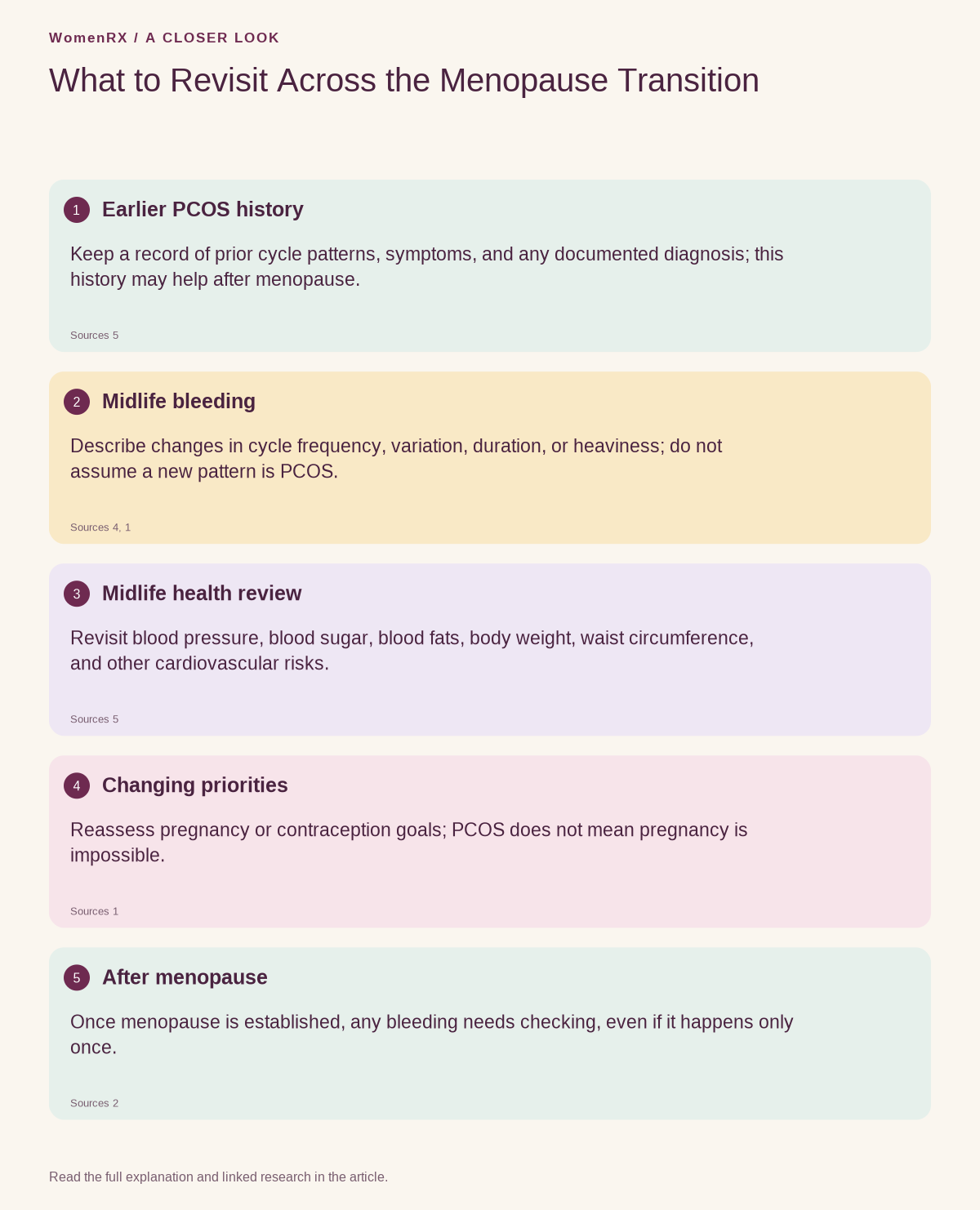
What to Revisit Across the Menopause Transition
Earlier PCOS history: Keep a record of prior cycle patterns, symptoms, and any documented diagnosis; this history may help after menopause.5
Midlife bleeding: Describe changes in cycle frequency, variation, duration, or heaviness; do not assume a new pattern is PCOS.41
Midlife health review: Revisit blood pressure, blood sugar, blood fats, body weight, waist circumference, and other cardiovascular risks.5
Changing priorities: Reassess pregnancy or contraception goals; PCOS does not mean pregnancy is impossible.1
After menopause: Once menopause is established, any bleeding needs checking, even if it happens only once.2
Read the figure as text
These are topics to reassess as your life stage and priorities change, not a fixed course that every woman with PCOS follows.- Earlier PCOS history: Keep a record of prior cycle patterns, symptoms, and any documented diagnosis; this history may help after menopause.5
- Midlife bleeding: Describe changes in cycle frequency, variation, duration, or heaviness; do not assume a new pattern is PCOS.41
- Midlife health review: Revisit blood pressure, blood sugar, blood fats, body weight, waist circumference, and other cardiovascular risks.5
- Changing priorities: Reassess pregnancy or contraception goals; PCOS does not mean pregnancy is impossible.1
- After menopause: Once menopause is established, any bleeding needs checking, even if it happens only once.2
More questions, answered
Can PCOS be diagnosed for the first time after menopause?
The menopause-care guide says menstrual features and ovarian morphology can’t establish a new diagnosis after menopause. A documented earlier diagnosis or a well-characterized reproductive history consistent with PCOS may still be useful. 5
Does PCOS mean I need extra cancer screening after menopause?
The menopause-care guide does not support additional endometrial, breast, or ovarian cancer screening solely because of PCOS. Bleeding after menopause is a separate matter and should be evaluated. 2 5
Sources you can check
- PCOS | Polycystic Ovary Syndrome | MedlinePlusAccessed 2026-09-25Return to first citation
- Postmenopausal bleeding - NHSAccessed 2026-09-25Return to first citation
- Metabolic Syndrome | MedlinePlusAccessed 2026-09-25Return to first citation
- Visually directed hysteroscopic biopsy in the evaluation of abnormal uterine bleeding and postmenopausal bleeding: a Joint Society Practice Guideline. Joint Society Practice Guideline from AAGL-ESGE-GCH. · Facts, views & vision in ObGyn · 2026Return to first citation
- From PCOS to PMOS: An EMAS clinical guide to the proposed terminology and its relevance to menopause care.Aktoz F, Erel CT, Ozcivit Erkan IB, Armeni E, Boban J, Ceausu I, van Dijken D, Hillard T, Hirschberg AL, Kiesel L, Lambrinoudaki I, Simoncini T, Smetnik A, Goldstajn MS, Stute P, R... · Maturitas · 2026Return to first citation
- Women with PCOS have a later menopausal transition and a lower prevalence of menopausal symptoms at age 46: A population-based birth cohort study.Lavi J, Savukoski S, Hurskainen E, Ollila MM, Morin-Papunen L, Niinimäki M, Piltonen TT. · Acta obstetricia et gynecologica Scandinavica · 2026Return to first citation