PCOS and Perimenopause: What Changes, What Still Matters
PCOS can remain relevant in midlife, especially for metabolic health, but it doesn’t explain every cycle change or new symptom.
During perimenopause, keep your PCOS history in view, but don’t assume it explains new bleeding or every change in how you feel. Metabolic health may remain relevant, while cycle changes need to be considered on their own. Bleeding after 12 months without a period should be evaluated, and new, severe, or rapidly worsening androgen-related symptoms warrant evaluation after menopause. 124
PCOS still matters, though its focus can shift
After menopause, menstrual patterns no longer help assess PCOS in the way they did earlier in life. Your PCOS history can still inform your care. A menopause-care guide emphasizes that PCOS-related cardiometabolic concerns may remain relevant during the transition and after menopause, even though research in postmenopausal women is limited. It recommends considering weight, waist circumference, blood pressure, blood sugar, cholesterol and other established cardiovascular risk factors as part of ongoing care. 4
That isn’t a reason to assume you’ll develop a particular condition. It’s a reason not to let the reproductive symptoms of PCOS crowd out broader health questions in midlife. The same guide says PCOS alone does not call for extra endometrial, breast or ovarian cancer screening, or a separate osteoporosis screening strategy. That’s about routine screening: it does not mean new symptoms should be ignored. 4
If you’re considering menopause hormone therapy for symptoms, PCOS alone is not a reason to rule it out. Evidence specifically about hormone therapy in people with PCOS is limited, so decisions follow standard menopause guidance and take symptoms and individual risks into account. 4
Read cycle changes as a separate question
PCOS can involve irregular periods. If your periods were irregular before perimenopause, a new pattern may be harder to interpret from cycle timing alone. The useful distinction is not whether a change “must be PCOS” or “must be menopause,” but whether the bleeding itself needs assessment. 45
Guidance on abnormal uterine bleeding recommends systematic evaluation to check for significant causes. So don’t automatically attribute bleeding that is unusually frequent, prolonged, heavy, or otherwise concerning for you to PCOS or perimenopause. 2
After 12 months without a period, bleeding is considered postmenopausal bleeding and should be checked, even if it happens once or seems slight. 12 This is symptom evaluation, not a recommendation for extra routine cancer screening because you have PCOS.
Longstanding hair changes differ from new ones
Androgen-related symptoms, such as excess facial or body hair, may still be present later in life. In one small follow-up study, 21 women with PCOS aged 72 to 91 were still more likely than 55 age-matched controls to have clinical signs of excess androgens, even though measured testosterone, free androgen index, sex hormone-binding globulin, and luteinizing hormone did not differ between groups. That finding describes this cohort; it can’t predict what will happen for you. 3
The distinction worth raising is whether a symptom is longstanding or newly changing. The menopause-care guide recommends further evaluation for new, severe, or rapidly progressive androgen-related symptoms after menopause, rather than assuming they are explained by prior PCOS. 4 It does not establish the same threshold specifically for perimenopause.
A focused midlife check-in
You can make a conversation about PCOS and perimenopause more useful by separating a few questions:
- Bleeding: What changed in its timing, duration, amount, or pattern? Has there been any bleeding after 12 months without a period? Abnormal or postmenopausal bleeding needs evaluation. 12
- Metabolic health: Have weight, waist circumference, blood pressure, blood sugar, or cholesterol been reviewed as part of your overall risk assessment? 4
- Androgen-related symptoms: Is hair growth a familiar, longstanding symptom, or has it changed quickly or become severe? After menopause, new, severe, or rapidly progressive symptoms warrant further evaluation. 34
- Menopause symptoms and treatment: If symptoms are bothering you, does your PCOS history change the usual discussion of options? PCOS alone is not a contraindication to hormone therapy, though PCOS-specific evidence is limited. 4
A population-based Finnish cohort offers one reason not to treat menopause timing as predictable from a PCOS diagnosis. At age 46, 3.1% of participants with PCOS and 18.4% of controls met that study’s definition of late perimenopause or postmenopause. This is one age-specific cohort result, not a forecast for an individual woman. 5
The practical takeaway: keep your PCOS history in the conversation, review metabolic health, and assess bleeding or symptoms on their own merits. No single cycle pattern or study result can tell you exactly when you’ll reach menopause.
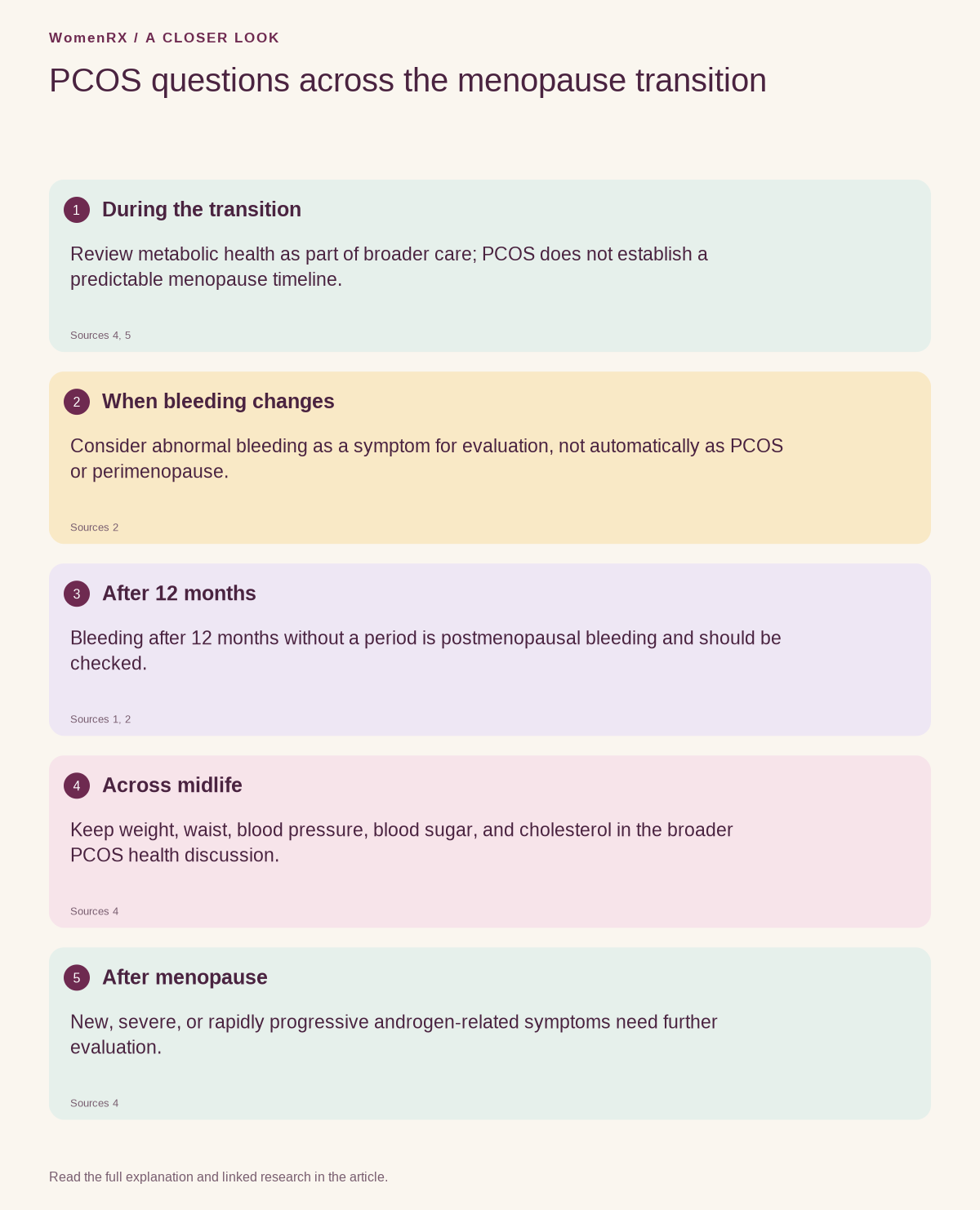
PCOS questions across the menopause transition
During the transition: Review metabolic health as part of broader care; PCOS does not establish a predictable menopause timeline.45
When bleeding changes: Consider abnormal bleeding as a symptom for evaluation, not automatically as PCOS or perimenopause.2
After 12 months: Bleeding after 12 months without a period is postmenopausal bleeding and should be checked.12
Across midlife: Keep weight, waist, blood pressure, blood sugar, and cholesterol in the broader PCOS health discussion.4
After menopause: New, severe, or rapidly progressive androgen-related symptoms need further evaluation.4
Read the figure as text
A life-stage view of what may remain relevant and which changes deserve their own assessment. The sequence does not predict when an individual will reach menopause.- During the transition: Review metabolic health as part of broader care; PCOS does not establish a predictable menopause timeline.45
- When bleeding changes: Consider abnormal bleeding as a symptom for evaluation, not automatically as PCOS or perimenopause.2
- After 12 months: Bleeding after 12 months without a period is postmenopausal bleeding and should be checked.12
- Across midlife: Keep weight, waist, blood pressure, blood sugar, and cholesterol in the broader PCOS health discussion.4
- After menopause: New, severe, or rapidly progressive androgen-related symptoms need further evaluation.4
More questions, answered
Does PCOS mean I need extra cancer screening after menopause?
Not solely because of PCOS. A menopause-care guide does not support additional endometrial, breast, or ovarian cancer screening on that basis alone. But bleeding after 12 months without a period still needs evaluation; symptom assessment is different from routine screening. 14
Can PCOS tell me when I’ll reach menopause?
No. One Finnish cohort found fewer participants with PCOS than controls met its definition of late perimenopause or postmenopause at age 46, but that age-specific result cannot predict an individual’s timing. 5
Sources you can check
- Postmenopausal bleeding - NHSAccessed 2026-09-25Return to first citation
- Visually directed hysteroscopic biopsy in the evaluation of abnormal uterine bleeding and postmenopausal bleeding: a Joint Society Practice Guideline. Joint Society Practice Guideline from AAGL-ESGE-GCH. · Facts, views & vision in ObGyn · 2026Return to first citation
- Reproductive Hormones and Anthropometry: A Follow-Up of PCOS and Controls From Perimenopause to Older Than 80 Years.Forslund M, Schmidt J, Brännström M, Landin-Wilhelmsen K, Dahlgren E. · The Journal of clinical endocrinology and metabolism · 2021Return to first citation
- From PCOS to PMOS: An EMAS clinical guide to the proposed terminology and its relevance to menopause care.Aktoz F, Erel CT, Ozcivit Erkan IB, Armeni E, Boban J, Ceausu I, van Dijken D, Hillard T, Hirschberg AL, Kiesel L, Lambrinoudaki I, Simoncini T, Smetnik A, Goldstajn MS, Stute P, R... · Maturitas · 2026Return to first citation
- Women with PCOS have a later menopausal transition and a lower prevalence of menopausal symptoms at age 46: A population-based birth cohort study.Lavi J, Savukoski S, Hurskainen E, Ollila MM, Morin-Papunen L, Niinimäki M, Piltonen TT. · Acta obstetricia et gynecologica Scandinavica · 2026Return to first citation