Metformin for PCOS: What Changes to Track
Metformin may change metabolic measures, menstrual patterns, or both, so judge progress against the goal you chose rather than someone else’s before-and-after story.
After starting metformin for PCOS, you may see a change in metabolic measures or menstrual pattern, but neither is guaranteed. A review of adolescent studies reported improvements in insulin resistance and menstruation; a small adult trial recorded a modest average weight change with metformin alone. Those results don’t predict yours. Track the outcome you’re treating, along with side effects, for your follow-up conversation. 2 4
Start with the reason you’re taking it
Metformin is used for PCOS and has been studied for metabolic and menstrual outcomes. Insulin-sensitizing medicines used for PCOS may help with insulin resistance and blood glucose, and may lower androgen levels, though that class-level description does not tell you which effects metformin will have for you. Which changes matter most depends on your reason for taking it. 1 2
Before you begin tracking, write down the main goal you discussed with your prescriber. It might be a metabolic measure, a change in cycle pattern, or another concern. This gives follow-up conversations a clearer focus than asking whether you feel “better” overall.
Keep three kinds of change separate
Cycle pattern. Record the first day of bleeding and any changes in how often periods come or how long bleeding lasts. If cycle changes are one of your goals, compare your record over time rather than relying on a general impression. PCOS itself can involve irregular periods or absent periods. In a review of adolescent PCOS studies, some participants resumed menstruating while taking metformin, but that finding doesn’t promise a particular change for you. 1 2
Symptoms. Choose the symptom you actually want to monitor, if you have one. Note whether it changes, stays the same, or becomes more bothersome. Not everyone with PCOS has the same symptoms, so a change in one concern doesn’t tell you whether another has changed. 1
Metabolic measures. Ask which lab or other measure is relevant to your treatment goal and when your prescriber wants to review it. PCOS medicines that improve insulin resistance may also help keep blood glucose levels steady. In adolescent studies, a review reported improvements in a research measure of insulin resistance called HOMA-IR and modest reductions in body mass index (BMI) with metformin alone. Those findings shouldn’t be treated as a forecast for every adult. 1 2
A simple note can be enough: the measure or symptom, what you noticed, and when. You don’t need to collect every possible number or symptom. The useful question is whether the measure you chose is changing in a way that matters to your goal.
Cycles, ovulation, and pregnancy are different goals
A change in cycle pattern is worth recording on its own. If ovulation or pregnancy is your goal, bring that up separately so your follow-up addresses it directly. Studies may assess these outcomes separately, and a result about menstrual patterns should not be mistaken for a pregnancy outcome. 3 4
For example, a 12-week randomized trial enrolled 196 women with PCOS who were being treated for infertility. Participants were assigned to metformin, myo-inositol, a plant extract, or placebo; ovulation induction with letrozole was also performed in the study. Pregnancy occurred in 7 of 49 participants assigned to metformin and 4 of 49 assigned to placebo. The difference in pregnancy outcomes between groups was not statistically significant. This result reflects an infertility-treatment setting and does not answer every question about cycles or ovulation. 3
What the studies show, and what they don’t
A systematic review of nonhormonal treatments in adolescents with PCOS included 19 studies and 744 adolescents; 11 studies examined metformin alone. It reported modest BMI reductions, improved HOMA-IR, and some return of menstruation with metformin. The authors described the adolescent-specific findings as coming from small randomized trials and observational studies. They don’t provide a dependable personal timeline or tell an adult exactly what to expect. 2
An adult trial offers a different point of reference. It randomized 60 overweight or obese Chinese women with PCOS to metformin alone or metformin plus tirzepatide. After 16 weeks, average weight change was −1.7 kg in the metformin-only group, compared with −10.4 kg in the combination group. That comparison shows why results from a combination treatment shouldn’t be attributed to metformin alone. It also isn’t a weight-loss prediction for you. 4
So it’s more useful to agree on what to review than to wait for a promised before-and-after result. Ask which outcomes fit your treatment goal, what changes would count as meaningful for you, and when your prescriber wants to check in. If gastrointestinal symptoms make treatment difficult, include that in the conversation; such symptoms are a recognized tolerability concern with metformin. 3
A short follow-up note
Bring a few concrete observations rather than trying to create a perfect record:
- The goal you’re monitoring.
- Any cycle dates or pattern changes, if relevant.
- The symptom or metabolic measure you chose.
- Any side effects that are affecting your day-to-day life.
- Whether your goal includes ovulation or pregnancy, so those outcomes can be discussed directly.
- One question you want answered, such as whether the measure you’re following is changing enough to meet your goal.
The point is not to judge yourself against someone else’s results. It’s to see whether the changes you care about are happening, and to make the next discussion specific.
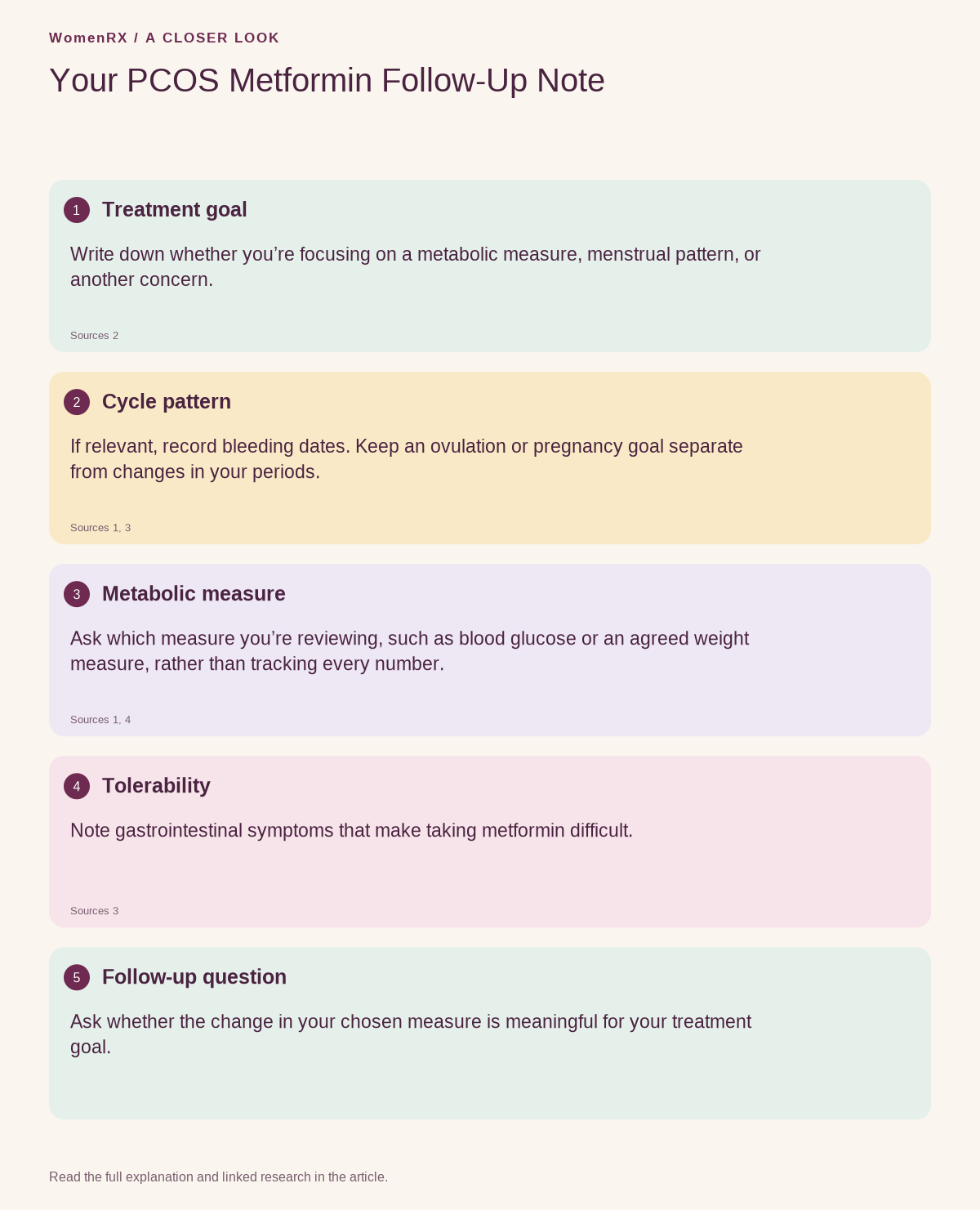
Your PCOS Metformin Follow-Up Note
Treatment goal: Write down whether you’re focusing on a metabolic measure, menstrual pattern, or another concern.2
Cycle pattern: If relevant, record bleeding dates. Keep an ovulation or pregnancy goal separate from changes in your periods.13
Metabolic measure: Ask which measure you’re reviewing, such as blood glucose or an agreed weight measure, rather than tracking every number.14
Tolerability: Note gastrointestinal symptoms that make taking metformin difficult.3
Follow-up question: Ask whether the change in your chosen measure is meaningful for your treatment goal.
Read the figure as text
Choose the parts that match your treatment goal, then use them to make your next conversation specific.- Treatment goal: Write down whether you’re focusing on a metabolic measure, menstrual pattern, or another concern.2
- Cycle pattern: If relevant, record bleeding dates. Keep an ovulation or pregnancy goal separate from changes in your periods.13
- Metabolic measure: Ask which measure you’re reviewing, such as blood glucose or an agreed weight measure, rather than tracking every number.14
- Tolerability: Note gastrointestinal symptoms that make taking metformin difficult.3
- Follow-up question: Ask whether the change in your chosen measure is meaningful for your treatment goal.
More questions, answered
Does metformin guarantee more regular periods?
No. A review of adolescent PCOS studies reported that some participants resumed menstruating with metformin, but the evidence doesn’t predict an individual result or timeline. 2
What if my main goal is pregnancy?
Say so directly. In a 12-week trial involving women with PCOS receiving infertility treatment in which letrozole ovulation induction was also performed, pregnancy outcomes did not differ significantly between the metformin and placebo groups. That result doesn’t settle every fertility question, but it shows why pregnancy should be discussed as its own outcome. 3
Sources you can check
- PCOS | Polycystic Ovary Syndrome | MedlinePlusAccessed 2026-09-25Return to first citation
- Nonhormonal Pharmacological Interventions in Adolescent Polycystic Ovary Syndrome (PCOS): A Systematic Review.Sibal R, Keogh M, Latthe P, Idkowiak J. · Journal of pediatric and adolescent gynecology · 2026Return to first citation
- Effects of Ziziphus jujuba, metformin, and myoinositol on pregnancy rates and metabolic parameters in infertile women with PCOS: a randomized controlled trial.Mashhadi F, Ghaebi NK, Rakhshandeh H, Khadem-Rezaiyan M, Roudi F, Nematy M. · Journal of ovarian research · 2026Return to first citation
- Short-Term Combined Treatment With Tirzepatide and Metformin for Overweight/Obese Chinese Women With Polycystic Ovary Syndrome: A Prospective, Open-Label, Randomised Controlled Trial.Yang Z, Xu Y, Du H, Liu W, Chen H, Liu D, Zhang L, Wang C. · Diabetes, obesity & metabolism · 2026Return to first citation