Could These Symptoms Be PCOS? What to Track
Irregular cycles and unwanted hair growth are useful clues, but no single symptom can tell you whether you have PCOS.
Track when your periods start, how far apart they are, and when acne, unwanted facial or body hair, or scalp hair thinning begins or changes. In adults, cycles more than 35 days apart or fewer than eight periods a year can be relevant to PCOS assessment; these patterns can also have other causes. Acne alone is common and doesn’t establish PCOS. 3 4 7
Irregular periods, acne, unwanted facial or body hair, and scalp hair thinning can all be associated with PCOS, but they don’t carry the same weight. The pattern matters: cycle changes alongside signs of excess androgen, such as unwanted coarse hair, are more informative than acne by itself. A symptom log can help you describe that pattern without trying to diagnose yourself. 5 7
Start with the cycle pattern
For each period, record the first day of bleeding, how many days it lasts, and the number of days until the next period starts. Also note whether your usual pattern has changed. In adults, cycles more than 35 days apart or fewer than eight periods in a year can reflect the ovulation irregularity considered in PCOS assessment. 3 7
Those numbers are clues, not a diagnosis. Irregular periods can also relate to puberty, pregnancy, hormonal contraception, excessive exercise, the transition toward menopause, or thyroid problems. 3 If you use hormonal contraception, include that in your notes because it can affect your bleeding pattern. 3
Record what changes, and when
For acne, note when it began, where it appears, and whether it comes and goes around your period. Acne is common, can begin at different ages, and may fluctuate with menstrual-cycle changes; on its own, it doesn’t identify PCOS. 2 4 A sudden start in adulthood is more worth discussing when it occurs with irregular periods or unwanted body hair. 1
For hair changes, describe what you notice rather than just writing “hair growth” or “hair loss.” For example, note whether coarse hair is appearing on your face or chest, or whether scalp hair seems to be thinning. PCOS can include unwanted hair growth and scalp hair loss, but either symptom alone is not enough to establish the condition. 5 7
A simple note might look like this: “Periods started March 2 and April 12; new coarse chin hairs noticed in February; acne worsens before periods.” That’s an example of the detail to capture, not a diagnostic pattern.
Age changes how clues are read
During adolescence: Acne commonly appears with puberty, so it is not a specific PCOS clue. For adolescents, both irregular ovulation and signs of hyperandrogenism are needed for a PCOS diagnosis; the adolescent review says ultrasound is not recommended for diagnosis in this age group. 2 8
In adulthood: A PCOS diagnosis generally draws on at least two of three features: androgen excess, ovulatory dysfunction, and polycystic ovarian morphology. The symptoms you can observe, such as unwanted hair growth or irregular cycles, are only part of that assessment. 7
After periods have stopped: A menstrual-cycle log is no longer a useful way to look for ovulatory irregularity. Some signs, including unwanted hair growth and scalp hair changes, may persist in women with PCOS, but research focused on the peri- and postmenopausal years is limited. Don’t assume a new change is PCOS based on a past diagnosis or a symptom list alone. 6
When it’s worth asking for an assessment
Consider bringing your notes to an appointment if your usual cycle pattern changes or stays irregular, especially if you also notice unwanted facial hair, weight change, or changes in your skin. Bleeding between periods, periods lasting longer than seven days, or difficulty getting pregnant alongside irregular periods are also reasons to seek an assessment. 3 New adult acne together with irregular periods or unwanted body hair is another pattern worth mentioning. 1
This is not a checklist you need to “pass.” It’s a way to show how symptoms relate over time and to make room for other explanations, including thyroid problems or effects of contraception. 3
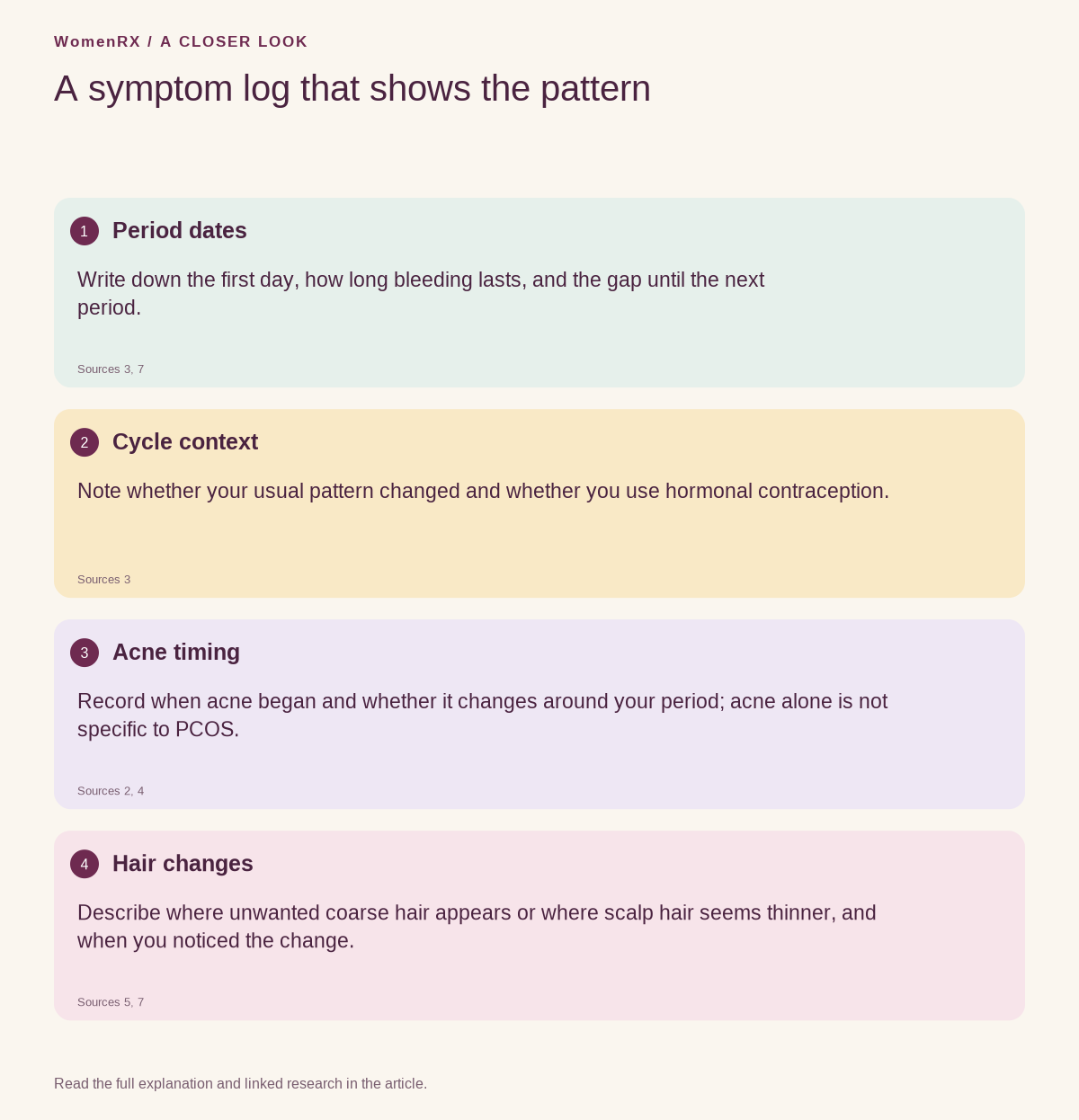
A symptom log that shows the pattern
Period dates: Write down the first day, how long bleeding lasts, and the gap until the next period.37
Cycle context: Note whether your usual pattern changed and whether you use hormonal contraception.3
Acne timing: Record when acne began and whether it changes around your period; acne alone is not specific to PCOS.24
Hair changes: Describe where unwanted coarse hair appears or where scalp hair seems thinner, and when you noticed the change.57
Read the figure as text
Record cycle timing alongside skin and hair changes. These notes can help describe what is happening, but they do not diagnose PCOS.- Period dates: Write down the first day, how long bleeding lasts, and the gap until the next period.37
- Cycle context: Note whether your usual pattern changed and whether you use hormonal contraception.3
- Acne timing: Record when acne began and whether it changes around your period; acne alone is not specific to PCOS.24
- Hair changes: Describe where unwanted coarse hair appears or where scalp hair seems thinner, and when you noticed the change.57
More questions, answered
Does acne by itself mean I might have PCOS?
Acne is common, can start at different ages, and can change with menstrual-cycle hormones. It becomes a more relevant PCOS clue when it appears alongside features such as irregular periods or unwanted hair growth, but it still can’t diagnose PCOS on its own. 1 4 7
Should an adolescent have an ultrasound to check for PCOS?
The adolescent review says ultrasound is not recommended for diagnosing PCOS in adolescents. It describes diagnosis as requiring both ovulatory irregularity and signs of hyperandrogenism. 8
Sources you can check
- Acne - Diagnosis - NHSAccessed 2026-09-25Return to first citation
- Acne - Causes - NHSAccessed 2026-09-25Return to first citation
- Irregular periods - NHSAccessed 2026-09-25Return to first citation
- Acne - NHSAccessed 2026-09-25Return to first citation
- Pathophysiology and diagnostic criteria of PCOS.Capozzi A, Vignali M, Scambia G, Lello S. · Minerva obstetrics and gynecology · 2025Return to first citation
- Exploring the Experiential Journey of Women with PCOS Across the Lifespan: A Qualitative Inquiry.Wright PJ, Dawson RM, Corbett CF. · International journal of women's health · 2024Return to first citation
- Polycystic Ovary Syndrome and the Effects of a Ketogenic Diet: A Scoping Review.Fleigle D, Brumitt J, McCarthy E, Adelman T, Asbell C. · Nutrients · 2025Return to first citation
- Polycystic Ovary Syndrome in Adolescents.Saleh FL, Starkman H, Furness A, Pfeifer SM, Kives S. · Obstetrics and gynecology clinics of North America · 2024Return to first citation