Could These Changes Be Perimenopause in Your Late 30s or 40s?
A changing cycle alongside hot flashes or night sweats can fit the menopausal transition, but age and symptoms alone can’t confirm the cause.
Perimenopause is the transition before the final menstrual period, when cycle length may become more variable and hot flashes or night sweats may occur. A cluster of changes that includes your cycle is more suggestive than one symptom by itself, but it still isn’t a diagnosis. If you’re under 40 and your periods become persistently irregular or stop, ask about other causes, including premature ovarian insufficiency. 3 1 2
Look for a pattern, not one telltale symptom
A hot flash, a rough stretch of sleep, a mood change, or a period that arrives late can each have more than one explanation. The pattern over time matters. During perimenopause, the years before the final period, menstrual cycles tend to become more variable in length; periods may also be absent at times. Hot flashes and other temperature-related symptoms can occur too. Menopause itself is defined only after 12 months without a period. 3
That makes cycle history a useful part of the picture, but not a home diagnostic test. For example, a new pattern of cycle changes alongside hot flashes or night sweats may fit the transition better than a single sleepless week with otherwise unchanged periods. Neither example confirms the cause. Symptoms that involve mood or sleep deserve attention in their own right, but they don’t establish that you’re perimenopausal.
In your late 30s, don’t assume the usual transition
Age matters most when symptoms begin before 40. Premature ovarian insufficiency (POI) is a distinct condition involving loss of ovarian function before that age. It can cause irregular or absent periods and symptoms that overlap with menopause, including hot flashes, night sweats, and insomnia. Similar symptoms don’t tell you whether you have POI or the usual menopausal transition, so persistent changes before 40 are worth discussing rather than simply attributing them to age. 2
A missed or irregular period can also have other explanations. Evaluation may take account of pregnancy possibility, eating and exercise patterns, stress, medications, and chronic illness, as well as symptoms that could point to an endocrine or other health issue. A review of amenorrhea describes pregnancy testing and checks of thyroid and prolactin levels, among other tests, as part of an evaluation; the exact assessment depends on the person’s history. 1
A practical threshold: the cited review defines secondary amenorrhea as no period for three months after previously regular periods, or no period for six months after previously irregular cycles. These definitions are a reason to seek assessment, not a reason to wait if you’re worried or have other significant symptoms. 1
What to notice before you talk it through
You don’t need to arrive with a perfect symptom log. A few details can make the conversation more useful: whether cycle length or bleeding pattern has changed, when temperature or sleep symptoms happen in relation to your cycle, when the changes began, and whether anything else changed around the same time, such as medication, stress, exercise, or health. These details help distinguish a developing pattern from a single symptom and give a clinician context for considering other explanations. 1 3
You can ask: “Could this pattern fit perimenopause, or should we check for another cause?” If you’re under 40, add: “Does the combination of my cycle changes and symptoms call for an assessment for premature ovarian insufficiency?” A discussion can start with your history; testing is chosen based on that history rather than on age or one symptom alone. 1 2
The main takeaway is simple: changes in cycle length, especially alongside temperature symptoms, can be a clue. They aren’t proof. And when the changes start before 40, checking for a different explanation matters because the next steps may differ from those for the usual menopausal transition.
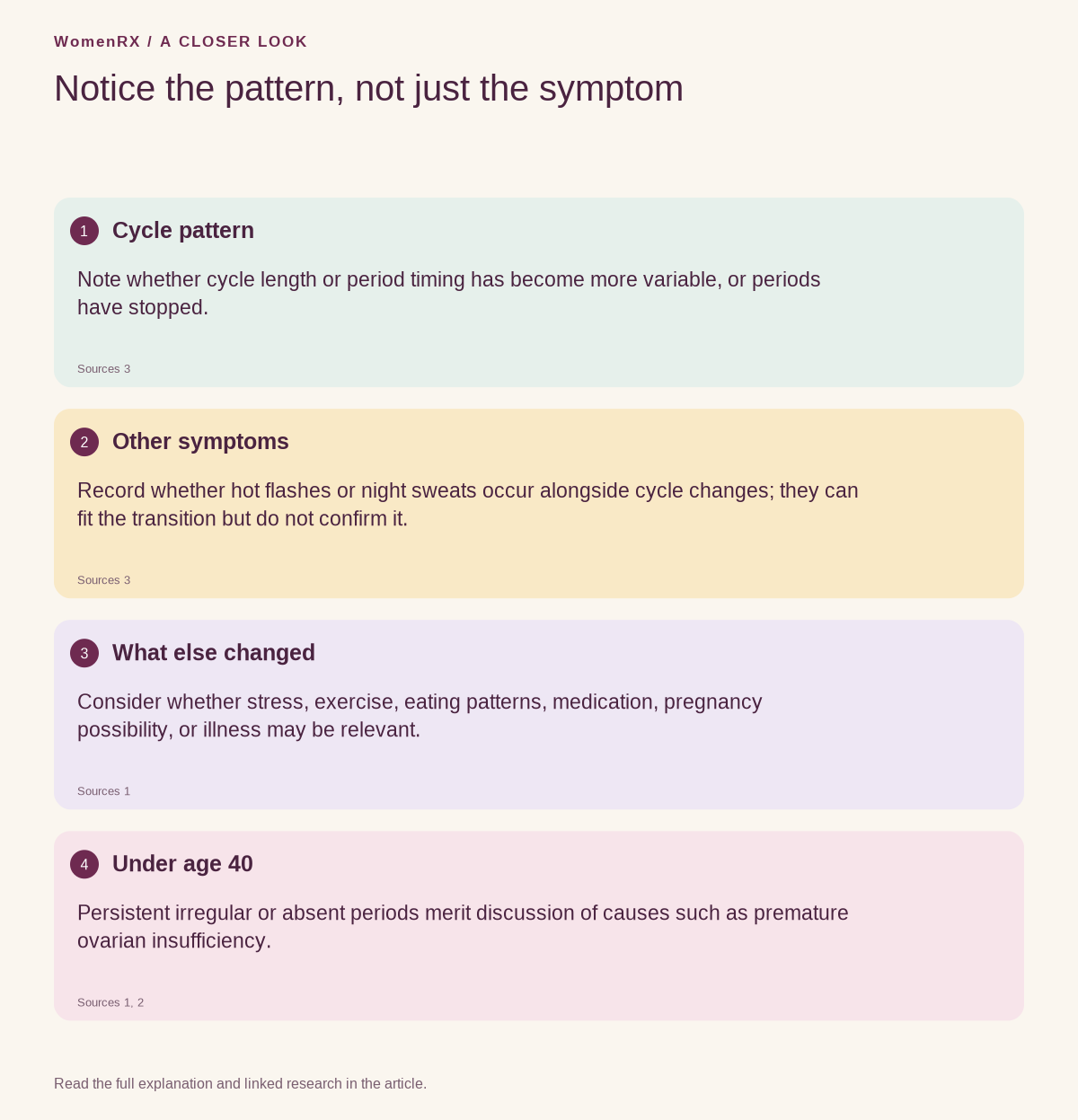
Notice the pattern, not just the symptom
Cycle pattern: Note whether cycle length or period timing has become more variable, or periods have stopped.3
Other symptoms: Record whether hot flashes or night sweats occur alongside cycle changes; they can fit the transition but do not confirm it.3
What else changed: Consider whether stress, exercise, eating patterns, medication, pregnancy possibility, or illness may be relevant.1
Under age 40: Persistent irregular or absent periods merit discussion of causes such as premature ovarian insufficiency.12
Read the figure as text
These prompts help organize what has changed; they are not a diagnostic checklist.- Cycle pattern: Note whether cycle length or period timing has become more variable, or periods have stopped.3
- Other symptoms: Record whether hot flashes or night sweats occur alongside cycle changes; they can fit the transition but do not confirm it.3
- What else changed: Consider whether stress, exercise, eating patterns, medication, pregnancy possibility, or illness may be relevant.1
- Under age 40: Persistent irregular or absent periods merit discussion of causes such as premature ovarian insufficiency.12
More questions, answered
Does a missed period mean I’m in perimenopause?
No. Pregnancy and other health or medication-related factors can also affect periods. If you’ve missed periods for a sustained stretch, or your pattern is changing, a clinician can use your cycle history and other details to decide what to assess. 1
Sources you can check
- Amenorrhea: A Practical Approach to Diagnosis and Management.Klein DA, Sylvester JE, Paradise SL. · American family physician · 2026Return to first citation
- Premature Ovarian Insufficiency in a Patient With Vogt-Koyanagi-Harada Syndrome: An Unusual Association-A Case Report.Rocha RB, Benzaquem DC, Passos PS, da Silva EKC, Mendonça JB, da Silva PRL, Ferreira JFB, Fantin C. · Case reports in medicine · 2026Return to first citation
- Hormone Therapy for the Primary Prevention of Chronic Conditions in Postmenopausal Persons: US Preventive Services Task Force Recommendation Statement.US Preventive Services Task Force, Mangione CM, Barry MJ, Nicholson WK, Cabana M, Caughey AB, Chelmow D, Coker TR, Davis EM, Donahue KE, Jaén CR, Kubik M, Li L, Ogedegbe G, Pbert L... · JAMA · 2022Return to first citation