Could These Changes Be Perimenopause? Signs and Other Possibilities
A changing cycle can be a useful clue, but symptoms alone can’t confirm perimenopause or explain every new change.
Perimenopause becomes more plausible when menstrual cycles grow less predictable, sometimes alongside hot flashes, night sweats, sleep difficulties, or mood changes. But symptoms aren’t a diagnosis: menopause is confirmed only after 12 months without a period, and pregnancy or other causes of bleeding may need consideration. Your age, bleeding pattern, and hormonal contraception all matter when interpreting what’s happening. 1 2 6

Look for a pattern, not one telltale symptom
Perimenopause is the transition before the final menstrual period. A common clue is that cycle length becomes more variable, or periods are sometimes skipped. Hot flashes, night sweats, sleep difficulties, and mood changes can occur too, but no single symptom confirms the transition. Menopause itself is identified retrospectively, after 12 months without a period. 1 2
That makes the overall pattern more informative than a rough day-to-day impression. For a few cycles, note the first day of each period, how long bleeding lasts, whether the flow seems different for you, and when symptoms show up. Include symptoms even when they don’t happen near a period. This is a practical record to help describe what’s changed, not a diagnostic test.
Age is context, not a verdict
The transition generally comes before the final menstrual period, and it’s discussed in guidance for women in middle age. Age can make perimenopause more or less plausible, but it doesn’t confirm the cause of a particular symptom. Menopause guidance also considers early menopause and premature ovarian insufficiency, so changes that happen earlier than expected shouldn’t automatically be dismissed or labeled perimenopause. 2 4
When periods or contraception complicate the picture
If you use hormonal contraception, write down the method and any bleeding changes. Hormonal contraceptives may be used both to prevent unintended pregnancy and to manage symptoms during perimenopause, but a systematic review found limited data and a lack of comparative studies on which approach is best. In other words, using contraception neither proves nor rules out the transition; it’s useful context when you discuss your symptoms. 3
If pregnancy is possible, keep it on the list of explanations. Pregnancy testing may be part of evaluating abnormal bleeding, depending on the circumstances. 6
Don’t assume every change is hormonal
Bleeding that is unusually heavy, prolonged, irregular, or persistent can have causes besides the menopausal transition. Guidance on abnormal uterine bleeding notes that evaluation may include checking for pregnancy or thyroid problems, among other possibilities, depending on the situation. Fibroids and other uterine or endometrial causes can also matter, which is why persistent bleeding or bleeding with pelvic pain deserves assessment rather than an automatic perimenopause label. 5 6
If you’ve already gone 12 months without a period, new bleeding is not simply a return of an ordinary cycle. Abnormal bleeding after menopause needs evaluation to look for endometrial or other causes. 2 5
A useful record to bring
Keep the notes simple: dates and duration of bleeding; changes in flow; symptoms and when they occur; and your age and any hormonal contraception. Add a question about what else could explain the pattern, especially if bleeding is persistent or unusual. The goal isn’t to arrive with a self-diagnosis. It’s to make the change clear enough that you and a clinician can decide what deserves a closer look.
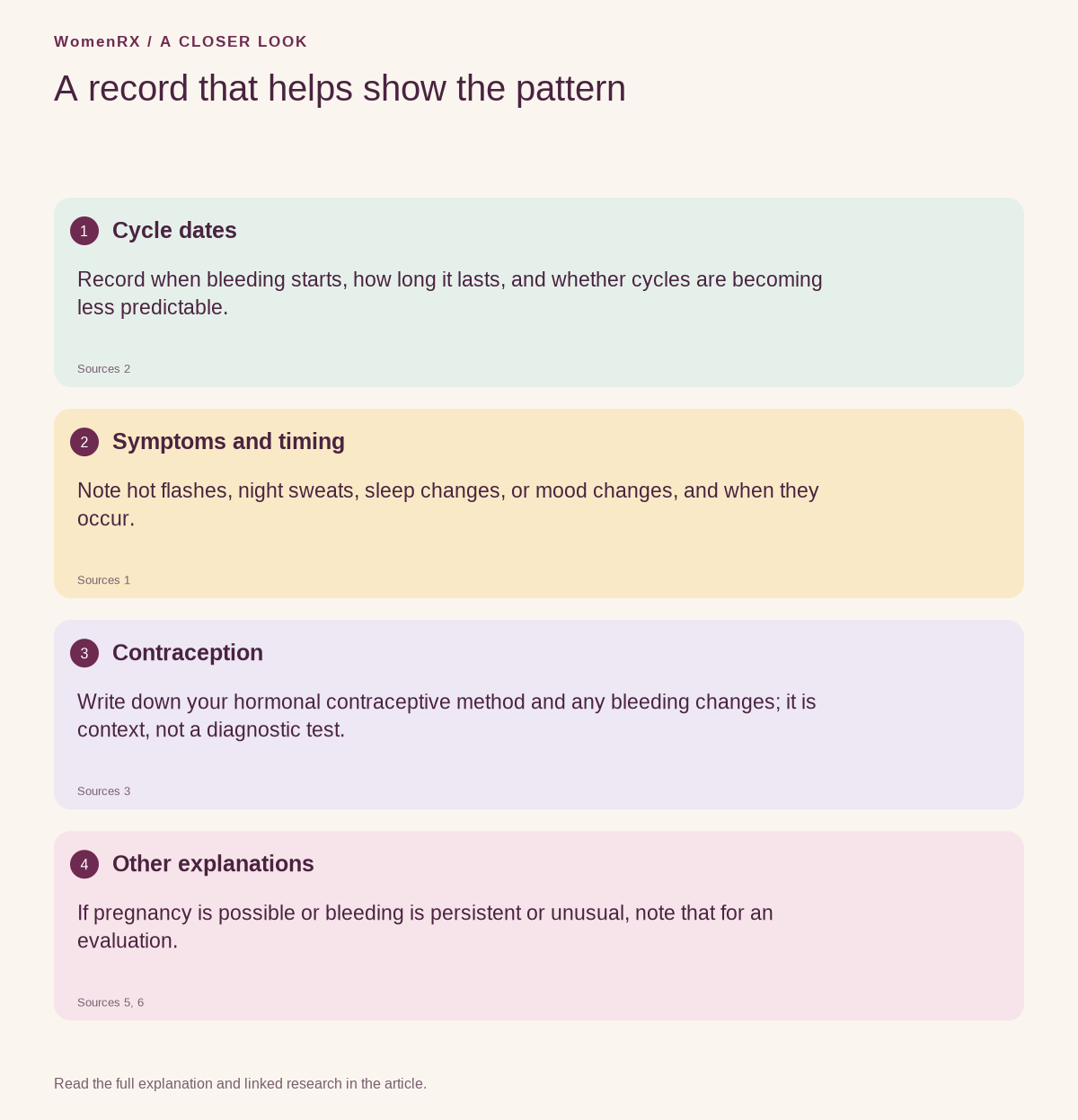
A record that helps show the pattern
Cycle dates: Record when bleeding starts, how long it lasts, and whether cycles are becoming less predictable.2
Symptoms and timing: Note hot flashes, night sweats, sleep changes, or mood changes, and when they occur.1
Contraception: Write down your hormonal contraceptive method and any bleeding changes; it is context, not a diagnostic test.3
Other explanations: If pregnancy is possible or bleeding is persistent or unusual, note that for an evaluation.56
Read the figure as text
Use these notes to describe what has changed. They organize information for a conversation; they do not diagnose perimenopause.- Cycle dates: Record when bleeding starts, how long it lasts, and whether cycles are becoming less predictable.2
- Symptoms and timing: Note hot flashes, night sweats, sleep changes, or mood changes, and when they occur.1
- Contraception: Write down your hormonal contraceptive method and any bleeding changes; it is context, not a diagnostic test.3
- Other explanations: If pregnancy is possible or bleeding is persistent or unusual, note that for an evaluation.56
More questions, answered
Can hot flashes or sleep changes tell me for sure that I’m in perimenopause?
No. Hot flashes, night sweats, and sleep difficulties can occur during the menopausal transition, but symptoms alone don’t confirm it. Cycle changes and the broader context matter too. 1 2
Does hormonal birth control mean I can’t be in perimenopause?
No. Hormonal contraceptives are used by some women during perimenopause for contraception and symptom management. The available review found limited comparative evidence, so the method is useful context, not a yes-or-no test for the transition. 3
Sources you can check
- Effects of Physical Exercise on Symptoms and Quality of Life in Women in Climacteric: A Systematic Review and Meta-Analysis.Trujillo-Muñoz PJ, Sánchez-Ojeda MA, Rodríguez-Huamán EC, Mezyani-Haddu K, Hoyo-Guillot I, Navarro-Prado S. · Healthcare (Basel, Switzerland) · 2025Return to first citation
- Hormone Therapy for the Primary Prevention of Chronic Conditions in Postmenopausal Persons: US Preventive Services Task Force Recommendation Statement.US Preventive Services Task Force, Mangione CM, Barry MJ, Nicholson WK, Cabana M, Caughey AB, Chelmow D, Coker TR, Davis EM, Donahue KE, Jaén CR, Kubik M, Li L, Ogedegbe G, Pbert L... · JAMA · 2022Return to first citation
- Use of hormonal contraceptives in perimenopause: A systematic review.Guerin J, Engelmann A, Mattamana M, Borgelt LM. · Pharmacotherapy · 2022Return to first citation
- European society of endocrinology clinical practice guideline for evaluation and management of menopause and the perimenopause.Lumsden MA, Dekkers OM, Faubion SS, Lindén Hirschberg A, Jayasena CN, Lambrinoudaki I, Louwers Y, Pinkerton JV, Sojat AS, van Hulsteijn L. · European journal of endocrinology · 2025Return to first citation
- Uterine Leiomyomas Across the Menopausal Transition.Encalada-Soto D, Hochberg LS, Laughlin-Tommaso S. · Obstetrics and gynecology · 2026Return to first citation
- 2020 Hong Kong College of Obstetricians and Gynaecologists guideline on investigations of premenopausal women with abnormal uterine bleeding.Lee JHS, Cheng EOL, Choi KM, Ngu SF, Cheung RYK, Hong Kong College of Obstetricians and Gynaecologists. · Hong Kong medical journal = Xianggang yi xue za zhi · 2020Return to first citation