Perimenopause Fatigue: Look at Sleep and Other Causes
Broken sleep may leave you exhausted, but the pattern of your fatigue can help reveal what else needs attention.
If fatigue is affecting daily life during perimenopause, start by looking at your sleep: are hot flashes or other symptoms waking you, and do you feel better after a good night? Then consider stress, health conditions, and medicines that could also contribute. Fatigue lasting several weeks deserves a broader health review, even if menopause symptoms seem to be part of the picture. 16
A tired day after a broken night makes sense. What’s harder is knowing whether the night explains all of the fatigue. During perimenopause, sleep complaints, hot flashes, and fatigue can occur together, but fatigue is a symptom with many possible causes. Looking at the pattern gives you a better next step than blaming hormones alone. 16
Is sleep the clearest link?
Think about the difference between a day that follows several awakenings and a day that follows what felt like enough sleep. For example, if you wake up hot repeatedly and feel most drained the next morning, the disrupted night is worth addressing. If you’re exhausted even after nights that feel restful, don’t assume hot flashes explain it. Neither pattern diagnoses a cause, but each points to a different question. 16
A study of 576 women in São Paulo examined menopausal status and waking at night with a headache. Among women reporting that problem, researchers also found more hot flashes, poorer reported sleep, insomnia complaints, anxiety symptoms, and fatigue. These symptoms can travel together; the study cannot tell us that menopause caused any individual woman’s fatigue. 6
What interrupts your sleep matters. Is it feeling hot, pain or a headache, worry, or trouble getting back to sleep? Sleep apnea and other sleep disorders can cause fatigue, too. A brief note about when you wake and how you feel the next day is more useful than simply recording “slept badly.” 16
What else belongs in the picture?
Sleep isn’t the only place to look. Anemia, thyroid disease, diabetes, infections, ongoing pain, depression, and anxiety are among the conditions that can contribute to fatigue. So can some medicines, including certain antidepressants, antihistamines, and medicines for nausea or pain. Noticing whether tiredness began around a medicine change can help focus a review without assuming the medicine is responsible. 1
Daily habits may matter as well. Too little sleep, alcohol, stress, and caffeine that interferes with sleep can all play a part. A useful record doesn’t have to be elaborate: note when your energy drops, whether rest helps, what disrupted the previous night, and any change in symptoms, medicines, or routine. MedlinePlus suggests a fatigue diary as a way to spot times of lower and higher energy. 1
Match the next step to the problem
If hot flashes are repeatedly waking you, you can discuss treatment for bothersome hot flashes rather than asking for a treatment for fatigue in general. Menopause guidance identifies hormone therapy as the most effective treatment for hot flashes and recommends several nonhormonal options, including cognitive-behavioral therapy, clinical hypnosis, and certain prescription medicines. Which option fits depends on the symptoms and the person. These recommendations address hot flashes; they don’t establish that treating them will resolve every cause of fatigue. 34
The distinction matters because direct evidence on treating perimenopausal fatigue is limited. In one small randomized pilot trial, 38 regularly cycling women with perimenopausal symptoms received a levonorgestrel IUD and were assigned to estrogen gel or placebo gel. Fatigue scores improved more in the estrogen group over the study period, but sleep-quality scores were not associated with estrogen use. That result is worth studying further, not a reason to treat unexplained fatigue with estrogen. 5
If fatigue doesn’t improve after several weeks, arrange a health review even if your sleep has been poor. A clinician can ask about sleep, activity, appetite, and other symptoms, review possible causes, and decide whether an exam or lab tests would help. You can bring the short pattern record you made, along with a list of medicines. Improving sleep habits and managing stress may help you feel less tired while you work out what’s going on, but persistent fatigue deserves more than a guess. 1
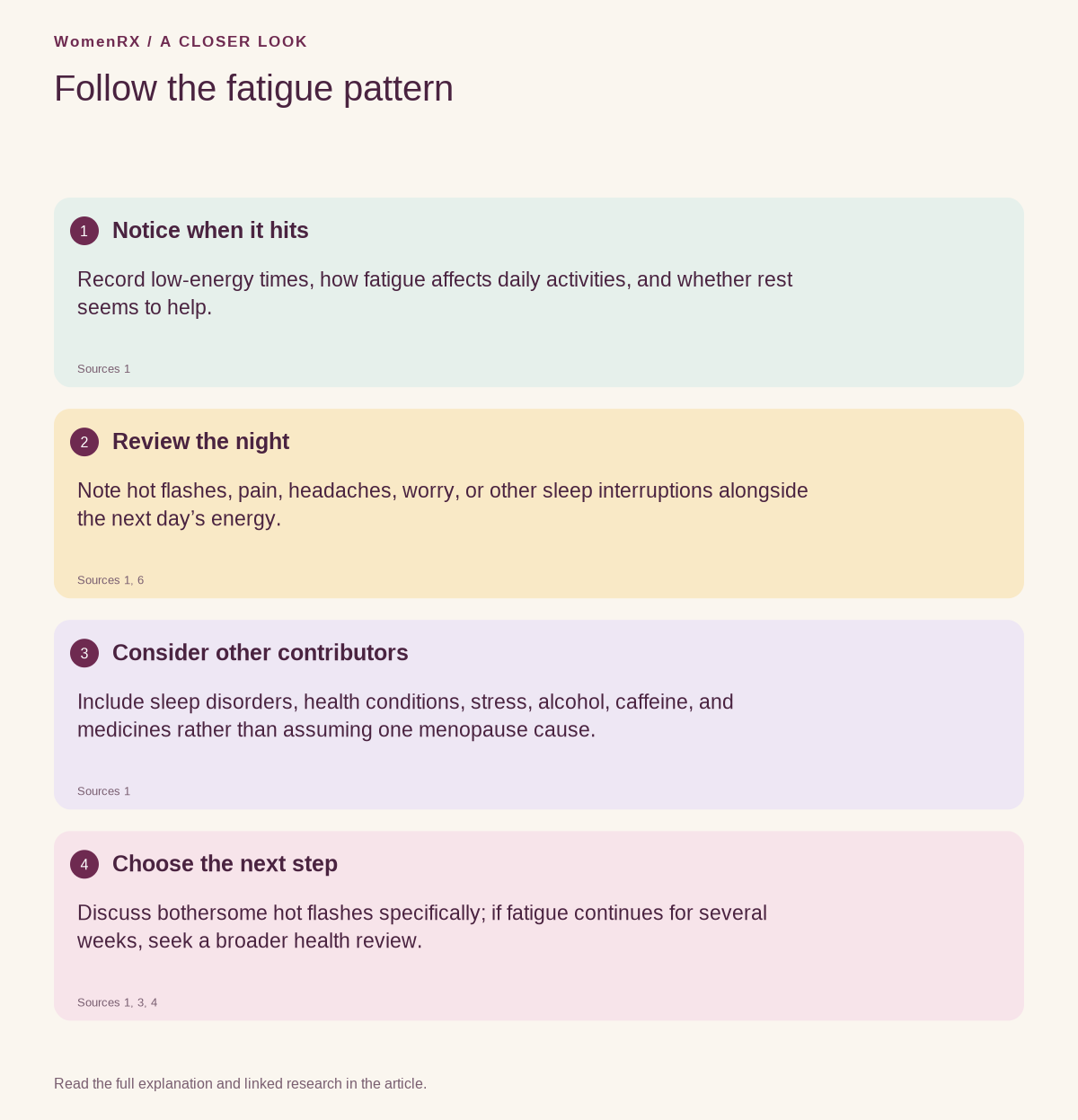
Follow the fatigue pattern
Notice when it hits: Record low-energy times, how fatigue affects daily activities, and whether rest seems to help.1
Review the night: Note hot flashes, pain, headaches, worry, or other sleep interruptions alongside the next day’s energy.16
Consider other contributors: Include sleep disorders, health conditions, stress, alcohol, caffeine, and medicines rather than assuming one menopause cause.1
Choose the next step: Discuss bothersome hot flashes specifically; if fatigue continues for several weeks, seek a broader health review.134
Read the figure as text
Use these questions to organize what may be contributing; the flow does not diagnose the cause.- Notice when it hits: Record low-energy times, how fatigue affects daily activities, and whether rest seems to help.1
- Review the night: Note hot flashes, pain, headaches, worry, or other sleep interruptions alongside the next day’s energy.16
- Consider other contributors: Include sleep disorders, health conditions, stress, alcohol, caffeine, and medicines rather than assuming one menopause cause.1
- Choose the next step: Discuss bothersome hot flashes specifically; if fatigue continues for several weeks, seek a broader health review.134
More questions, answered
Does fatigue mean I’m in perimenopause?
No. Fatigue can occur alongside perimenopausal symptoms, but sleep disorders, health conditions, medicines, and other factors can also cause it. Fatigue alone can’t identify which explanation fits. 16
Should I try a supplement for the fatigue?
Don’t assume a supplement will address the cause. Small studies of ashwagandha have examined sleep or fatigue in mixed adult groups, not established it as a treatment for perimenopausal fatigue. Menopause guidance does not recommend supplements or herbal remedies for hot flashes. 24
Sources you can check
- Fatigue: MedlinePlusAccessed 2026-09-25Return to first citation
- Ashwagandha: Is it helpful for stress, anxiety, or sleep? - Health Professional Fact SheetAccessed 2026-09-25Return to first citation
- The 2022 hormone therapy position statement of The North American Menopause Society.“The 2022 Hormone Therapy Position Statement of The North American Menopause Society” Advisory Panel. · Menopause (New York, N.Y.) · 2022Return to first citation
- The 2023 nonhormone therapy position statement of The North American Menopause Society.Menopause (New York, N.Y.) · 2023Return to first citation
- Use of a levonorgestrel-containing intrauterine system with supplemental estrogen improves symptoms in perimenopausal women: a pilot study.Santoro N, Teal S, Gavito C, Cano S, Chosich J, Sheeder J. · Menopause (New York, N.Y.) · 2015Return to first citation
- Does menopause influence nocturnal awakening with headache?Lucchesi LM, Hachul H, Yagihara F, Santos-Silva R, Tufik S, Bittencourt L. · Climacteric : the journal of the International Menopause Society · 2013Return to first citation