Perimenopause Fatigue: Find the Pattern, Check Other Causes
Fatigue can overlap with perimenopause symptoms, but its timing and company may point to sleep disruption, heavy bleeding, or another cause worth checking.
There’s no dependable countdown for perimenopause fatigue. It may fluctuate alongside sleep problems, mood changes, or menstrual changes, but fatigue is also linked to anemia, thyroid conditions, sleep disorders, and other causes. Notice when it worsens and what else is happening. If it lasts for weeks, or heavy bleeding is part of the picture, seek an evaluation rather than assuming it’s menopause. 1 2
Start with the pattern, not the label
Fatigue can happen during perimenopause, alongside symptoms such as sleep disruption, mood changes, and irregular or heavy periods. But fatigue on its own doesn’t show that hormones are the cause. It can also be related to anemia, thyroid disease, sleep disorders, depression or anxiety, and other health conditions. 1 2
There isn’t one predictable timeline for fatigue. It may come and go, or stick around, depending on what’s driving it. The length of the perimenopause transition doesn’t tell you how long your fatigue will last. Instead of waiting for it to pass, look for clues in the days and weeks around it.
What the timing might help you notice
Fatigue after broken sleep: Record whether you’re waking often, sleeping poorly, or noticing hot flashes around the same time. Sleep problems and fatigue can occur during perimenopause, but a pattern doesn’t prove one causes the other. If you snore, wake unrefreshed, or feel sleepy during the day, mention that too: sleep apnea and other sleep disorders are possible causes of fatigue. 1 2
Fatigue that follows heavier bleeding: Note how your bleeding has changed and whether low energy worsens during or after your period. Heavy menstrual bleeding and iron-deficiency anemia can be especially relevant in perimenopause, and their symptoms can overlap with fatigue, low mood, difficulty concentrating, and sleep disturbance. Heavy bleeding can have several underlying causes, so it’s worth discussing rather than treating it as an unavoidable part of the transition. 2
Fatigue alongside mood or thinking changes: Perimenopause can include mood changes and difficulty concentrating. Depression and anxiety can also be associated with fatigue, so include changes in mood, interest, or concentration in the picture you share. 1 2
Fatigue that doesn’t follow a clear pattern: That’s useful information too. A fatigue diary can help you see when your energy dips and how it relates to sleep and daily activities. Other possibilities include thyroid disease, other chronic conditions, recent illness, pain, and the effects of some treatments. 1
Make a brief record that can answer a question
For a couple of weeks, jot down a few details once a day. Keep it simple enough to maintain:
- Energy: When was fatigue strongest? Did it interfere with work, errands, or usual activities?
- Sleep: How restful did sleep feel? Did you wake often or notice hot flashes?
- Bleeding: Was your period heavier, longer, or less predictable than usual?
- Other changes: Note mood, concentration, pain, illness, and any recent medicine or treatment changes.
The aim isn’t to diagnose yourself or score your symptoms. It’s to make a connection easier to describe, or to show that the fatigue doesn’t match any obvious pattern. A fatigue diary can help identify daily patterns, and questions about sleep and daily activities are part of evaluating ongoing fatigue. 1
When to look beyond perimenopause
If fatigue has continued for weeks, contact a health care provider to discuss possible causes. Evaluation may involve questions about sleep, daily activities, appetite, and exercise, along with an exam or lab tests. Depending on your symptoms, you could ask whether anemia or iron deficiency, a thyroid condition, a sleep disorder, or another cause should be considered. The right evaluation depends on the whole picture, not just your age or cycle changes. 1 2
If bleeding is heavy or has changed substantially, bring that up even if fatigue is your main concern. Ask whether the bleeding itself needs evaluation and whether anemia or iron deficiency could be contributing. Perimenopausal heavy bleeding may have different causes, so identifying the cause and addressing symptoms can be considered together. 2
A useful next step is to bring one specific pattern, or the fact that there isn’t one, to the conversation: “My energy is worst after nights when I wake repeatedly,” or “It gets worse around heavier periods.” That gives you and your provider a clearer starting point than assuming fatigue is simply part of menopause.
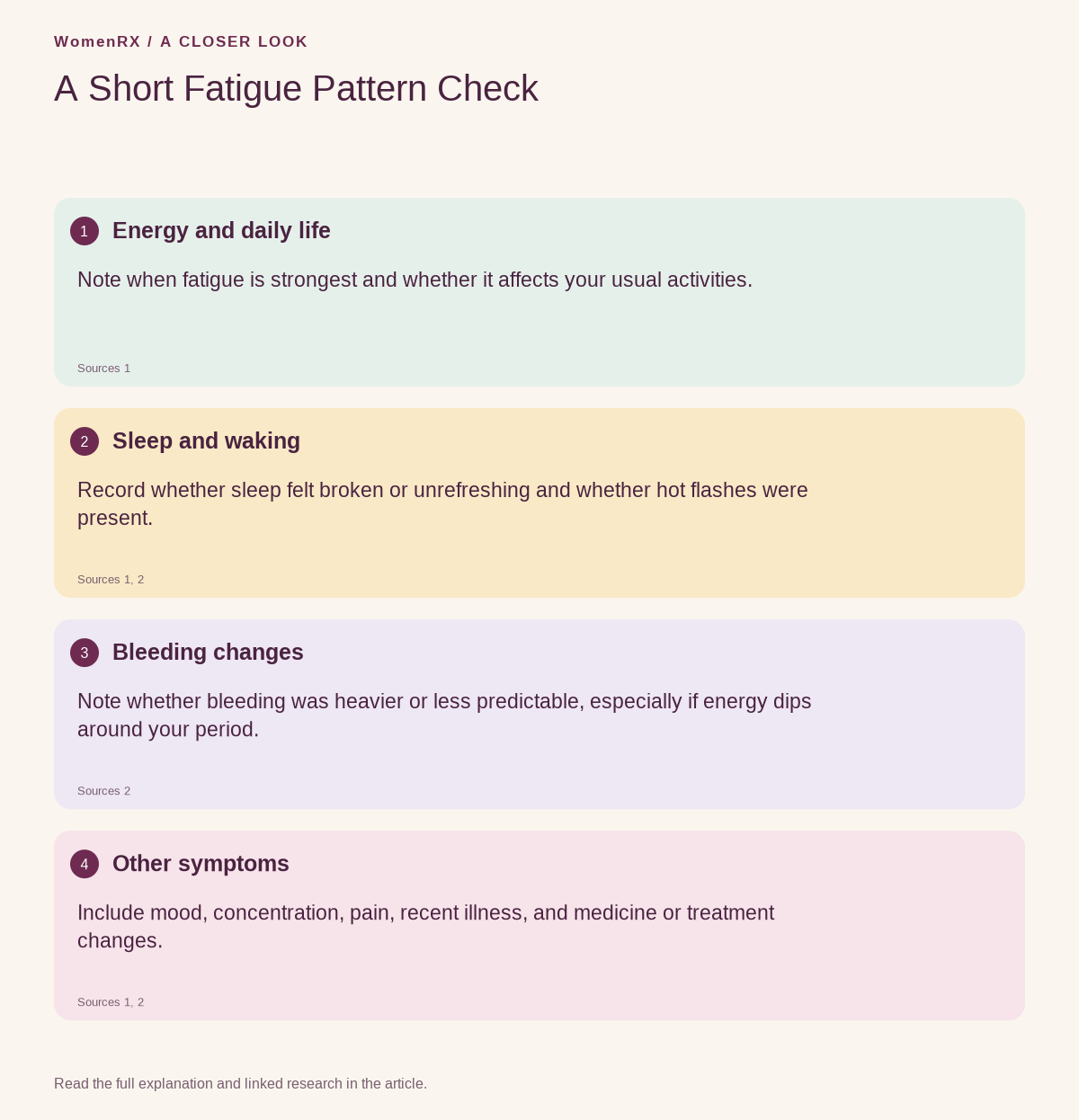
A Short Fatigue Pattern Check
Energy and daily life: Note when fatigue is strongest and whether it affects your usual activities.1
Sleep and waking: Record whether sleep felt broken or unrefreshing and whether hot flashes were present.12
Bleeding changes: Note whether bleeding was heavier or less predictable, especially if energy dips around your period.2
Other symptoms: Include mood, concentration, pain, recent illness, and medicine or treatment changes.12
Read the figure as text
Record a few details to see whether fatigue tends to appear with sleep changes, bleeding, or other symptoms. These clues can guide a conversation but cannot diagnose the cause.- Energy and daily life: Note when fatigue is strongest and whether it affects your usual activities.1
- Sleep and waking: Record whether sleep felt broken or unrefreshing and whether hot flashes were present.12
- Bleeding changes: Note whether bleeding was heavier or less predictable, especially if energy dips around your period.2
- Other symptoms: Include mood, concentration, pain, recent illness, and medicine or treatment changes.12
More questions, answered
Does fatigue by itself mean I’m in perimenopause?
No. Fatigue can occur alongside perimenopause symptoms, but it also has many other possible causes, including anemia, thyroid disease, sleep disorders, depression, and anxiety. Fatigue alone can’t identify the cause. 1 2
Sources you can check
- Fatigue: MedlinePlusAccessed 2026-09-25Return to first citation
- Addressing the perimenopause: what's blood got to do with it?Cutts BA, Fennessy K. · Research and practice in thrombosis and haemostasis · 2025Return to first citation