Fatigue in Perimenopause and Postmenopause: What Changes?
Changing periods give fatigue a different context, but tiredness alone can’t tell you where you are in the menopause transition.
Fatigue can happen while periods are becoming irregular and after they’ve stopped. One study found it was reported more often by postmenopausal than perimenopausal women, but that group finding can’t predict your pattern or explain your fatigue. The practical difference is what else you investigate: changing bleeding may need attention during perimenopause, while sleep and other possible causes matter at either stage. 6 3 1
The stage changes the context, not the meaning of fatigue
If your periods are becoming unpredictable and you’re exhausted, it’s reasonable to wonder whether the two are connected. Irregular periods become more likely as menopause approaches, and hormonal changes are among the possible contributors to tiredness. But fatigue is a symptom with many possible causes, not a way to identify your menopause stage. 3 1 2
After periods stop, the question doesn’t disappear. You may still be dealing with poor sleep or other symptoms, and you can also develop a cause of fatigue unrelated to menopause. Rather than asking whether tiredness is normal for your stage, look at what has changed alongside it. 1 2
What the direct comparison tells us
A retrospective study compared perimenopausal and postmenopausal women who had visited an obstetrics and gynecology hospital in China. Among all 1,225 participants, aged 34 to 76, 75.84% reported fatigue. Fatigue was reported more often in the postmenopausal group than in the perimenopausal group, and its severity differed between the groups. 6
That’s a finding about women in one hospital sample, not a forecast of when you’ll feel most tired. The study doesn’t establish that reaching postmenopause causes fatigue or that fatigue follows a predictable stage-by-stage pattern. Insomnia was also commonly reported in the full study group, but the study’s symptom counts don’t show that insomnia caused any individual woman’s fatigue. 6
During irregular cycles, pay attention to bleeding too
A changing cycle can provide useful context during perimenopause, but don’t assume every bleeding change is part of the transition. If periods last longer than seven days or you have bleeding between periods, those changes warrant a medical assessment. Thyroid problems are among the other possible causes of irregular periods. 3
Bleeding and fatigue are worth describing together. For example, if you’re also short of breath, noticeably aware of your heartbeat, or looking unusually pale, those symptoms can occur with iron-deficiency anemia. They don’t diagnose it, but they give a clinician a more useful picture than “I’m tired” alone. 1
At either stage, ask what’s happening to your sleep
There’s a difference between feeling drained after repeatedly waking at night and feeling exhausted despite apparently adequate sleep. Difficulty sleeping itself can contribute to fatigue. If hot flashes or sweating interrupt your nights, say so: that identifies a specific symptom to address, though it doesn’t rule out another cause of tiredness. 1 6
There are evidence-based treatments for bothersome hot flashes. Menopause hormone therapy is the most effective treatment for these symptoms, and recommended nonhormonal options include cognitive behavioral therapy and several prescription treatments. Those are options for hot flashes, not proof that treating them will resolve fatigue from another cause. 4 5
Also mention loud snoring or gasping, snorting, or choking sounds during sleep. Those clues can point toward sleep apnea as a reason for daytime tiredness, regardless of when your periods stopped. 1 2
When tiredness deserves a closer look
If fatigue has lasted a few weeks without a clear explanation, is affecting your daily life, or comes with changes such as weight loss or mood symptoms, arrange an assessment. Depending on your symptoms, a clinician may consider tests for anemia, diabetes, or an overactive thyroid. The aim is to find the cause you can act on, not to decide whether your fatigue ‘counts’ as menopause-related. 1 2
What changes, and what doesn’t
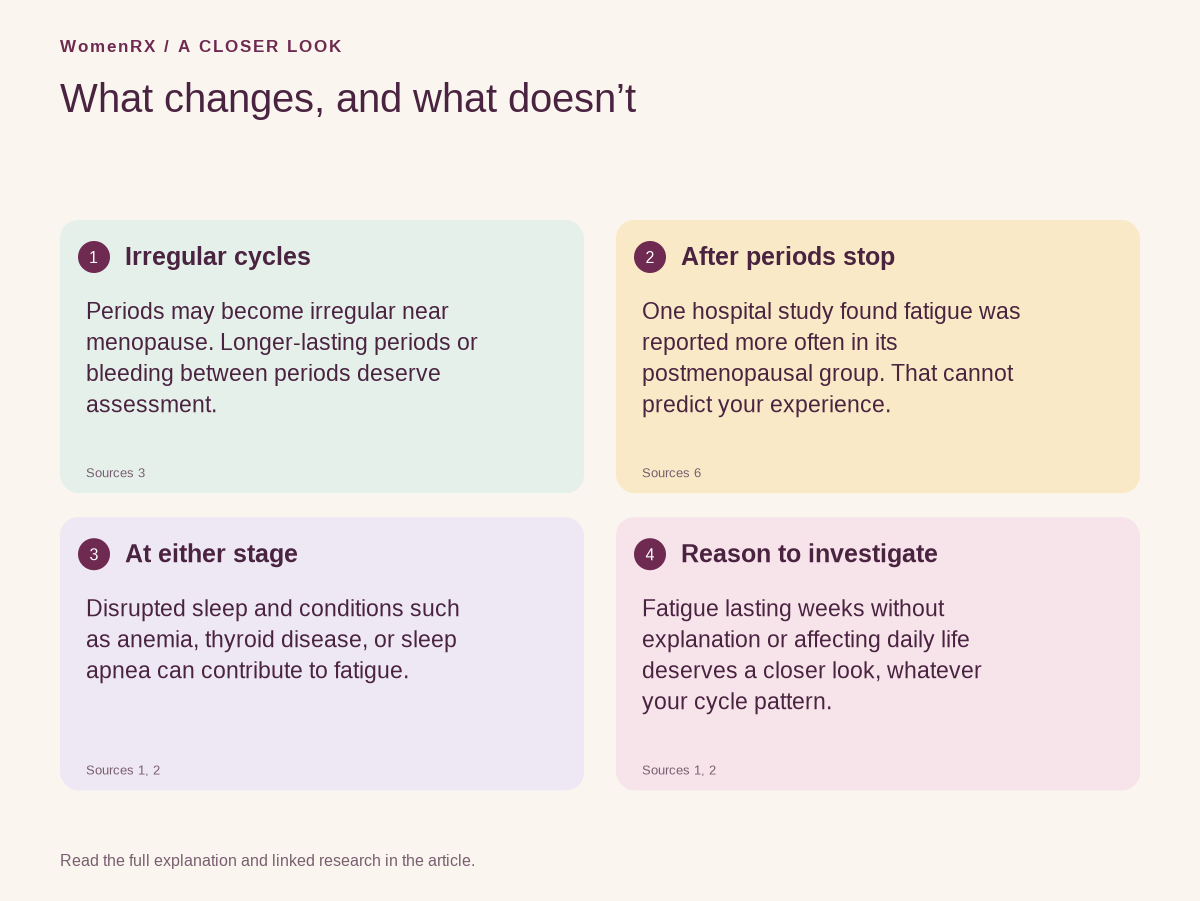
Irregular cycles: Periods may become irregular near menopause. Longer-lasting periods or bleeding between periods deserve assessment.3
After periods stop: One hospital study found fatigue was reported more often in its postmenopausal group. That cannot predict your experience.6
At either stage: Disrupted sleep and conditions such as anemia, thyroid disease, or sleep apnea can contribute to fatigue.12
Reason to investigate: Fatigue lasting weeks without explanation or affecting daily life deserves a closer look, whatever your cycle pattern.12
Read the figure as text
Menstrual context differs across stages; the need to consider other reasons for fatigue does not.- Irregular cycles: Periods may become irregular near menopause. Longer-lasting periods or bleeding between periods deserve assessment.3
- After periods stop: One hospital study found fatigue was reported more often in its postmenopausal group. That cannot predict your experience.6
- At either stage: Disrupted sleep and conditions such as anemia, thyroid disease, or sleep apnea can contribute to fatigue.12
- Reason to investigate: Fatigue lasting weeks without explanation or affecting daily life deserves a closer look, whatever your cycle pattern.12
More questions, answered
Can fatigue tell me I’ve moved from perimenopause to postmenopause?
No. Menstrual changes help describe the transition, while fatigue has many possible causes. Even though one hospital study found fatigue was reported more often in its postmenopausal group, that doesn’t make tiredness a marker of stage for an individual woman. 3 6 2
Sources you can check
- Tiredness and fatigue - NHSAccessed 2026-09-25Return to first citation
- Fatigue: MedlinePlusAccessed 2026-09-25Return to first citation
- Irregular periods - NHSAccessed 2026-09-25Return to first citation
- The 2022 hormone therapy position statement of The North American Menopause Society.“The 2022 Hormone Therapy Position Statement of The North American Menopause Society” Advisory Panel. · Menopause (New York, N.Y.) · 2022Return to first citation
- The 2023 nonhormone therapy position statement of The North American Menopause Society.Menopause (New York, N.Y.) · 2023Return to first citation
- Prevalence of climacteric symptoms comparing perimenopausal and postmenopausal Chinese women.Ruan X, Cui Y, Du J, Jin F, Mueck AO. · Journal of psychosomatic obstetrics and gynaecology · 2017Return to first citation