Bloating in Perimenopause and Postmenopause
Changing periods can give bloating a cycle-related context; after menopause, a new or persistent pattern deserves attention, but neither pattern identifies the cause.
Perimenopause is the time when periods become irregular; postmenopause follows 12 months without a period if you’re not using hormonal contraception. Bloating before bleeding may suggest a cycle-linked pattern, but it cannot identify the cause or your menopause stage. After menopause, there’s no menstrual timing to compare. Hysterectomy or hormonal treatment can make the stage harder to determine from bleeding alone. 5 6 7 2
Start with the menstrual context
Perimenopause is the transition when periods become irregular. Menopause is identified after 12 months without a period when you’re not using hormonal contraception; the time afterward is postmenopause. Periods may come more or less often, and bleeding may become heavier or lighter before it stops. If you’ve had a hysterectomy, you cannot use the date of a final period in the usual way. Hormonal contraception or other hormonal treatment can also change bleeding, making menstrual history less useful for identifying your stage. Bloating does not establish it. 5 6 7
When periods are changing but you can still track bleeding, notice whether bloating tends to show up before it or at other times. Irregular bleeding can make a recurring pattern harder to recognize. After menopause, you cannot compare bloating with bleeding; a new or persistent pattern should not be explained away by menstrual timing. If bleeding cannot be tracked for another reason, that comparison is unavailable too. Bloating cannot establish its own cause. 2 4 1
A survey of 100 perimenopausal women aged 43 to 53 at one university hospital found abdominal bloating among their most prominent premenstrual symptoms. The survey was small and relied on questionnaires rather than prospective symptom tracking. It supports bloating as a reported premenstrual symptom in this group, but cannot show how often it occurs among all women in perimenopause or establish that a particular episode of bloating is cycle-related. 2
A review discussed gastrointestinal symptoms, including bloating, around menstruation and during perimenopause in women with and without irritable bowel syndrome (IBS). The authors proposed that changing ovarian hormone levels might contribute, but said more clinical research was needed. That’s a possible explanation, not proof that hormones cause an individual woman’s bloating. 3
What the postmenopause finding does, and doesn’t, say
One longitudinal study followed 291 women and examined bloating severity across reproductive-aging stages. Early and late menopause-transition stages were associated with increased severity in its multivariable analysis. Early postmenopause was associated with decreased severity only in a simpler, univariate analysis that did not include the other factors in the multivariable analysis; the lower-severity finding was not reported in the multivariable results. These group-level associations do not establish cause or predict an individual’s symptoms. In particular, the early-postmenopause result is not a dependable rule that bloating decreases after menopause and cannot explain new or persistent bloating later in postmenopause. 4
When to look beyond the calendar
A brief note of when bloating starts, how long it lasts, whether it eases, and whether it tends to track with bleeding can help distinguish a possible recurring pattern from bloating that continues regardless of menstrual timing. Neither pattern identifies a cause. If bloating is new after your periods have ended, do not assume menopause explains it. Seek medical advice if you’re often bloated or it doesn’t go away, whether your periods are changing or have ended. Bloating with unintentional weight loss or blood in your stool also warrants medical advice; if you are bloated and have a swollen stomach with severe stomach pain that came on very suddenly, get immediate emergency help. 1
Bloating and Menstrual Context
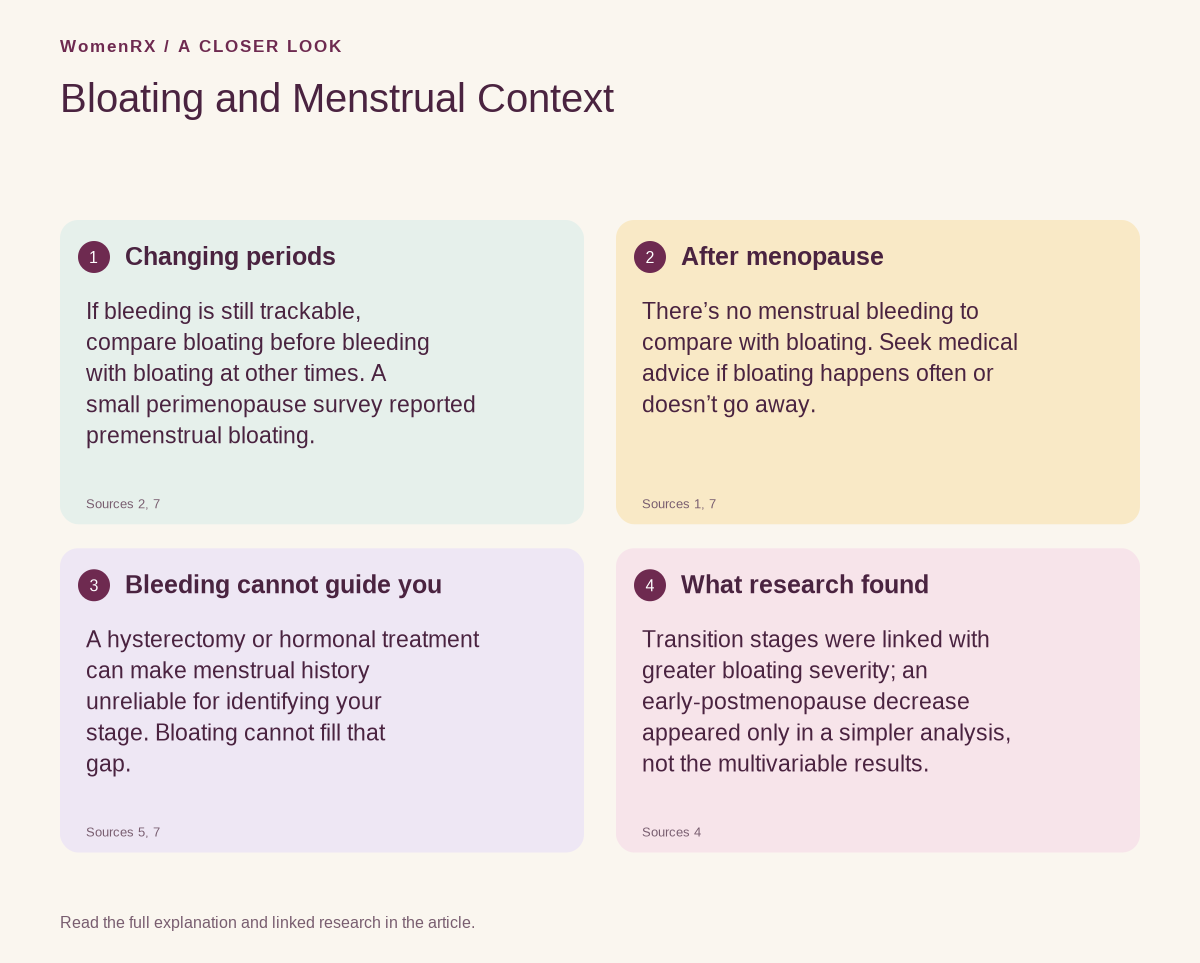
Changing periods: If bleeding is still trackable, compare bloating before bleeding with bloating at other times. A small perimenopause survey reported premenstrual bloating.27
After menopause: There’s no menstrual bleeding to compare with bloating. Seek medical advice if bloating happens often or doesn’t go away.17
Bleeding cannot guide you: A hysterectomy or hormonal treatment can make menstrual history unreliable for identifying your stage. Bloating cannot fill that gap.57
What research found: Transition stages were linked with greater bloating severity; an early-postmenopause decrease appeared only in a simpler analysis, not the multivariable results.4
Read the figure as text
What you can compare changes across the transition, but bloating patterns cannot determine menopause stage or cause.- Changing periods: If bleeding is still trackable, compare bloating before bleeding with bloating at other times. A small perimenopause survey reported premenstrual bloating.27
- After menopause: There’s no menstrual bleeding to compare with bloating. Seek medical advice if bloating happens often or doesn’t go away.17
- Bleeding cannot guide you: A hysterectomy or hormonal treatment can make menstrual history unreliable for identifying your stage. Bloating cannot fill that gap.57
- What research found: Transition stages were linked with greater bloating severity; an early-postmenopause decrease appeared only in a simpler analysis, not the multivariable results.4
Sources you can check
- Bloating - NHSAccessed 2026-09-25Return to first citation
- Premenstrual syndrome and premenstrual dysphoric disorder in perimenopausal women.Chung SH, Kim TH, Lee HH, Lee A, Jeon DS, Park J, Kim Y. · Journal of menopausal medicine · 2014Return to first citation
- Do fluctuations in ovarian hormones affect gastrointestinal symptoms in women with irritable bowel syndrome?Heitkemper MM, Chang L. · Gender medicine · 2009Return to first citation
- Bloating During the Menopause Transition: Observations from the Seattle Midlife Women's Health Study.Kamp KJ, Callan NGL, Mitchell ES, Heitkemper MM, Woods NF. · Journal of women's health (2002) · 2026Return to first citation
- Recommendations | Menopause: identification and management | Guidance | NICEAccessed 2026-09-25Return to first citation
- What are menopause and perimenopause? - NHSAccessed 2026-09-25Return to first citation
- Symptoms of menopause and perimenopause - NHSAccessed 2026-09-25Return to first citation