Does Insomnia Change Between Perimenopause and Postmenopause?
Sleep trouble can happen before and after your final period, but the way you sleep can’t tell you which stage you’re in.
Insomnia can happen in both perimenopause, when periods are changing but haven’t ended, and postmenopause, after the final period. A meta-analysis found insomnia symptoms more commonly reported in postmenopausal groups, but trouble falling asleep or staying asleep doesn’t identify your stage. What wakes you, how you feel during the day, and your menstrual history are more useful starting points. 2 3 5
Periods tell you more about stage than sleep does
If your sleep trouble started while your periods were changing, it may have begun in perimenopause. Postmenopause refers to the time after the final menstrual period. That menstrual context matters: waking repeatedly at night doesn’t tell you whether you’re still in the transition or past it. Difficulty falling asleep, waking during the night, and waking too early are reported around the menopause transition and afterward. 3 5
There is a group-level difference, though it won’t predict your next night’s sleep. A systematic review and meta-analysis reported a pooled point prevalence of insomnia symptoms of 27% among perimenopausal women and 42% among postmenopausal women. Those estimates combine studies that measured symptoms in different ways; a review of sleep disruption also notes that prevalence depends on the definition and method of measurement. They don’t mean that an individual woman’s insomnia must worsen after her periods stop. 2 7
Sleep can also change within perimenopause. In a 10-year analysis of self-reported symptoms from 3,302 multiethnic midlife women who were premenopausal or perimenopausal at the start, the odds of reporting any insomnia symptom were 1.3 times higher in late than early perimenopause. That is a comparison between groups, not a timetable for your own sleep. 4
What might be keeping you awake?
A nighttime hot flash is one recognizable possibility. Hot flashes can interrupt sleep, and women with more frequent or severe hot flashes are more likely to report insomnia. Hormonal changes may also affect sleep during perimenopause. But not every awakening is caused by a hot flash, even when hot flashes are part of your day. 3
Other contributors can persist or appear after periods stop. Mood symptoms, pain, medicines, caffeine or alcohol, and other sleep disorders can all matter. Reviews of sleep around menopause include sleep-related breathing disorders and movement disorders alongside insomnia. That’s why a sleep problem that began during perimenopause deserves a fresh look if its pattern changes or it continues into postmenopause. 1 3 7
For example, waking hot and then struggling to fall back asleep points to a different question than lying awake for hours before sleep begins. Either can be insomnia. The distinction helps identify what might need attention; it doesn’t establish a menopause stage. 1 3
What an evaluation can look at
For persistent sleep trouble, a sleep history can cover whether the difficulty is falling asleep, staying asleep, or both, and how it affects you the next day. A health history and examination can help look for other contributors; a sleep study may be considered when another sleep problem is suspected. Your menstrual history and symptoms such as nighttime hot flashes add context to that assessment rather than replacing it. 1 3
The next step depends on what’s disrupting sleep. Cognitive behavioral therapy for insomnia, or CBT-I, is an option for ongoing insomnia. In a trial described in a menopause sleep review, telephone-delivered CBT-I improved sleep among women with at least moderate insomnia symptoms and frequent hot flashes; the participants included women in perimenopause and postmenopause. The study doesn’t establish that one stage responds better than the other. 1 3
If hot flashes are a major part of the problem, addressing them is a separate treatment discussion. Menopause guidance identifies hormone therapy as the most effective treatment for bothersome hot flashes and lists evidence-supported nonhormonal options. Treating hot flashes and treating persistent insomnia aren’t necessarily the same task, even when both are happening at night. 5 6
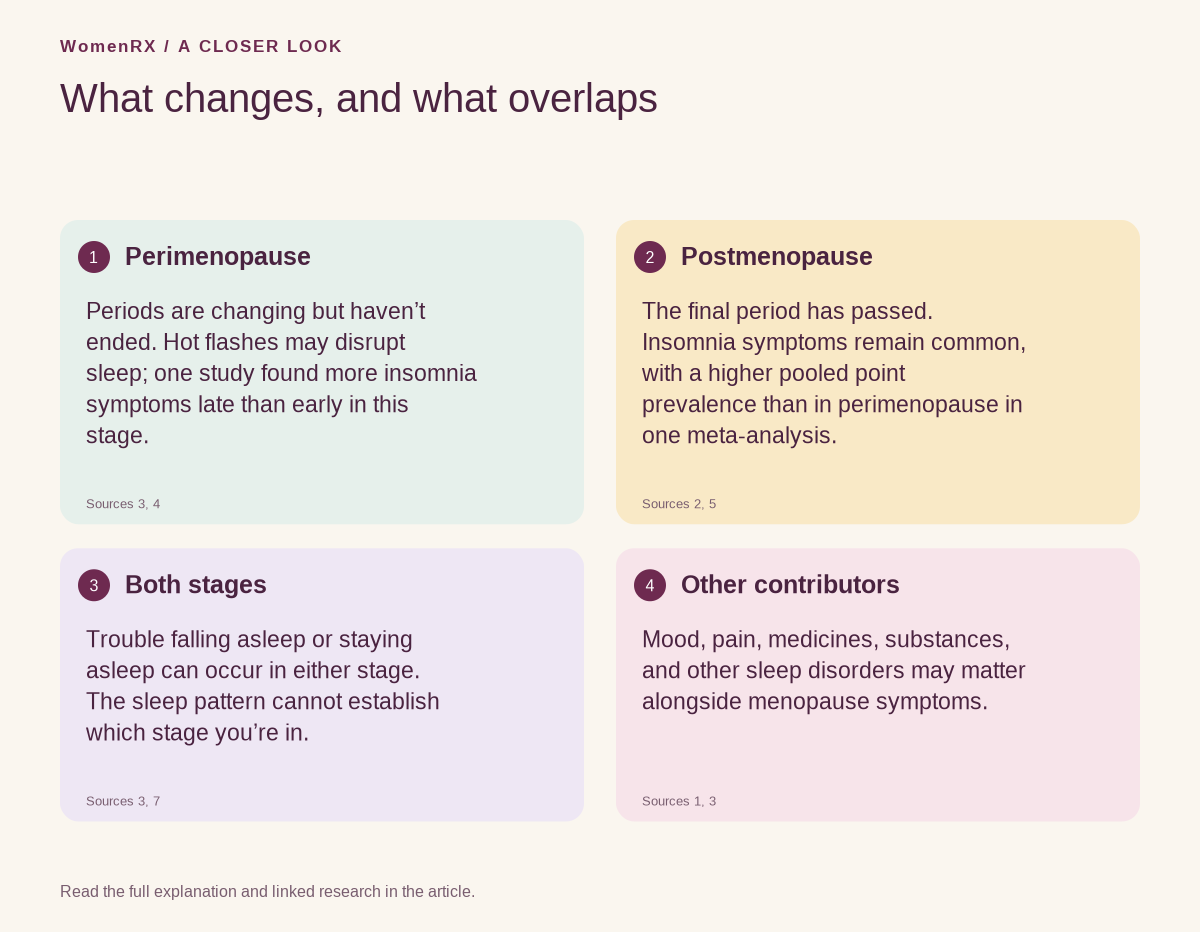
What changes, and what overlaps
Perimenopause: Periods are changing but haven’t ended. Hot flashes may disrupt sleep; one study found more insomnia symptoms late than early in this stage.34
Postmenopause: The final period has passed. Insomnia symptoms remain common, with a higher pooled point prevalence than in perimenopause in one meta-analysis.25
Both stages: Trouble falling asleep or staying asleep can occur in either stage. The sleep pattern cannot establish which stage you’re in.37
Other contributors: Mood, pain, medicines, substances, and other sleep disorders may matter alongside menopause symptoms.13
Read the figure as text
Menstrual history helps place the stage. Sleep symptoms help frame what may be disrupting your nights.- Perimenopause: Periods are changing but haven’t ended. Hot flashes may disrupt sleep; one study found more insomnia symptoms late than early in this stage.34
- Postmenopause: The final period has passed. Insomnia symptoms remain common, with a higher pooled point prevalence than in perimenopause in one meta-analysis.25
- Both stages: Trouble falling asleep or staying asleep can occur in either stage. The sleep pattern cannot establish which stage you’re in.37
- Other contributors: Mood, pain, medicines, substances, and other sleep disorders may matter alongside menopause symptoms.13
More questions, answered
If my sleep improves after my periods stop, was menopause the cause?
Not necessarily. Sleep symptoms can change over the transition, but hot flashes, mood, health conditions, and other sleep problems can also affect your nights. Improvement alone can’t establish what caused the earlier trouble. 3 7
Sources you can check
- Insomnia | MedlinePlusAccessed 2026-09-25Return to first citation
- Prevalence and incidence of depressive, anxiety, and insomnia symptoms in perimenopausal and postmenopausal women: Systematic review and meta-analysis.Balasubramanian I, Abhijita B, Krishnamoorthy Y, Gnanadhas J, Beg MJ, Menon V. · General hospital psychiatry · 2026Return to first citation
- Sleep Disturbance and Perimenopause: A Narrative Review.Troìa L, Garassino M, Volpicelli AI, Fornara A, Libretti A, Surico D, Remorgida V. · Journal of clinical medicine · 2025Return to first citation
- Longitudinal Study of Insomnia Symptoms Among Women During Perimenopause.Ciano C, King TS, Wright RR, Perlis M, Sawyer AM. · Journal of obstetric, gynecologic, and neonatal nursing : JOGNN · 2017Return to first citation
- The 2022 hormone therapy position statement of The North American Menopause Society.“The 2022 Hormone Therapy Position Statement of The North American Menopause Society” Advisory Panel. · Menopause (New York, N.Y.) · 2022Return to first citation
- The 2023 nonhormone therapy position statement of The North American Menopause Society.Menopause (New York, N.Y.) · 2023Return to first citation
- Sleep Disruption in the Menopausal Transition and Postmenopause: A Narrative Review.Lyu AC, Kravitz HM. · Obstetrics and gynecology · 2026Return to first citation