Perimenopause to Postmenopause: What the Timeline Means
The final period becomes clear only in hindsight, and symptoms don’t follow a set schedule around it.
Perimenopause is the changing stretch around your final period. Menopause is identified retrospectively, after 12 consecutive months without a period, and postmenopause describes the time after the final period. These terms give you landmarks, not a symptom schedule. If periods aren’t available as a marker, such as after removal of the uterus, the usual bleeding-based timeline can’t date the transition on its own. 234
The final period is a landmark you recognize later
If your periods have started changing, it’s reasonable to wonder whether you’re in perimenopause or already past menopause. The distinction rests mainly on menstrual history, not on how many symptoms you have.
Perimenopause is the transition around the final menstrual period. A menopause society describes it as beginning with the first menstrual-cycle changes and extending through the year after periods definitively stop. Menopause refers to the final period, identified only once 12 consecutive months have passed without another one. Postmenopause describes the stage after the final period. Because the final period can be recognized only in hindsight, descriptions of early postmenopause and the end of perimenopause can overlap. 23
For example, if your cycles have become irregular but you’re still having periods, the 12-month marker hasn’t been reached. If you’ve gone a full year without a period, you can look back and identify which period was your last. Neither example tells you how long symptoms will last. 23
Symptoms don’t run on the same clock as periods
Hot flashes can begin while periods are changing. They don’t have to wait until after the final period. In a large cross-sectional study of Australian women ages 40 to 69, moderately to severely bothersome hot flashes were more common in late perimenopause than before the transition. Low mood and poor memory varied less across the stages studied. That comparison describes groups of women at one point in time, not a sequence any one person should expect. 34
This is why a hot flash may help explain what you’re experiencing without dating your last period. Likewise, not having hot flashes doesn’t give you a different menstrual timeline. Cycle changes are useful landmarks when you can observe them; symptoms add context, but they aren’t calendar dates. 34
What if you don’t have periods to count?
The usual timeline is harder to apply when bleeding isn’t an available marker. Cycle-based staging can be unhelpful for people who rarely menstruate or don’t menstruate. If your uterus has been removed, for example, you can’t use a year without periods to identify a final period, because there are no periods to observe. That doesn’t mean your symptoms aren’t real; it means the standard menstrual-history rule can’t place you precisely on this timeline. 24
Hot flashes may offer a clue when periods are absent, but they still aren’t a precise way to date menopause for an individual. A discussion of your symptoms and surgical history is more useful than trying to make the 12-month rule fit a situation it wasn’t designed to describe. 4
One bleeding change not to file under “irregular periods”
If you’ve reached menopause based on your menstrual history and then notice vaginal bleeding, even a single episode of spotting or pink or brown discharge, arrange to have it checked. There are several possible causes, many of them not cancer, but bleeding after menopause can sometimes signal a serious problem. 1
The useful distinction is this: irregular periods can be part of perimenopause, while bleeding after menopause deserves a separate look. The timeline helps you tell those situations apart without expecting every woman’s symptoms to follow the same path. 13
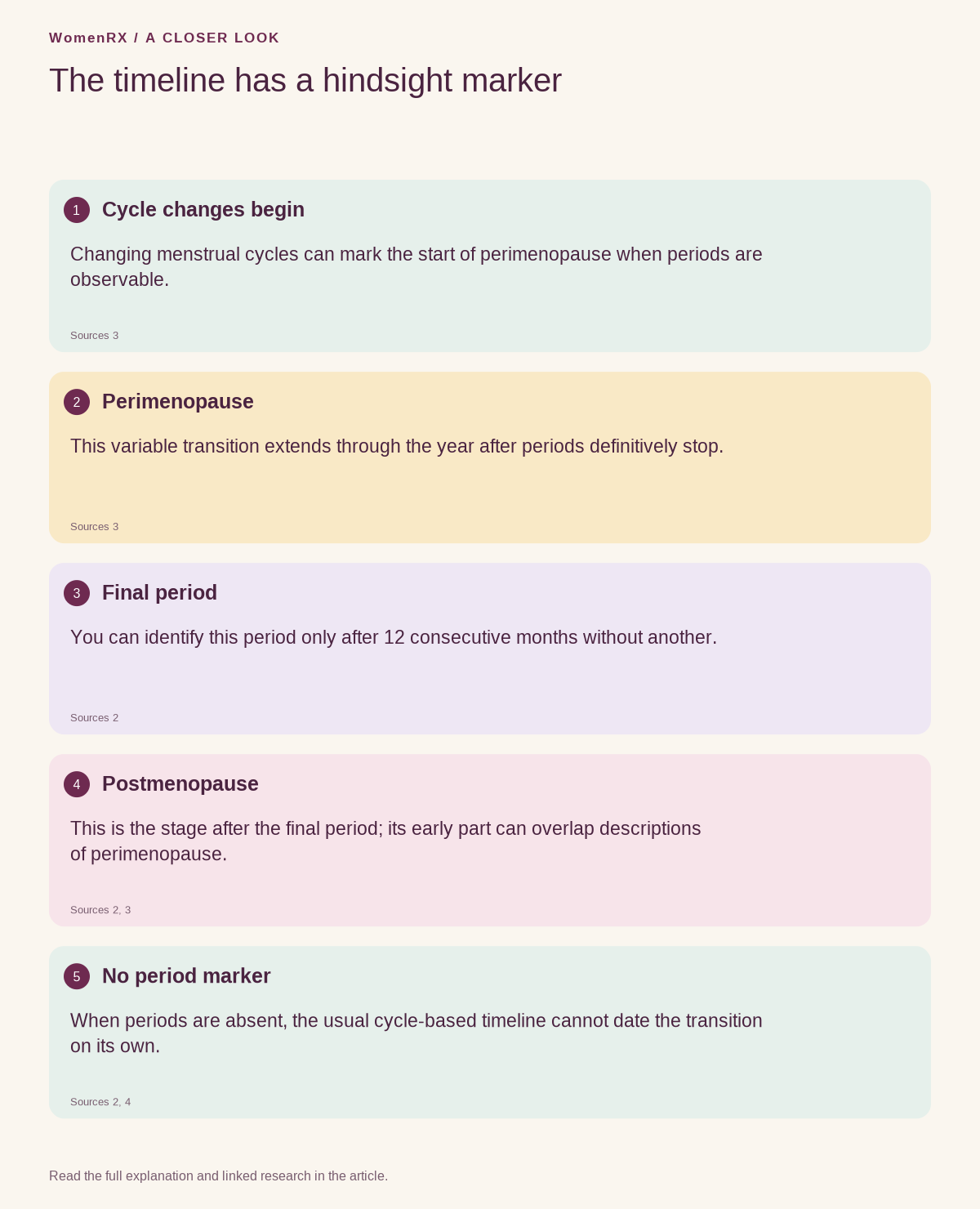
The timeline has a hindsight marker
Cycle changes begin: Changing menstrual cycles can mark the start of perimenopause when periods are observable.3
Perimenopause: This variable transition extends through the year after periods definitively stop.3
Final period: You can identify this period only after 12 consecutive months without another.2
Postmenopause: This is the stage after the final period; its early part can overlap descriptions of perimenopause.23
No period marker: When periods are absent, the usual cycle-based timeline cannot date the transition on its own.24
Read the figure as text
Period changes can help place the transition, but the final period is identified only later. The side note shows where that approach has a limit.- Cycle changes begin: Changing menstrual cycles can mark the start of perimenopause when periods are observable.3
- Perimenopause: This variable transition extends through the year after periods definitively stop.3
- Final period: You can identify this period only after 12 consecutive months without another.2
- Postmenopause: This is the stage after the final period; its early part can overlap descriptions of perimenopause.23
- No period marker: When periods are absent, the usual cycle-based timeline cannot date the transition on its own.24
Sources you can check
- Postmenopausal bleeding - NHSAccessed 2026-09-25Return to first citation
- Associations between reproductive health factors and sociodemographic characteristics and the severity of moderate to severe postmenopausal depression: a secondary analysis of randomized controlled trial data.Wang X, Zhang Q, Wang G, Zhou J. · Menopause (New York, N.Y.) · 2025Return to first citation
- Position of the Spanish Menopause Society regarding the management of perimenopause.Mendoza N, Sánchez-Borrego R, Cancelo MJ, Calvo A, Checa MA, Cortés J, Elorriaga MA, Díaz T, González JV, Lete I, Lobo P, Martínez-Astorquiza T, Nieto A, Olalla MA, Pérez-Campos E,... · Maturitas · 2013Return to first citation
- Prevalence and severity of symptoms across the menopause transition: cross-sectional findings from the Australian Women's Midlife Years (AMY) Study.Islam RM, Bond M, Ghalebeigi A, Wang Y, Walker-Bone K, Davis SR. · The lancet. Diabetes & endocrinology · 2025Return to first citation