Menopause and Perimenopause: What Changes and What Helps
Understand the stages, when a hormone test helps, which symptoms have treatment options and why bleeding after menopause needs a check.
Perimenopause is the transition toward the end of your periods. Menopause is confirmed after 12 consecutive months without a period when another cause does not explain the change. You can have symptoms while periods continue, and you can seek treatment before that year is up. Hormonal contraception and surgery can make the calendar harder to interpret. 126
You might arrive here because your periods have changed. Or because you wake up hot at 3 a.m., sex has become uncomfortable, or you feel unlike yourself. The name for the stage matters, but so does the part of your day you want back.
Three terms, one changing timeline
Perimenopause is the transition toward your final period. Hormone levels fluctuate, and your cycles may become less predictable. Menopause is confirmed after a full year without a period. Postmenopause describes the years afterward. The average age of menopause in the United States is 52, but an average cannot predict your date. 1
The calendar and the symptoms do not move in lockstep. Hot flashes, sleep difficulties, mood changes and vaginal dryness can begin while you still have periods. Symptoms may also continue after menopause. Having few symptoms is possible, too. 3
Here is a fictional calendar example: your last period was in March, then you have another period in September. You have not completed 12 consecutive months without a period. Keep the actual dates; six quiet months do not become a confirmed menopause date. 1
When the calendar cannot answer the question
Hormonal contraception and hysterectomy can make period tracking unhelpful. In those situations, identifying menopause depends on your symptoms and treatment or surgery history. 2
Missing periods can have other causes, including pregnancy. You can still become pregnant during perimenopause, so a contraception decision needs its own conversation. 14
Do you need a hormone blood test?
Hormone levels fluctuate during the transition. For otherwise healthy women aged 45 or older with typical symptoms, NICE recommends identifying menopause or perimenopause without routine laboratory testing. 2
NICE advises considering an FSH test at ages 40 to 45 when symptoms and cycle changes suggest menopause, or under 40 when it is suspected. Discuss possible menopause before age 45 without waiting a full year. 2
Start with the symptom that is costing you the most
A treatment discussion becomes more useful when you name the problem you want to solve. These are options to discuss, not a plan everyone needs to follow. 46
| What is bothering you? | Options to ask about | A useful detail to bring |
|---|---|---|
| Hot flashes or night sweats | Whether hormone therapy fits your health history, or whether a nonhormonal prescription is a better option. 4 | When episodes happen and what they interrupt. |
| Dryness or pain with sex | Vaginal moisturizers, lubricants and prescription vaginal treatment. They serve different purposes. 4 | Whether discomfort occurs throughout the day, with sex or both. |
| Trouble sleeping | Whether night sweats are waking you, or whether insomnia or another sleep problem needs attention. 4 | What wakes you and how you feel the next day. |
| Mood changes | Support matched to the symptoms; persistent depression or anxiety deserves its own assessment. 4 | What has changed in daily life, not just a symptom score. |
You do not have to wait until periods stop to discuss treatment. The choice of HRT also depends on factors such as whether you still have periods and whether you have had a hysterectomy. 6
Bleeding after menopause deserves a separate check
If bleeding starts after menopause, book a medical assessment even if it happens once or is only spotting. It often has a noncancerous cause, but it can be a sign of cancer and should not be dismissed as a final period. 5
While periods are still happening, a change toward heavier bleeding also deserves attention. An irregular cycle does not explain every new bleeding pattern. 3
Make one useful note, not a perfect diary
Try this fictional example: “My cycles used to be about a month apart. The last three started on May 4, June 11 and August 2. I woke sweating three nights this week. Sleep is the problem I most want help with.”
Add the medicines or hormones you use and any surgery that affects your periods. Bring whatever you already know; you do not need a polished spreadsheet. End with a practical question: “What can we try for this symptom, and when will we check whether it helped?”
The goal is not to collect every possible menopause symptom. It is to make the changes you are experiencing clear enough to choose a useful next step.
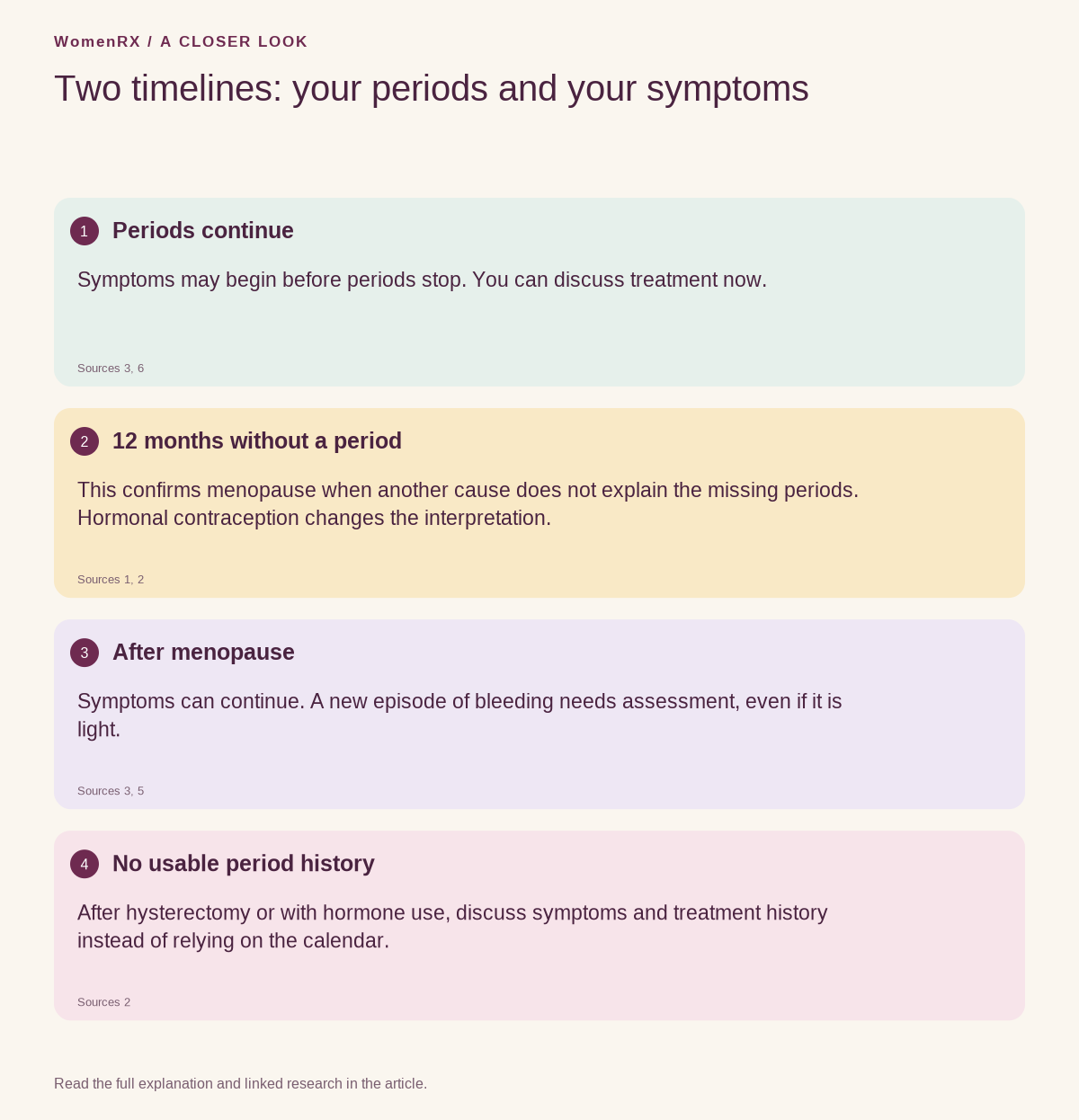
Two timelines: your periods and your symptoms
Periods continue: Symptoms may begin before periods stop. You can discuss treatment now.36
12 months without a period: This confirms menopause when another cause does not explain the missing periods. Hormonal contraception changes the interpretation.12
After menopause: Symptoms can continue. A new episode of bleeding needs assessment, even if it is light.35
No usable period history: After hysterectomy or with hormone use, discuss symptoms and treatment history instead of relying on the calendar.2
Read the figure as text
A calendar helps identify the stage. Symptoms determine what you want help with.- Periods continue: Symptoms may begin before periods stop. You can discuss treatment now.36
- 12 months without a period: This confirms menopause when another cause does not explain the missing periods. Hormonal contraception changes the interpretation.12
- After menopause: Symptoms can continue. A new episode of bleeding needs assessment, even if it is light.35
- No usable period history: After hysterectomy or with hormone use, discuss symptoms and treatment history instead of relying on the calendar.2
More questions, answered
Can perimenopause symptoms start while I still have periods?
Symptoms can begin before periods stop. Describe the symptoms and your cycle pattern together instead of waiting for a missed period to ask for help. 3
Does a normal hormone test rule out perimenopause?
Not by itself. Hormone levels change unpredictably during the transition, which limits what one measurement can tell you. Your age, symptoms, periods and medicines help put the result in context. 1
Do I have to wait 12 months before getting treatment?
No. Treatment can be discussed during perimenopause. The year without periods helps identify the stage; it is not a requirement for seeking symptom relief. 6
Should I restart the calendar if I bleed after menopause?
Get the bleeding assessed instead of treating it as a new period. Even one small episode needs a check. 5
Sources you can check
- Menopause basics, Office on Women's HealthAccessed 2026-09-29Return to first citation
- Menopause: identification and management, NICE NG23, recommendations 1.3 and 1.7Accessed 2026-09-29Return to first citation
- Symptoms of menopause and perimenopause, NHSAccessed 2026-09-29Return to first citation
- Menopause symptoms and relief, Office on Women's HealthAccessed 2026-09-29Return to first citation
- Postmenopausal bleeding, NHSAccessed 2026-09-29Return to first citation
- Treatment for menopause and perimenopause, NHSAccessed 2026-09-29Return to first citation