Menopause and Sleep: Find the Likely Cause
Night sweats can wake you, but sleep problems in midlife can have several overlapping causes.
During perimenopause and after menopause, sleep may be disrupted by night sweats, but menopause isn’t the only possible explanation. Pain, urinary symptoms, mood changes, stress, substances, medicines, and sleep-disordered breathing can also contribute. Notice what happens when you wake and what comes with it; that pattern can help point toward a useful next step, such as addressing hot flashes or evaluating ongoing insomnia. 1 7 8
Start with what happens at night
Trouble falling asleep, waking repeatedly, and waking too early are all insomnia symptoms, but they don’t point to one cause by themselves. Sleep disruption is common during the menopause transition and after menopause. Night sweats and hot flashes can interrupt sleep, yet insomnia can occur with or without those symptoms. Menopause may be part of the picture without explaining all of it. 1 5 6
For a few nights, note when you wake, whether you felt hot or sweaty, and what else was going on: pain, needing to urinate, anxious thoughts, or a change in a medicine or substance. This isn’t a diagnostic test. It’s a way to see whether a pattern stands out and describe it clearly.
Match the pattern to a question
You wake hot or sweaty. A hot flash or night sweat may be interrupting sleep. If this happens often, the next question is whether treating bothersome hot flashes could help. Menopausal hormone therapy is the most effective treatment for vasomotor symptoms, but its effect on sleep is not consistent. A discussion about treating hot flashes is not a guarantee that insomnia will resolve. 3 7
You wake without feeling hot. Consider other common contributors. Midlife sleep problems may occur alongside anxiety, depression, relationship stress, or substance use. Pain and lower urinary tract symptoms can also interfere with sleep, and sleep-disordered breathing is another possibility. A sleep problem without night sweats is still worth taking seriously. 7 8
You can’t fall asleep, or your mind stays alert. Stress can trigger short-term insomnia, and some medicines, caffeine, tobacco, or alcohol can contribute to ongoing sleep difficulty. If something changed around the time your sleep changed, mention it; don’t stop a prescribed medicine on your own. 1
You feel very sleepy or unrefreshed during the day. Poor-quality sleep can leave you tired, irritable, or unable to concentrate. If you’re sleepy behind the wheel, don’t drive while drowsy. 1
These patterns can overlap. For example, night sweats may wake you, then worry about falling back asleep may keep you awake. More than one contributor may need attention. 5 7
Choose a next step that fits
If hot flashes or night sweats are a clear part of the pattern, discuss options for those symptoms. Hormone therapy is an effective option for vasomotor symptoms for some women, but whether it’s suitable depends on individual risks and circumstances. Its sleep benefits are not assured. For women who prefer or need nonhormonal treatment for vasomotor symptoms, evidence-based options exist, though they address hot flashes rather than every cause of insomnia. 3 4 7
If difficulty sleeping continues even when you aren’t having hot flashes, ask about insomnia itself and possible contributors such as pain, urinary symptoms, mood changes, medicines, or sleep-disordered breathing. Cognitive behavioral therapy for insomnia (CBT-I) is a particularly well-supported non-drug approach: a 2026 review of trials in peri- and postmenopausal women found nonpharmacological treatments improved sleep quality and insomnia severity, while total sleep time did not change. The review identified CBT-I among the more robust approaches. 6
Sleep problems lasting months, or problems that make daily life hard to manage, are a good reason to seek help rather than assuming you have to put up with them. A clinician can ask about your sleep and health history, review possible causes, and decide whether further evaluation is needed. 1 2
The useful distinction
The key question isn’t simply “Is this menopause?” It’s “What seems to be waking me, and what keeps me awake afterward?” That distinction can help guide the next conversation: treating bothersome hot flashes, addressing another symptom or contributor, or getting support for persistent insomnia. Menopause can be part of the explanation, but sleep trouble deserves its own attention too. 6 7
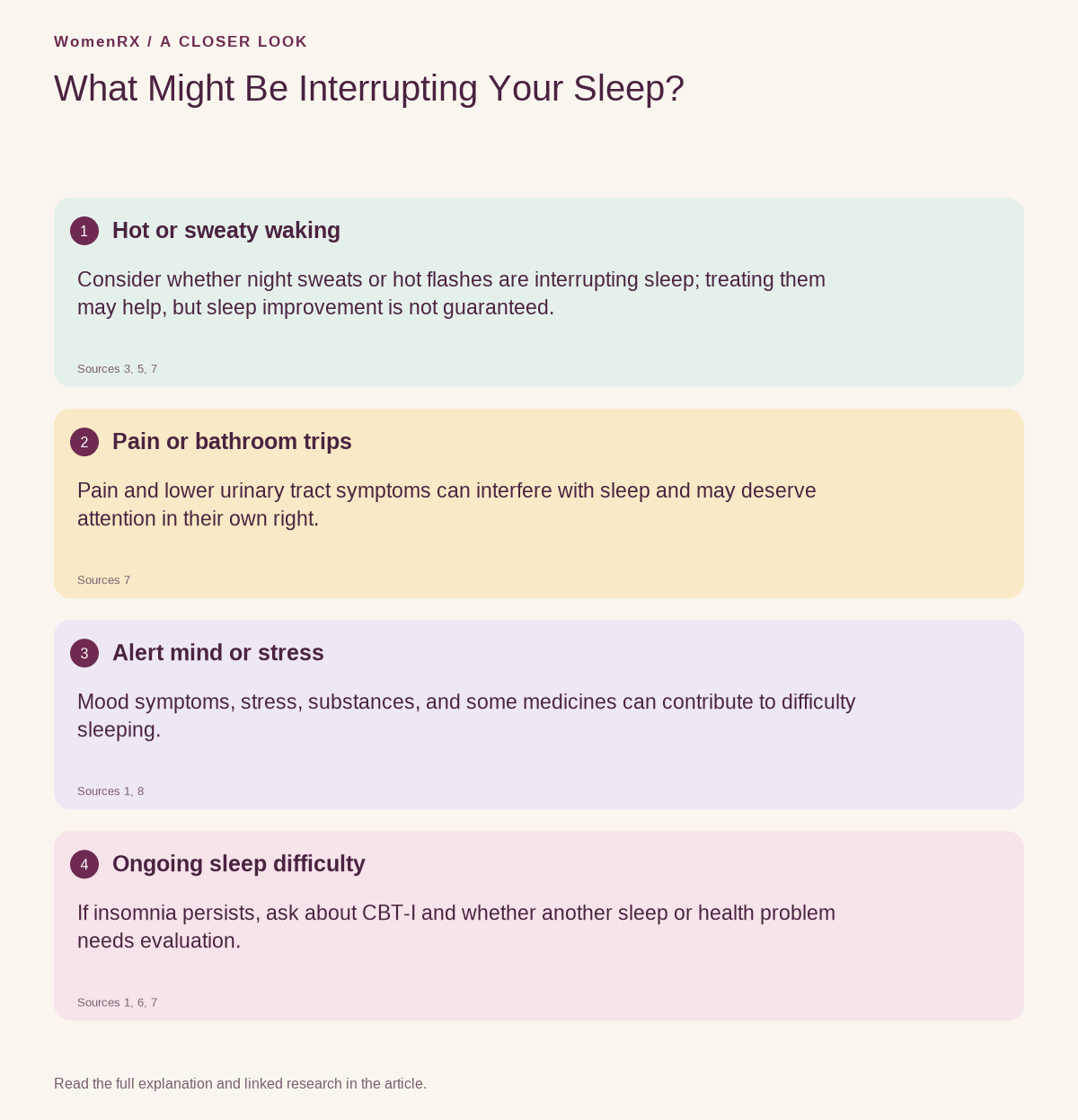
What Might Be Interrupting Your Sleep?
Hot or sweaty waking: Consider whether night sweats or hot flashes are interrupting sleep; treating them may help, but sleep improvement is not guaranteed.357
Pain or bathroom trips: Pain and lower urinary tract symptoms can interfere with sleep and may deserve attention in their own right.7
Alert mind or stress: Mood symptoms, stress, substances, and some medicines can contribute to difficulty sleeping.18
Ongoing sleep difficulty: If insomnia persists, ask about CBT-I and whether another sleep or health problem needs evaluation.167
Read the figure as text
Use the pattern around a waking as a clue for what to consider next, not as a diagnosis.- Hot or sweaty waking: Consider whether night sweats or hot flashes are interrupting sleep; treating them may help, but sleep improvement is not guaranteed.357
- Pain or bathroom trips: Pain and lower urinary tract symptoms can interfere with sleep and may deserve attention in their own right.7
- Alert mind or stress: Mood symptoms, stress, substances, and some medicines can contribute to difficulty sleeping.18
- Ongoing sleep difficulty: If insomnia persists, ask about CBT-I and whether another sleep or health problem needs evaluation.167
More questions, answered
Can insomnia happen without night sweats?
Yes. Chronic insomnia has been reported in peri- and postmenopausal women with or without vasomotor symptoms. Mood, stress, pain, urinary symptoms, substances, medicines, and sleep-disordered breathing can also be relevant. 6 7 8
Will treating hot flashes necessarily fix my sleep?
No. Hormone therapy is the most effective treatment for vasomotor symptoms, but reviews describe its sleep benefits as inconsistent. If sleep difficulty continues, it may need attention as insomnia or have another contributor. 3 7
Sources you can check
- Insomnia | MedlinePlusAccessed 2026-09-25Return to first citation
- Insomnia - NHSAccessed 2026-09-25Return to first citation
- The 2022 hormone therapy position statement of The North American Menopause Society.“The 2022 Hormone Therapy Position Statement of The North American Menopause Society” Advisory Panel. · Menopause (New York, N.Y.) · 2022Return to first citation
- The 2023 nonhormone therapy position statement of The North American Menopause Society.Menopause (New York, N.Y.) · 2023Return to first citation
- Dietary interventions to support and improve sleep disturbances and insomnia disorder in menopause: From bench to bedside.Musgrave RH, Nowakowski S, Watermeyer TJ, Arentson-Lantz EJ, Elder GJ. · Post reproductive health · 2025Return to first citation
- Pharmacological and non-pharmacological treatments for chronic insomnia in perimenopausal and postmenopausal women: a systematic review and meta-analysis.Bruyneel M, Rozenberg S, Sanida C, Demaeyer N, Castermans E, Bruyneel AV. · Sleep medicine · 2026Return to first citation
- Sleep Disturbances during Menopause: Mechanisms and Management Approaches.Terauchi M. · Journal of menopausal medicine · 2026Return to first citation
- Sleep disturbances in midlife women: prevalence, correlates, and treatments.Jakubowski K. · Menopause (New York, N.Y.) · 2026Return to first citation