Can Menopause Hormone Therapy Help You Sleep?
It may help when night sweats are waking you, but persistent insomnia can have other causes.
Menopausal hormone therapy is the most effective treatment for bothersome hot flashes and night sweats, so it may help sleep when those symptoms are waking you. But sleep disruption can happen without them or continue after they improve. Hormone therapy isn’t established as a general insomnia treatment; ongoing trouble falling or staying asleep may need its own assessment and treatment, such as CBT-I. 3 5 7
Start with what’s waking you
If you’re in perimenopause or after menopause, night sweats may be part of why you’re waking. Menopausal hormone therapy is the most effective treatment for bothersome vasomotor symptoms, including hot flashes and night sweats. When those symptoms repeatedly interrupt sleep, treating them may help with that part of the problem. 3 5
But waking in a sweat isn’t the only way sleep trouble can show up. You might have difficulty falling asleep, wake often without feeling overheated, or wake too early and feel unrefreshed. Insomnia can occur without vasomotor symptoms, and even severe hot flashes don’t always disrupt sleep. Relieving night sweats may reduce sleep disruption without resolving all of it. 1 5
That distinction matters in both perimenopause and postmenopause. A study protocol focused on women in late perimenopause describes a planned comparison of hormone therapy, cognitive behavioral therapy for insomnia (CBT-I), and sleep hygiene, not completed results. A separate clinic cohort included women aged 40 to 65 in the menopausal transition and after menopause. These findings don’t establish hormone therapy as a general treatment for insomnia. 5 6
What the sleep studies can tell you
A clinic-based cohort study followed 285 women who received either tibolone or combined hormone therapy. After 12 months, sleep-quality scores had improved in both groups. Because the study compared two treated groups rather than including an untreated comparison group, it can’t show how much of the improvement was caused by treatment or what to expect when insomnia is the main concern. 6
There’s also a small study of the progesterone component used in some hormone therapy. Thirty-six women already taking hormone therapy switched from synthetic progestins to micronized progesterone while their estrogen treatment stayed the same. Some measures of falling asleep and waking during the night improved at three months, but the overall insomnia score did not. Twenty-two women completed one-year follow-up, when significant changes weren’t observed. This preliminary finding doesn’t establish progesterone as a reliable insomnia treatment. 4
The clearest reason to consider hormone therapy in this context is bothersome hot flashes or night sweats, not insomnia by itself. Whether hormone therapy is appropriate depends on individual benefits and risks, which vary with factors such as treatment type and timing. 3
When sleep needs a closer look
If sleep remains difficult even on nights without sweating, consider other contributors. Insomnia can be related to medical conditions, medicines, other sleep disorders, stress, or substances such as caffeine, tobacco, and alcohol. Sometimes insomnia is the main problem rather than a symptom of something else. 1
An assessment can start with a conversation about when you wake, what seems to interrupt sleep, and how you feel during the day. A physical exam may help check for other medical causes, and a sleep study may be recommended in some cases. If symptoms suggest another sleep disorder, such as sleep apnea, further assessment may be appropriate. 1 2
If insomnia continues, ask about care directed at insomnia rather than assuming a change in menopause treatment will solve it. CBT-I is a structured treatment for insomnia. A meta-analysis of randomized trials in women after natural menopause found improved sleep-quality or insomnia scores with CBT and several other non-drug approaches. That supports considering insomnia-focused care; the findings don’t mean every approach is suitable for every person. 7
A useful distinction is whether hot flashes or night sweats are the main thing waking you, or whether you’re struggling to sleep even when they aren’t happening. If night sweats seem central, discuss whether treating vasomotor symptoms makes sense for you. If sleep trouble happens without them, or continues after they improve, consider insomnia and other possible causes separately. 3 5 1
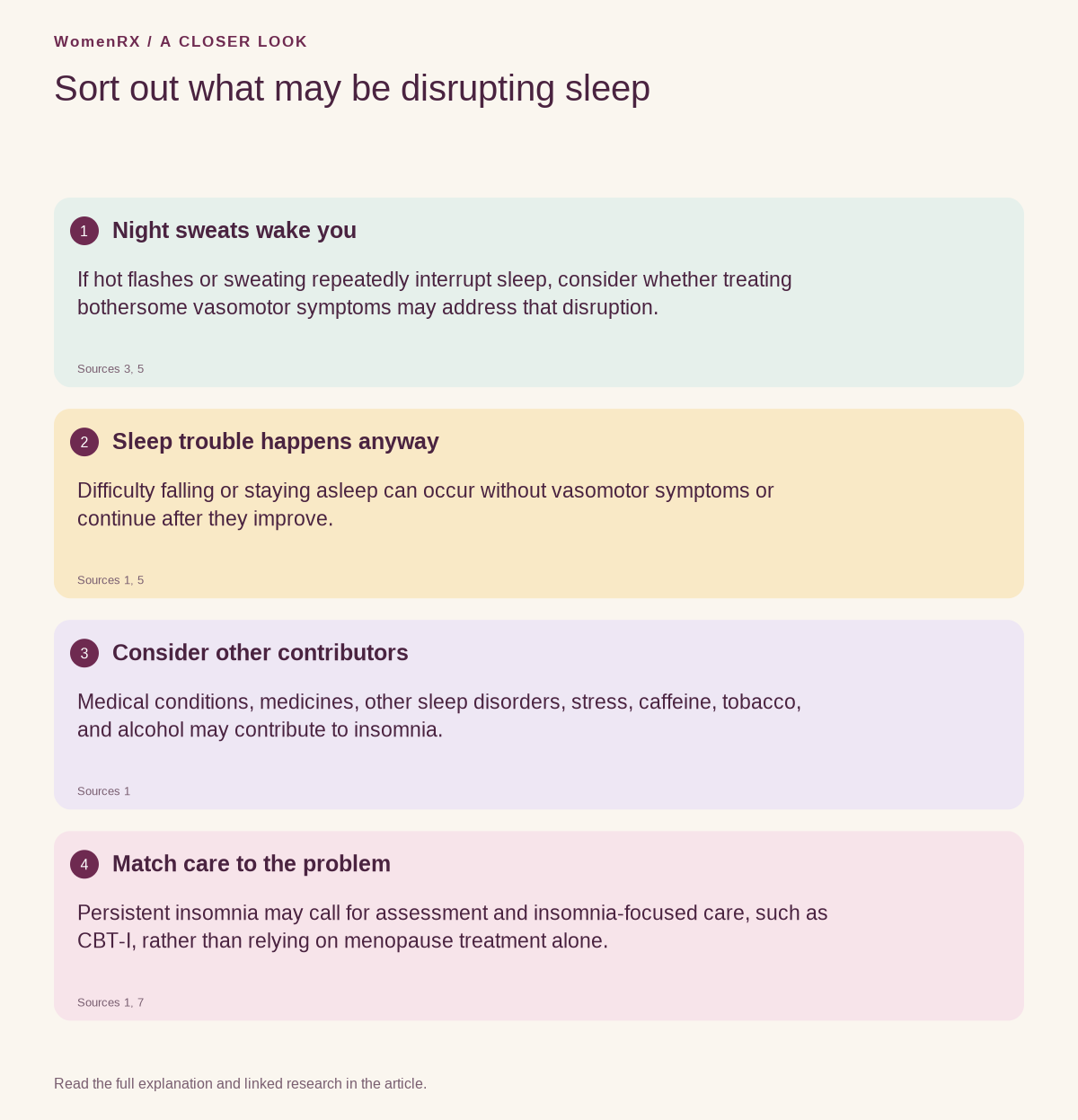
Sort out what may be disrupting sleep
Night sweats wake you: If hot flashes or sweating repeatedly interrupt sleep, consider whether treating bothersome vasomotor symptoms may address that disruption.35
Sleep trouble happens anyway: Difficulty falling or staying asleep can occur without vasomotor symptoms or continue after they improve.15
Consider other contributors: Medical conditions, medicines, other sleep disorders, stress, caffeine, tobacco, and alcohol may contribute to insomnia.1
Match care to the problem: Persistent insomnia may call for assessment and insomnia-focused care, such as CBT-I, rather than relying on menopause treatment alone.17
Read the figure as text
Use this flow to separate sleep interruption linked to night sweats from insomnia or other sleep problems that may need their own attention.- Night sweats wake you: If hot flashes or sweating repeatedly interrupt sleep, consider whether treating bothersome vasomotor symptoms may address that disruption.35
- Sleep trouble happens anyway: Difficulty falling or staying asleep can occur without vasomotor symptoms or continue after they improve.15
- Consider other contributors: Medical conditions, medicines, other sleep disorders, stress, caffeine, tobacco, and alcohol may contribute to insomnia.1
- Match care to the problem: Persistent insomnia may call for assessment and insomnia-focused care, such as CBT-I, rather than relying on menopause treatment alone.17
More questions, answered
Can hormone therapy help if I don’t have night sweats?
The available findings don’t establish hormone therapy as a general insomnia treatment when vasomotor symptoms aren’t present. If you regularly struggle to fall or stay asleep, consider other causes and insomnia-focused care such as CBT-I. 5 7
Does progesterone help with sleep?
In a small study, some sleep measures improved three months after women switched to micronized progesterone while continuing estrogen, but the overall insomnia score did not. Significant changes weren’t observed at one year. That isn’t enough to establish progesterone as a reliable insomnia treatment. 4
Sources you can check
- Insomnia | MedlinePlusAccessed 2026-09-25Return to first citation
- Insomnia - NHSAccessed 2026-09-25Return to first citation
- The 2022 hormone therapy position statement of The North American Menopause Society.“The 2022 Hormone Therapy Position Statement of The North American Menopause Society” Advisory Panel. · Menopause (New York, N.Y.) · 2022Return to first citation
- Effects of Micronized Progesterone in Menopausal Hormone Replacement Therapy on Sleep.Hirose A, Terauchi M, Hirata M, Matsuoka K, Umayahara K, Sakamoto M, Miyasaka N. · The journal of obstetrics and gynaecology research · 2026Return to first citation
- No more sleepless nights in perimenopause-an open-label, randomized, parallel-group, active controlled intervention study in perimenopausal women with vasomotor symptoms and insomnia to investigate the efficacy of hormone replacement therapy and cognitive behavioral therapy for the treatment of insomnia: study protocol.Pavicic E, Stute P, Rudzik F, Urech A, Lozza-Fiacco S. · Trials · 2025Return to first citation
- Comparative Effectiveness of Tibolone and Combined Hormone Therapy in Relieving Menopausal Insomnia.Song Z, Li C, Jin F, Sun D, Tao M. · Women's health reports (New Rochelle, N.Y.) · 2025Return to first citation
- Effectiveness of non-pharmacological interventions for insomnia related to natural menopause: A meta-analysis of randomized controlled trials.Luo R, Zhu J, Yang J. · Maturitas · 2026Return to first citation