Can Menopause Hormone Therapy Improve Insomnia?
Hormone therapy may help sleep when hot flashes or night sweats are waking you, but persistent insomnia can need its own care.
Menopause hormone therapy is most likely to help sleep when hot flashes or night sweats are part of what’s waking you. Treating those symptoms may reduce sleep disruption, but it doesn’t reliably treat insomnia on its own. If sleep stays difficult, ask about insomnia-focused care such as cognitive behavioral therapy for insomnia (CBT-I), and whether another sleep or health issue needs assessment. 4 5
Start with the kind of wake-up
Sleep can change during perimenopause and after menopause, but a night of poor sleep doesn’t automatically mean hormones are the cause. Notice what happens when you wake: do you feel suddenly hot or sweaty, or are you awake without that pattern? Hot flashes and night sweats can interrupt sleep, but women can also have insomnia without them, and some women with hot flashes sleep through them. 5
If you regularly wake with soaking-wet clothes or sheets, particularly when the room is cool, that’s worth mentioning during a medical evaluation. Night sweats can have causes other than menopause, including anxiety, alcohol or drug use, and some medical conditions. 1
When hormone therapy could help
Menopausal hormone therapy is the most effective treatment for menopause-related hot flashes and other vasomotor symptoms. When those symptoms are waking you, treating them may reduce the sleep disruption they cause. That isn’t the same as hormone therapy being a dependable treatment for insomnia independent of hot flashes or night sweats. 4 5
Whether hormone therapy is a reasonable option depends on your individual benefits and risks. The North American Menopause Society’s position statement says treatment should be individualized and periodically reevaluated. For women younger than 60 or within 10 years of menopause onset who have no contraindications, it describes the benefit-risk ratio as favorable when treating bothersome vasomotor symptoms. 4
Sleep may not fully improve even if hot flashes do. One clinic-based study followed 285 women in the menopausal transition or after menopause who received one of two hormone treatments. Both groups’ sleep-quality scores improved after 12 months, but because the study had no untreated comparison group, it can’t establish that hormone therapy caused the improvement or show that it treats insomnia on its own. 6
When sleep needs a separate look
Insomnia can mean trouble falling asleep, waking repeatedly, or waking too early and being unable to return to sleep. Stress, medicines, alcohol or caffeine, long-term pain, medical conditions, and other sleep disorders can contribute. Anxiety may also be part of the picture. 2 3
If you’re still lying awake after hot flashes improve, or you wake without feeling hot, don’t assume that more treatment for hot flashes is the answer. A clinician can assess other possible causes. If another sleep disorder such as sleep apnea is suspected, that may call for a separate evaluation; a sleep study may be recommended in some cases. 2 3
Persistent insomnia can affect daytime energy, concentration, and mood. Feeling too sleepy to drive safely is a reason not to drive. 2
Treat insomnia as insomnia
Cognitive behavioral therapy for insomnia, or CBT-I, targets thoughts and behaviors that can keep insomnia going. It’s different from treating hot flashes, and it’s more than general sleep-habit advice. CBT-I is considered a leading treatment for insomnia in adults generally, although menopause-specific evidence is still developing. A study protocol describes a planned comparison of CBT-I and hormone therapy, not results from a completed trial. 3 5
A 2026 meta-analysis of randomized trials in women after natural menopause reported improved sleep-quality scores in its cognitive behavioral therapy subgroup. That supports considering behavioral treatment, while leaving room for an individual assessment of what’s disrupting sleep. 7
A useful way to describe the pattern is: “I wake up with a hot flash,” “I wake but don’t feel hot,” or “The hot flashes improved, but I’m still awake for long stretches.” Those distinctions can help clarify whether the next step should target vasomotor symptoms, insomnia, or another sleep problem.
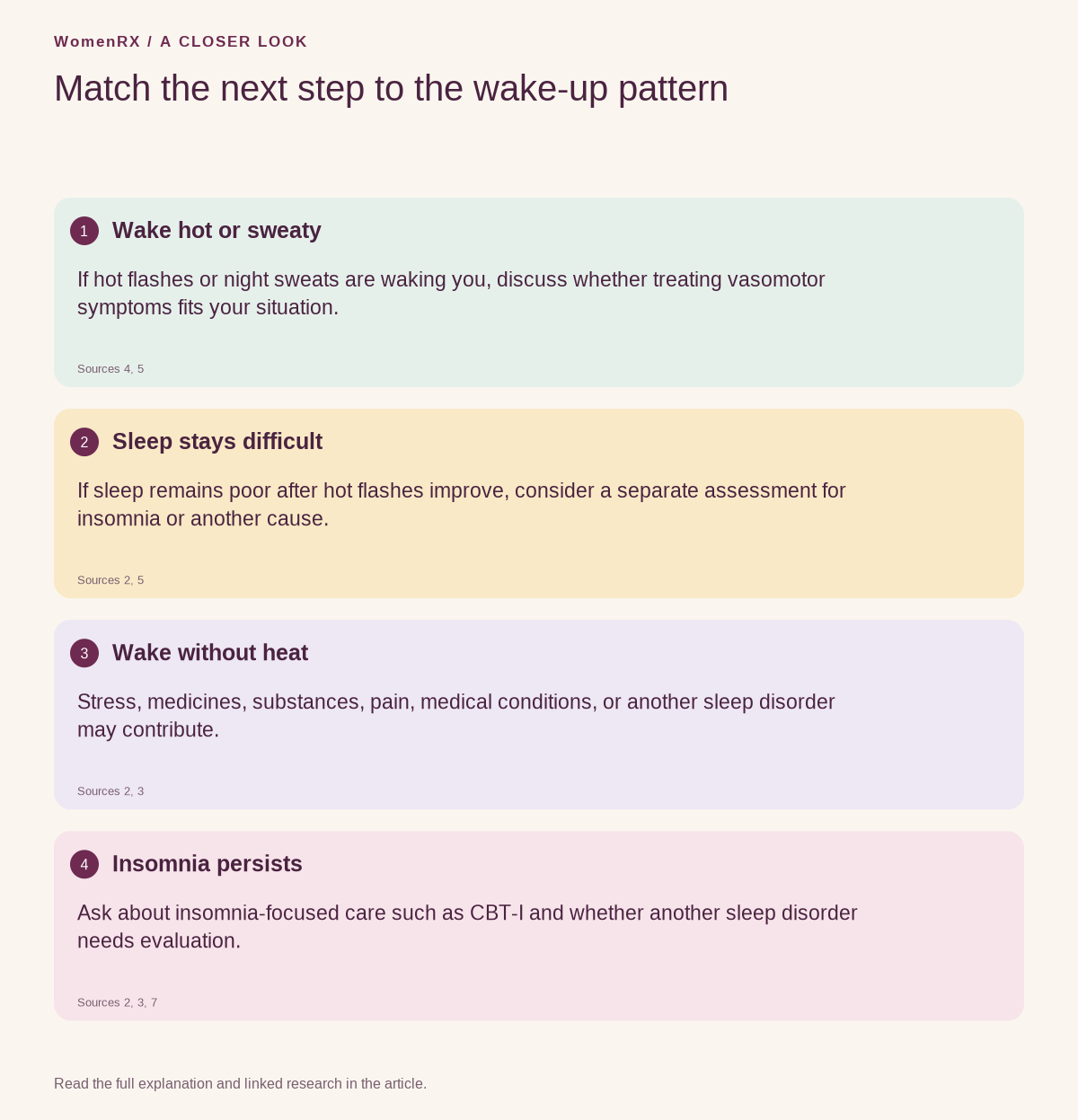
Match the next step to the wake-up pattern
Wake hot or sweaty: If hot flashes or night sweats are waking you, discuss whether treating vasomotor symptoms fits your situation.45
Sleep stays difficult: If sleep remains poor after hot flashes improve, consider a separate assessment for insomnia or another cause.25
Wake without heat: Stress, medicines, substances, pain, medical conditions, or another sleep disorder may contribute.23
Insomnia persists: Ask about insomnia-focused care such as CBT-I and whether another sleep disorder needs evaluation.237
Read the figure as text
Use the pattern of waking to consider whether the main target may be vasomotor symptoms, insomnia, or another sleep problem.- Wake hot or sweaty: If hot flashes or night sweats are waking you, discuss whether treating vasomotor symptoms fits your situation.45
- Sleep stays difficult: If sleep remains poor after hot flashes improve, consider a separate assessment for insomnia or another cause.25
- Wake without heat: Stress, medicines, substances, pain, medical conditions, or another sleep disorder may contribute.23
- Insomnia persists: Ask about insomnia-focused care such as CBT-I and whether another sleep disorder needs evaluation.237
More questions, answered
If hormone therapy reduces my hot flashes, will my sleep improve?
It may, if hot flashes or night sweats were waking you. But sleep can have more than one cause, so fewer hot flashes don’t guarantee that insomnia will resolve. 5
Is CBT-I the same as improving sleep habits?
No. CBT-I works with thoughts and behaviors that can maintain insomnia. General sleep-habit changes may be useful, but they are not the same as insomnia-focused therapy. 3
Sources you can check
- Night sweats - NHSAccessed 2026-09-25Return to first citation
- Insomnia | MedlinePlusAccessed 2026-09-25Return to first citation
- Insomnia - NHSAccessed 2026-09-25Return to first citation
- The 2022 hormone therapy position statement of The North American Menopause Society.“The 2022 Hormone Therapy Position Statement of The North American Menopause Society” Advisory Panel. · Menopause (New York, N.Y.) · 2022Return to first citation
- No more sleepless nights in perimenopause-an open-label, randomized, parallel-group, active controlled intervention study in perimenopausal women with vasomotor symptoms and insomnia to investigate the efficacy of hormone replacement therapy and cognitive behavioral therapy for the treatment of insomnia: study protocol.Pavicic E, Stute P, Rudzik F, Urech A, Lozza-Fiacco S. · Trials · 2025Return to first citation
- Comparative Effectiveness of Tibolone and Combined Hormone Therapy in Relieving Menopausal Insomnia.Song Z, Li C, Jin F, Sun D, Tao M. · Women's health reports (New Rochelle, N.Y.) · 2025Return to first citation
- Effectiveness of non-pharmacological interventions for insomnia related to natural menopause: A meta-analysis of randomized controlled trials.Luo R, Zhu J, Yang J. · Maturitas · 2026Return to first citation