Can Menopause Hormone Therapy Improve Brain Fog?
Hormone therapy can help hot flashes, but it hasn’t been shown to reliably improve memory or concentration.
Menopause hormone therapy isn’t an established treatment for brain fog. A review of randomized trials in younger menopausal women found no demonstrated benefit for cognition, though research findings about cognition don’t necessarily tell us whether someone feels clearer in daily life. Hormone therapy does have an established role for bothersome hot flashes, so the reason for considering it matters. 3 5
Brain fog and cognition studies ask different questions
“Brain fog” usually means a felt change: losing your train of thought, struggling to focus, or finding it harder to recall a word. Research findings about cognition describe outcomes in studies, but they don’t automatically answer whether a person feels less foggy in everyday life. Those are related questions, not identical ones.
A 2026 systematic review of 17 randomized trials in younger menopausal women found no demonstrated benefit of hormone therapy for cognition. The review included women aged 60 or younger, or near menopause as defined by each study. That finding doesn’t prove hormone therapy never changes how someone feels, but it doesn’t support relying on it to improve everyday memory or concentration. 5
A separate review asked about mild cognitive impairment and dementia, not day-to-day brain fog. Across 10 studies, including one randomized trial and nine observational studies, it found no significant association between hormone therapy and either outcome. The certainty of evidence ranged from moderate to very low. These findings don’t establish a dementia-prevention benefit. 4
When hormone therapy may still make sense
Hormone therapy has an established role in treating bothersome hot flashes and other vasomotor symptoms. Whether it’s a reasonable option depends on the person and on factors such as the type of therapy, route, timing, duration, and whether a progestogen is used. 3
So it can help to separate two questions: “Could hormone therapy treat my hot flashes?” and “Will it directly improve my concentration?” The first has a recognized treatment role; the second doesn’t have a reliable yes in the evidence above. If hot flashes are a major reason you’re considering treatment, discuss that benefit on its own terms rather than assuming clearer thinking will follow. 3 5
Widen the search beyond menopause
Memory or concentration changes aren’t proof of estrogen deficiency. When trying to understand what’s going on, include the timing of symptoms and any changes in sleep, mood, or medicines in the conversation. These details are useful context to review; by themselves, they don’t identify a cause.
Some health conditions are also worth considering. MedlinePlus lists thyroid, kidney, and liver problems among possible contributors to more serious memory problems. 2 If you take thyroid replacement, the prescribing information for one estradiol-and-progesterone product notes that estrogen can affect thyroid-binding globulin and that thyroid function may need monitoring during treatment. This is a product-specific consideration, not evidence that menopause hormone therapy explains every concentration change. 1
Notice what the change looks like in ordinary life. For example, is it mostly trouble concentrating on a task, or are familiar activities becoming difficult? Memory problems such as getting lost or forgetting how to use a familiar device can be signs of a more serious issue and deserve medical assessment. 2
The practical takeaway: consider hormone therapy for an established reason such as bothersome hot flashes, not as a dependable brain-fog remedy or a way to prevent dementia. At the same time, take a new or persistent change in thinking seriously enough to look at the wider picture, including health conditions and changes in sleep, mood, or medicines.
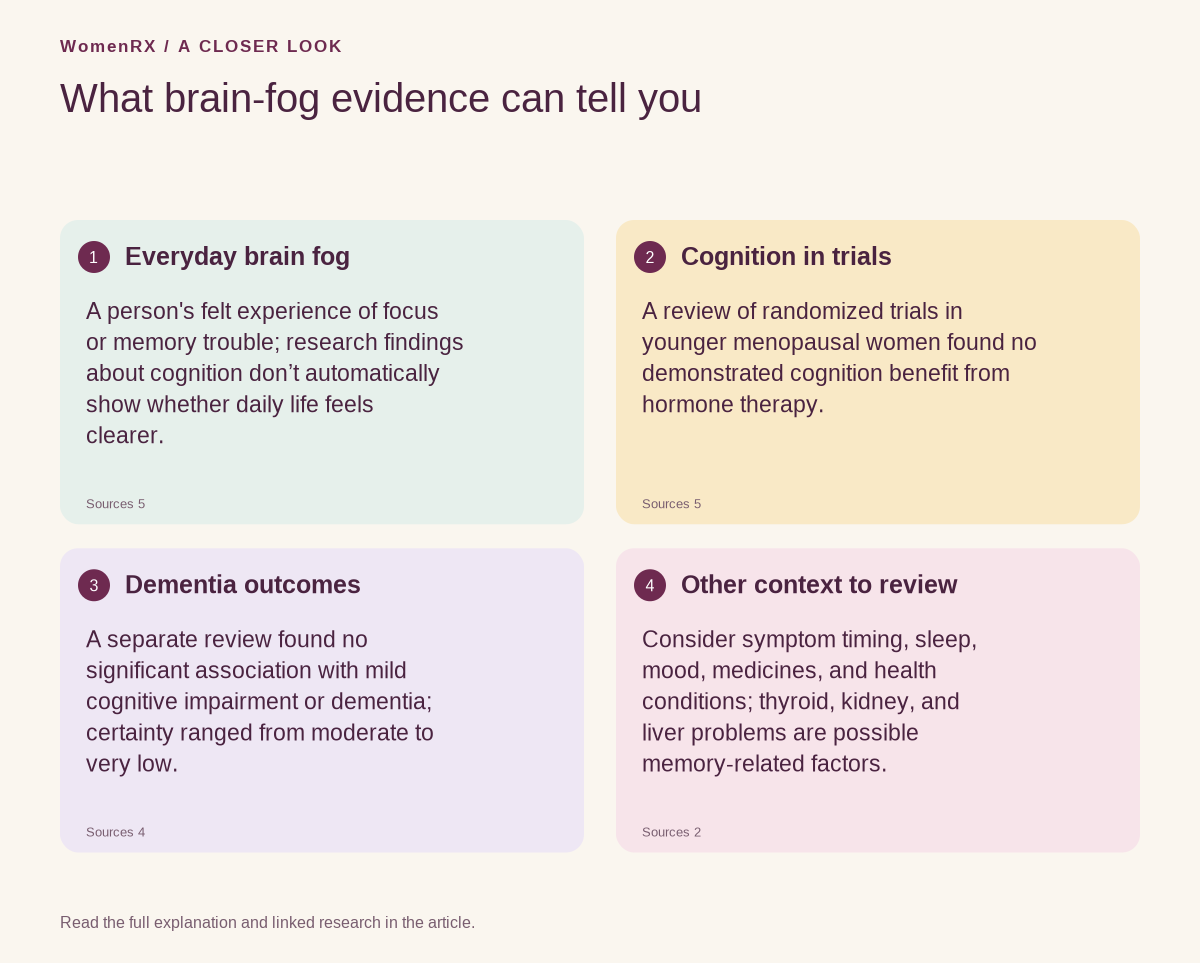
What brain-fog evidence can tell you
Everyday brain fog: A person's felt experience of focus or memory trouble; research findings about cognition don’t automatically show whether daily life feels clearer.5
Cognition in trials: A review of randomized trials in younger menopausal women found no demonstrated cognition benefit from hormone therapy.5
Dementia outcomes: A separate review found no significant association with mild cognitive impairment or dementia; certainty ranged from moderate to very low.4
Other context to review: Consider symptom timing, sleep, mood, medicines, and health conditions; thyroid, kidney, and liver problems are possible memory-related factors.2
Read the figure as text
Everyday concentration, cognition outcomes in trials, and dementia risk are different questions. Here’s what the findings do and don’t establish.- Everyday brain fog: A person's felt experience of focus or memory trouble; research findings about cognition don’t automatically show whether daily life feels clearer.5
- Cognition in trials: A review of randomized trials in younger menopausal women found no demonstrated cognition benefit from hormone therapy.5
- Dementia outcomes: A separate review found no significant association with mild cognitive impairment or dementia; certainty ranged from moderate to very low.4
- Other context to review: Consider symptom timing, sleep, mood, medicines, and health conditions; thyroid, kidney, and liver problems are possible memory-related factors.2
More questions, answered
Should I take hormone therapy to prevent dementia?
No. A review found no significant association between hormone therapy and mild cognitive impairment or dementia, and its findings don’t establish that therapy prevents dementia. Hormone therapy decisions should be based on other benefits and risks. 4 3
Sources you can check
- BIJUVA (ESTRADIOL AND PROGESTERONE) CAPSULE [MAYNE PHARMA] | US prescribing information and patient instructionsAccessed 2026-09-25Return to first citation
- Memory | MedlinePlusAccessed 2026-09-25Return to first citation
- The 2022 hormone therapy position statement of The North American Menopause Society.“The 2022 Hormone Therapy Position Statement of The North American Menopause Society” Advisory Panel. · Menopause (New York, N.Y.) · 2022Return to first citation
- Menopause hormone therapy and risk of mild cognitive impairment or dementia: a systematic review and meta-analysis.Melville M, He L, Desai R, Nyamayaro P, Fox C, Kothari KU, Condron P, Miao M, Hickey M, Spector A. · The lancet. Healthy longevity · 2025Return to first citation
- The effects of menopausal hormone therapy on cardiovascular disease, cancer, cognition and depression in younger women: A systematic review.Bencivenga PA, Fort N, Fugh-Berman A, Scialli AR. · JRSM open · 2026Return to first citation