Perimenopause Brain Fog: What the Evidence Shows
Forgetfulness and trouble concentrating can happen during perimenopause, but a felt change doesn’t always show up as a clear deficit on cognitive tests.
“Brain fog” usually means subjective changes such as losing a word, forgetting why you walked into a room, or struggling to focus. Research finds some differences in cognitive test results during perimenopause, but the pattern is inconsistent and depends partly on how researchers define menopause stages. Track what’s changing and whether it affects daily life; seek evaluation if problems worsen, disrupt routine tasks, or involve getting lost or struggling with familiar activities. 2 3 1
What people mean by “brain fog”
Brain fog isn’t a single test result or diagnosis. During the menopause transition, people use the phrase for experiences such as losing track of a thought, searching for a familiar word, misplacing things, or finding it harder to concentrate. These are subjective complaints: you notice a change in how your thinking feels. Neuropsychological tests measure particular tasks, such as memory or attention, and may not capture every frustrating moment in a busy day. 3
That difference matters. A real, bothersome change in everyday thinking doesn’t automatically mean a test will show impairment, and a test result doesn’t explain by itself what’s behind a person’s experience.
What studies find, and why results differ
The evidence suggests a possible change in some aspects of cognition during perimenopause, not inevitable or uniform decline. A 2026 systematic review and meta-analysis covering 26 articles and 9,428 participants found poorer cognitive outcomes for perimenopausal than premenopausal groups overall. That difference appeared only in studies that used the STRAW+10 criteria to classify reproductive stages. The review found no overall difference between perimenopausal and postmenopausal groups. 2
A separate study of 687 participants found poorer performance on learning-efficiency measures when early and late perimenopause were combined, compared with reproductive and postmenopausal groups. It did not find a significant difference between early and late perimenopause in either reported memory complaints or objective performance. These results offer a useful clue, not a precise forecast for any one person. 4
The studies don’t all measure the same thing or sort menopause stages in the same way. That makes it hard to reduce the findings to “perimenopause causes memory loss.” It’s more accurate to say that some research detects differences in certain cognitive measures, while people’s day-to-day experiences and test results don’t always line up neatly. 2 4
Why sleep, mood, and daily demands belong in the picture
Hormone fluctuations are one proposed part of the story. Researchers also point to sleep disruption and vasomotor symptoms, such as hot flashes, as well as anxiety, depression, and workplace pressures. These factors may contribute to cognitive complaints or make concentration harder; their presence doesn’t prove that perimenopause is the only explanation. 3
That’s why a useful record looks at context, not just memory slips. For example, note whether trouble concentrating tends to follow a night of disrupted sleep, coincide with hot flashes, or show up during a particularly stressful stretch. The point isn’t to diagnose the cause yourself. It’s to see whether a pattern is emerging and describe what the change feels like in real life.
A practical way to track what’s changing
Keep notes brief and specific. When something happens, jot down:
- What you noticed: losing a word, rereading a paragraph, forgetting an errand, or losing focus.
- What was happening around it: the task, time of day, and whether you were interrupted or under pressure.
- What else was going on: sleep disruption, hot flashes, mood changes, or other symptoms you’ve noticed.
- The effect: whether you recovered your train of thought, needed a reminder, or couldn’t complete a familiar task.
- The pattern: whether the experience is occasional, becoming more frequent, or affecting work and home routines.
This kind of record can help distinguish an occasional lapse from a change that is persistent or affecting function. It isn’t a validated cognitive test or a way to determine the cause on your own.
When to seek an evaluation
Consider arranging an evaluation if the changes are getting worse, are interfering with work or everyday responsibilities, or make familiar tasks difficult. Trouble remembering how to use a familiar device or finding your way in a familiar place is more concerning than occasionally forgetting a name or misplacing keys, and warrants assessment. Memory problems can have causes beyond menopause, including thyroid, kidney, or liver problems and head injury. 1
A clear description helps: what changed, when you first noticed it, how it affects daily life, and whether sleep, hot flashes, mood, or stress seem to accompany it. The goal is to understand the whole picture, rather than assume either that every lapse is menopause or that every complaint signals a serious cognitive disorder.
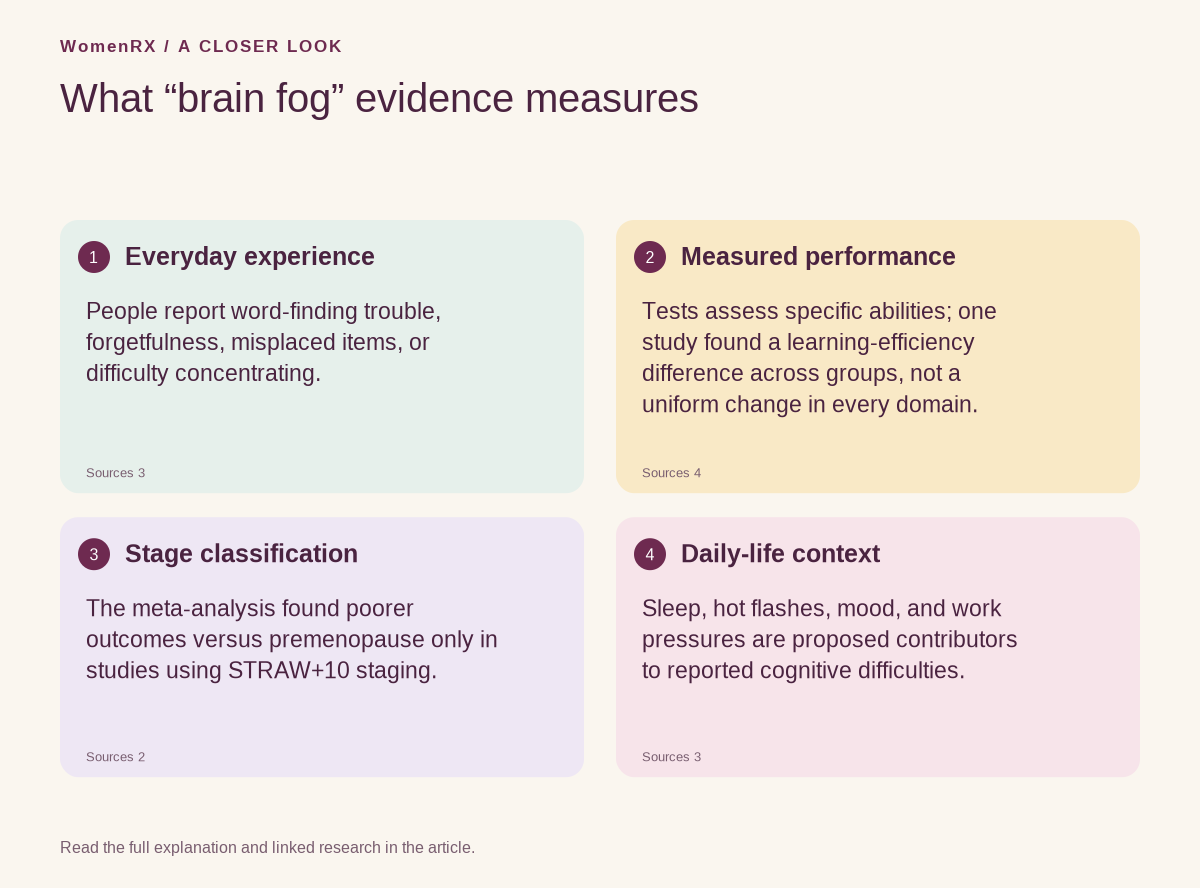
What “brain fog” evidence measures
Everyday experience: People report word-finding trouble, forgetfulness, misplaced items, or difficulty concentrating.3
Measured performance: Tests assess specific abilities; one study found a learning-efficiency difference across groups, not a uniform change in every domain.4
Stage classification: The meta-analysis found poorer outcomes versus premenopause only in studies using STRAW+10 staging.2
Daily-life context: Sleep, hot flashes, mood, and work pressures are proposed contributors to reported cognitive difficulties.3
Read the figure as text
A reported lapse and a cognitive test result describe different parts of the picture; research findings also depend on how menopause stages are classified.- Everyday experience: People report word-finding trouble, forgetfulness, misplaced items, or difficulty concentrating.3
- Measured performance: Tests assess specific abilities; one study found a learning-efficiency difference across groups, not a uniform change in every domain.4
- Stage classification: The meta-analysis found poorer outcomes versus premenopause only in studies using STRAW+10 staging.2
- Daily-life context: Sleep, hot flashes, mood, and work pressures are proposed contributors to reported cognitive difficulties.3
Sources you can check
- Memory | MedlinePlusAccessed 2026-09-25Return to first citation
- Cognitive functioning in perimenopause: An updated systematic review and meta-analysis.Bangle A, Williams D, Walters J, Nguyen L. · Psychology and aging · 2026Return to first citation
- Cognitive Stimulation Therapy in Menopause: Feasibility randomised controlled trial.Spector A, Faulkner A, Gilchrist H, Sethi S, He L, Gurvich C, Evans R. · Reproduction & fertility · 2026Return to first citation
- Subjective cognition and objective cognitive performance in early versus late perimenopause.Furey RT, Zhu C, Li Q, Gurvich C. · Journal of clinical and experimental neuropsychology · 2026Return to first citation