Perimenopause Brain Fog: What to Notice and When to Act
Memory and focus can feel different during perimenopause, but the pattern and its effect on daily life matter more than the label “brain fog.”
Perimenopause can coincide with changes in memory and attention, but an occasional lapse doesn’t tell you what caused it or predict lasting decline. Notice what happens, whether it recurs or worsens, and whether familiar activities have become harder. Include sleep, mood, menopause symptoms, and medication changes as context. If the change keeps happening or disrupts daily life, seek a review rather than assuming it’s menopause. 14
What brain fog does and doesn’t tell you
Maybe you’ve lost your train of thought midway through a task, or you’re reaching for a familiar word more often. “Brain fog” can describe that experience, but it isn’t a diagnosis. An occasional misplaced item is also different from a growing difficulty doing something you usually manage. 1
Cognitive changes during the menopause transition are worth taking seriously without assuming they signal lasting decline. In a UK Biobank study of 15,486 women, with an average age of 52 at the start, researchers compared cognitive performance across menopause stages over an average of eight years. Perimenopausal and postmenopausal women performed less well than premenopausal women on some measures, including memory and reasoning. For most measures, though, their rates of change over time did not differ. This observational study cannot tell you whether perimenopause caused your own symptoms or what will happen next. 4
The distinction between performance at one point and change over time matters. Feeling different now does not, by itself, mean you’re on a path to dementia. Whether cognitive changes around menopause are causally linked to later dementia remains an open research question. 4
Describe the lapse before trying to explain it
A brief note when something happens can be more useful than a tally of every forgotten word. Start with the specific change. For example, did you struggle to stay with a conversation, forget an appointment, or lose your place in a familiar task? Then note whether it was a one-off or keeps happening, and what it affected.
Add context without treating it as proof. Did the lapse happen after a difficult night’s sleep? Are night sweats, hot flashes, or mood symptoms also bothering you? Did it begin around a medication change? Those details give you and a clinician something concrete to discuss; they can’t establish the cause on their own.
You don’t need a perfect diary or a particular number of lapses. A few examples that show what changed, when you noticed it, and whether it’s improving or getting in the way are enough to start a conversation. This is a way to describe your experience, not a diagnostic test.
When perimenopause may not be the whole explanation
An occasional forgotten word or misplaced item is common. A change that keeps recurring, gets worse, or makes familiar activities difficult deserves a closer look rather than being put down to perimenopause. You don’t need to wait for a set number of lapses to explain what’s changed to a clinician. 1
Memory problems can have explanations beyond ordinary aging. MedlinePlus lists thyroid, kidney, and liver problems among possible causes. It also gives forgetting how to use a phone or find the way home as examples of changes that may signal a more serious problem, specifically in its discussion of older adults. Those examples aren’t a perimenopause-specific test or threshold. 1
You can describe the change plainly: “I’ve always managed this task, and now I’m having trouble with it.” Bring examples and an up-to-date medication list. The useful question isn’t only “Is this menopause?” It’s also “What else fits this pattern, and what should we address first?”
Choose treatment for the symptom it’s meant to help
If hot flashes or night sweats are disrupting your life, those symptoms have treatment options. Menopause guidance identifies hormone therapy as an effective treatment for vasomotor symptoms, and a separate position statement identifies nonhormonal options supported for that purpose. Evidence that a treatment helps hot flashes or night sweats shouldn’t be taken as evidence that it improves memory or concentration. 23
In the UK Biobank cognitive analysis, accounting for menopausal hormone therapy use did not change the researchers’ models. That observational finding isn’t a trial of treatment for brain fog. It’s a reason to keep two questions separate: what might help a bothersome menopause symptom, and what explains a change in thinking or memory? You can address the first without assuming it answers the second. 4
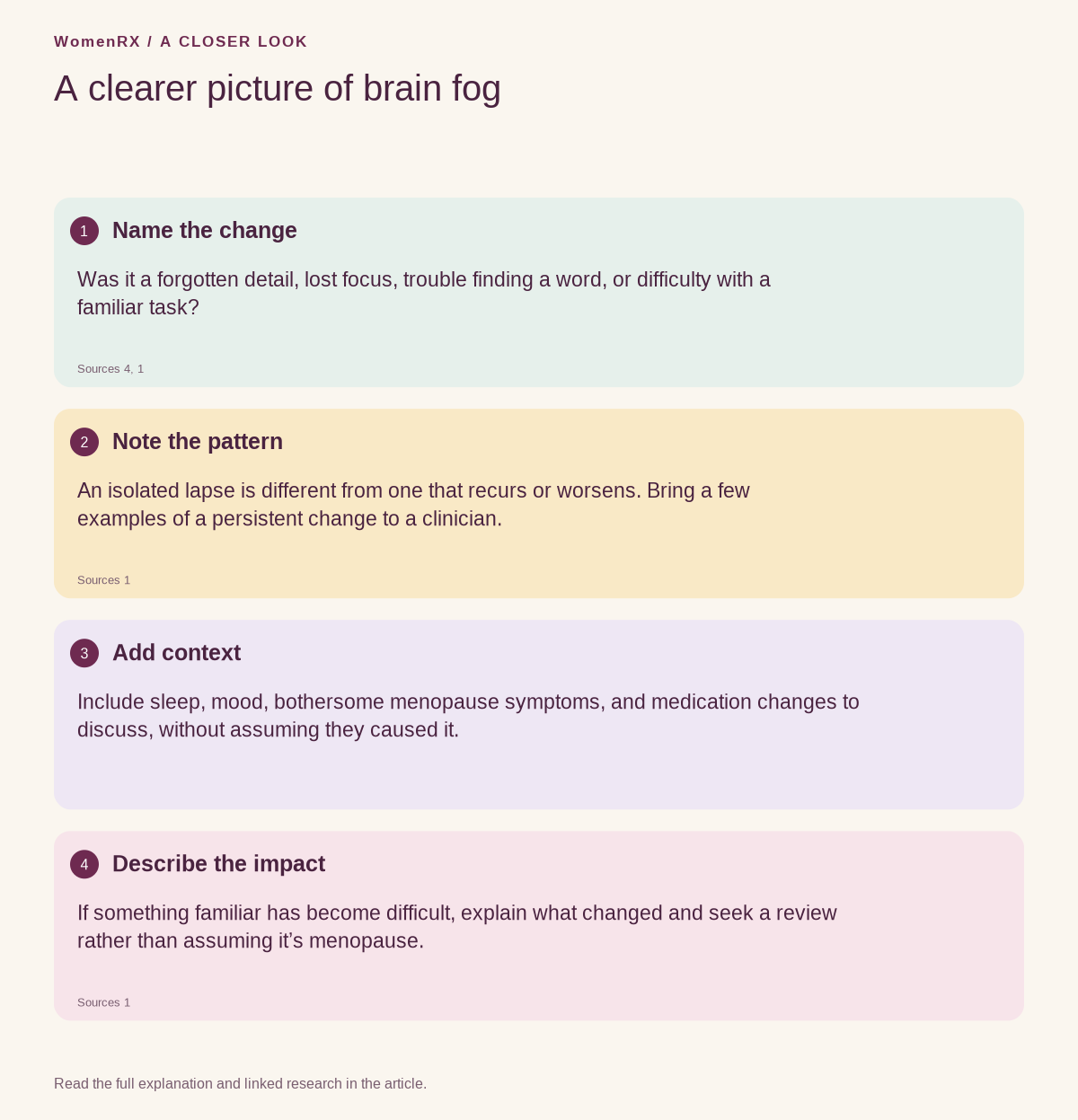
A clearer picture of brain fog
Name the change: Was it a forgotten detail, lost focus, trouble finding a word, or difficulty with a familiar task?41
Note the pattern: An isolated lapse is different from one that recurs or worsens. Bring a few examples of a persistent change to a clinician.1
Add context: Include sleep, mood, bothersome menopause symptoms, and medication changes to discuss, without assuming they caused it.
Describe the impact: If something familiar has become difficult, explain what changed and seek a review rather than assuming it’s menopause.1
Read the figure as text
Use these prompts to describe a change and decide what to bring up, not to score or diagnose it.- Name the change: Was it a forgotten detail, lost focus, trouble finding a word, or difficulty with a familiar task?41
- Note the pattern: An isolated lapse is different from one that recurs or worsens. Bring a few examples of a persistent change to a clinician.1
- Add context: Include sleep, mood, bothersome menopause symptoms, and medication changes to discuss, without assuming they caused it.
- Describe the impact: If something familiar has become difficult, explain what changed and seek a review rather than assuming it’s menopause.1
More questions, answered
Does perimenopause brain fog mean dementia?
Not by itself. Brain fog describes an experience, not a dementia diagnosis. Research has not established that cognitive changes during the menopause transition cause later dementia. If a change recurs, worsens, or makes familiar activities difficult, discuss what’s happening with a clinician. 14
Sources you can check
- Memory | MedlinePlusAccessed 2026-09-25Return to first citation
- The 2022 hormone therapy position statement of The North American Menopause Society.“The 2022 Hormone Therapy Position Statement of The North American Menopause Society” Advisory Panel. · Menopause (New York, N.Y.) · 2022Return to first citation
- The 2023 nonhormone therapy position statement of The North American Menopause Society.Menopause (New York, N.Y.) · 2023Return to first citation
- Cognitive trajectories during the menopausal transition.Than S, Moran C, Beare R, Vincent A, Lane E, Collyer TA, Callisaya ML, Srikanth V. · Frontiers in dementia · 2023Return to first citation