Perimenopause Dizziness: What to Notice and When to Act
Whether you feel spinning, faint, or unsteady, the timing and accompanying symptoms offer better clues than assuming perimenopause is the cause.
Dizziness during perimenopause may be brief, recur, or persist; its duration alone doesn’t tell you why it’s happening. Notice whether you feel spinning, faint, or off-balance, then note when it began, how long it lasts, what brings it on, and what comes with it. Dizziness that keeps returning or won’t go away warrants assessment. 1 4
First, put the feeling into words
“Dizzy” can describe several different sensations. Spinning means you feel as though you or the room is moving. Faintness feels more like you might pass out. Imbalance means you feel unsteady, perhaps when walking. You don’t have to choose a medical term. Your own description gives a clinician a better starting point than “I’m dizzy.” 1
For example, “the room spins when I turn in bed” tells a different story from “I feel faint when I stand up.” Dizziness on standing can occur with a sudden drop in blood pressure, while spinning or imbalance may point a clinician toward an inner-ear problem. Neither description establishes a diagnosis on its own. 1
Timing changes the question
Think about when the dizziness first began, how long an episode lasts, and whether it goes away completely or stays with you. If it returns, does it happen in similar circumstances each time? Clinical guidance for adults with acute dizziness uses timing and triggers to guide assessment, rather than treating every report of dizziness alike. 4
Triggers are worth describing precisely. Did the feeling start when you stood up, when you moved your head, or while you were sitting still? Also note what happened alongside it. Hearing changes or ringing in the ears, nausea, headache, fainting, and changes in your pulse can all affect what a clinician considers. A new prescription is another detail to mention because dizziness can be a medication side effect. 1
A short note might read: “Spinning began when I turned in bed; it passed, then happened again the next morning; I felt nauseated but noticed no hearing change.” That’s an example of useful detail, not a way to identify the cause yourself.
Where perimenopause fits, and where it doesn’t
If episodes seem to coincide with cycle changes or other menopause-transition symptoms, that timing is worth recording. It isn’t proof that hormones are responsible. A 2026 review describes possible ways hormonal changes could affect the balance system, but says clinical studies of the connection are scarce. Many human studies it discusses were case-control studies with limited methodological quality. 5
In one cross-sectional study, 93 women aged 40 to 65 with recurrent vestibular symptoms were assessed at a specialist clinic. Greater menopause-related symptom scores were associated with greater dizziness-related handicap. Because the women were selected for recurring symptoms and assessed at one point in time, the finding can’t show that menopause caused their dizziness or predict what will happen for you. 6
That leaves room to consider perimenopause and other explanations. For example, symptoms on standing, ear symptoms, or dizziness after starting a medicine each suggest a different question to investigate. 1
When not to wait and see
Seek emergency assessment for sudden dizziness with new weakness or trouble speaking, or if you have severe difficulty walking. Stroke is one possible cause of acute dizziness, sometimes even when dizziness is the main complaint. Its assessment depends on the full pattern and a clinical examination, not on a home test. 2 3 4
Arrange medical assessment if dizziness won’t go away, keeps coming back, or comes with fainting, collapse, pulse changes, or headaches. 1
If you’re dizzy right now, lie down until it passes, then get up slowly and move carefully. Drinking water is another simple step. These measures may help you get through the moment, but they don’t explain recurring symptoms. 1
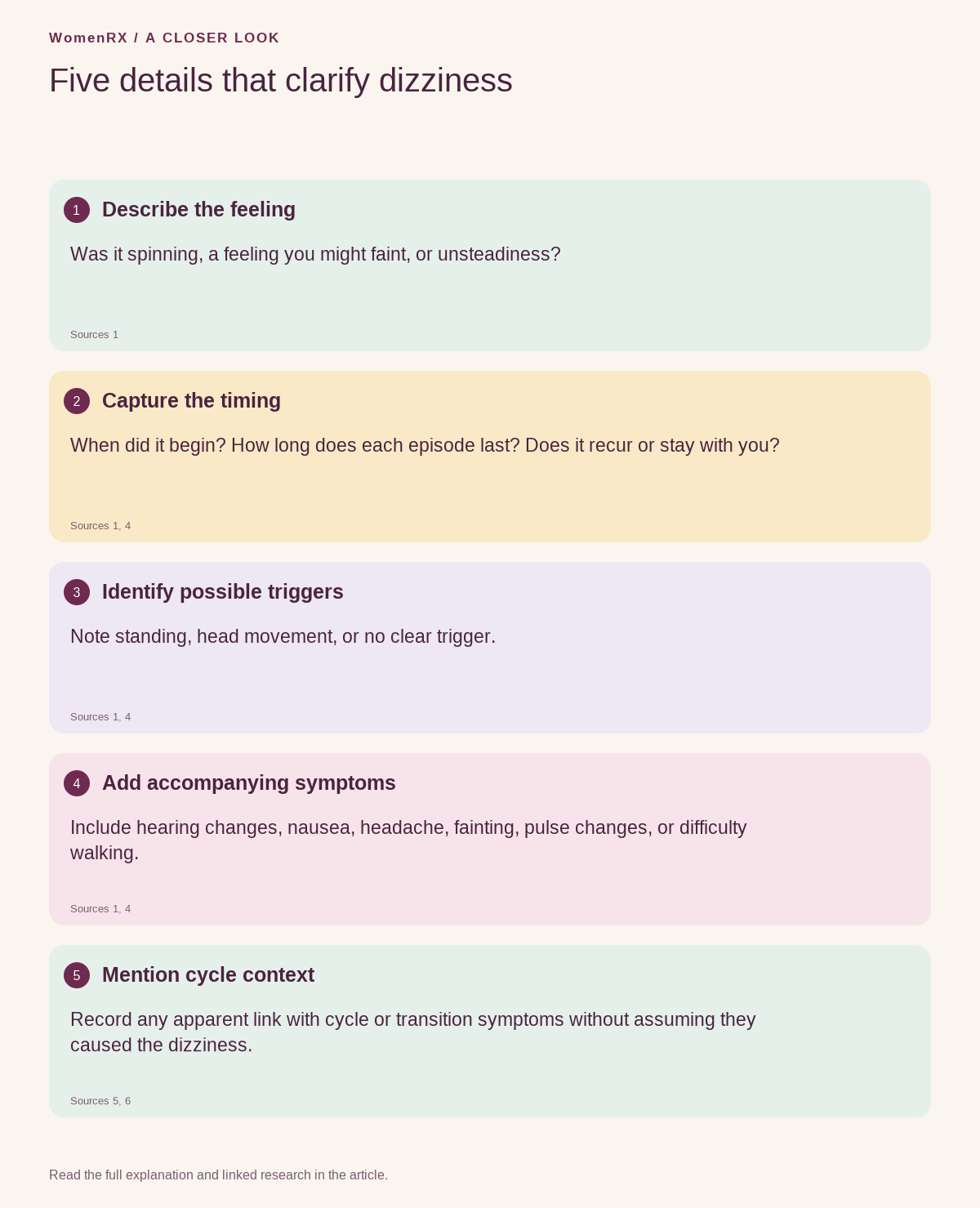
Five details that clarify dizziness
Describe the feeling: Was it spinning, a feeling you might faint, or unsteadiness?1
Capture the timing: When did it begin? How long does each episode last? Does it recur or stay with you?14
Identify possible triggers: Note standing, head movement, or no clear trigger.14
Add accompanying symptoms: Include hearing changes, nausea, headache, fainting, pulse changes, or difficulty walking.14
Mention cycle context: Record any apparent link with cycle or transition symptoms without assuming they caused the dizziness.56
Read the figure as text
Use these prompts to describe what happened. They’re conversation aids, not a diagnostic score.- Describe the feeling: Was it spinning, a feeling you might faint, or unsteadiness?1
- Capture the timing: When did it begin? How long does each episode last? Does it recur or stay with you?14
- Identify possible triggers: Note standing, head movement, or no clear trigger.14
- Add accompanying symptoms: Include hearing changes, nausea, headache, fainting, pulse changes, or difficulty walking.14
- Mention cycle context: Record any apparent link with cycle or transition symptoms without assuming they caused the dizziness.56
More questions, answered
How long should I track dizziness before getting it assessed?
You don’t need to wait for a set number of days if dizziness keeps returning or won’t go away. Note when it began, whether each episode is brief or prolonged, and whether you feel fully well between episodes. Seek assessment sooner if you faint or notice pulse changes; sudden dizziness with new weakness, speech trouble, or severe difficulty walking calls for emergency assessment. 1 3 4
Sources you can check
- Dizziness - NHSAccessed 2026-09-25Return to first citation
- Acute dizziness in the emergency department: trends, diagnostic challenges and stroke mimics among thrombolysed patients.Bailey Tysland T, Ajmi SC, Goplen FK, Wathne N, Rezai M, Mjelva ØR, Kurz MW. · Frontiers in neurology · 2026Return to first citation
- Developing a clinical decision support tool for stratifying stroke risk in patients presenting with dizziness to the emergency department: A retrospective cohort study.Sung SF, Hu YH. · Digital health · 2026Return to first citation
- Guidelines for reasonable and appropriate care in the emergency department 3 (GRACE-3): Acute dizziness and vertigo in the emergency department.Edlow JA, Carpenter C, Akhter M, Khoujah D, Marcolini E, Meurer WJ, Morrill D, Naples JG, Ohle R, Omron R, Sharif S, Siket M, Upadhye S, E Silva LOJ, Sundberg E, Tartt K, Vanni S, ... · Academic emergency medicine : official journal of the Society for Academic Emergency Medicine · 2023Return to first citation
- Is there any relationship between the menopause transition and dizziness?Mangia LRL, Bittar RSM. · Brazilian journal of otorhinolaryngology · 2026Return to first citation
- Clinical Features of Midlife Women With Isolated Episodic Vestibular Syndrome and Their Relationship With Migraine and Menopause Transition.Mangia LRL, Bittar RSM. · Otology & neurotology : official publication of the American Otological Society, American Neurotology Society [and] European Academy of Otology and Neurotology · 2026Return to first citation