Dizziness in Perimenopause: Possible Causes and Warning Signs
A dizzy spell during perimenopause isn’t automatically a menopause symptom; its pattern and accompanying symptoms offer better clues about what to do next.
Dizziness can mean spinning, lightheadedness, or feeling off-balance, and the sensation alone can’t identify its cause. During perimenopause, consider the same broad range of explanations as at other life stages, including blood-pressure changes, inner-ear problems, migraine, or a medicine side effect. Get emergency help for sudden or severe dizziness with vision problems, slurred speech, or weakness; arrange an appointment if it persists or recurs. 1 3 5
Start with what the sensation feels like
“Dizzy” can mean lightheaded or faint, unsteady on your feet, or as if you or the room is spinning. That spinning feeling is called vertigo. These descriptions are useful clues, but the sensation by itself can’t reliably tell you what’s causing it or whether the cause is minor or serious. 1 3 5
Dizziness that happens during perimenopause isn’t automatically caused by the transition. The timing of a spell alongside menstrual changes may be useful context, but it doesn’t establish a hormonal cause. Consider other explanations, too.
Match the pattern to possible explanations
Lightheaded after standing up? A sudden drop in blood pressure is one possible reason dizziness happens when you stand or sit up. Note whether the spell starts with a position change and whether sitting or lying down helps. 3
Spinning after a particular head movement? Specific head movements can trigger benign paroxysmal positional vertigo (BPPV), an inner-ear problem. Inner-ear conditions are common causes of vertigo, but a movement trigger is a clue, not a diagnosis. 2
Dizziness after a medicine change? Dizziness can be a side effect of a prescription medicine. If the timing lines up, record what changed and when so you can include it when discussing the symptom. 3
Episodes with migraine features? Vestibular migraine can cause vertigo or dizziness. A history of migraine and symptoms such as headache, visual aura, or sensitivity to light or sound during attacks may be relevant. There isn’t a single definitive test for vestibular migraine. 4
Other causes are possible, including ear infections and conditions affecting balance or other body systems. The broad range of causes is why neither “spinning” nor “lightheaded” settles the question on its own. 3 5
Choose your next step by urgency
Get emergency help now for sudden or severe dizziness or vertigo accompanied by vision problems, slurred speech, or weakness. These can be signs of a more serious condition. 1
Arrange a medical appointment if dizziness keeps returning, doesn’t go away, or affects daily life. Fainting or collapsing, changes in your pulse, or changes in hearing or vision are also reasons to seek medical advice. 1 2 3
While a spell is happening, reduce your chance of falling. Sit or lie down until it eases, then get up slowly. Avoid driving, climbing, or using heavy equipment while you feel dizzy or unsteady. 3
Keep a short record if it happens again
Note what the sensation felt like, what you were doing just before it began, whether standing or head movement triggered it, how long it lasted, and any symptoms that came with it. You can also record where it fell in your menstrual cycle, without assuming the timing explains the dizziness. This information can help describe the pattern; it can’t diagnose the cause.
A clinician may ask about your symptoms and medicines and check your hearing, balance, or walking. The evaluation depends on the pattern and accompanying symptoms. 1 5
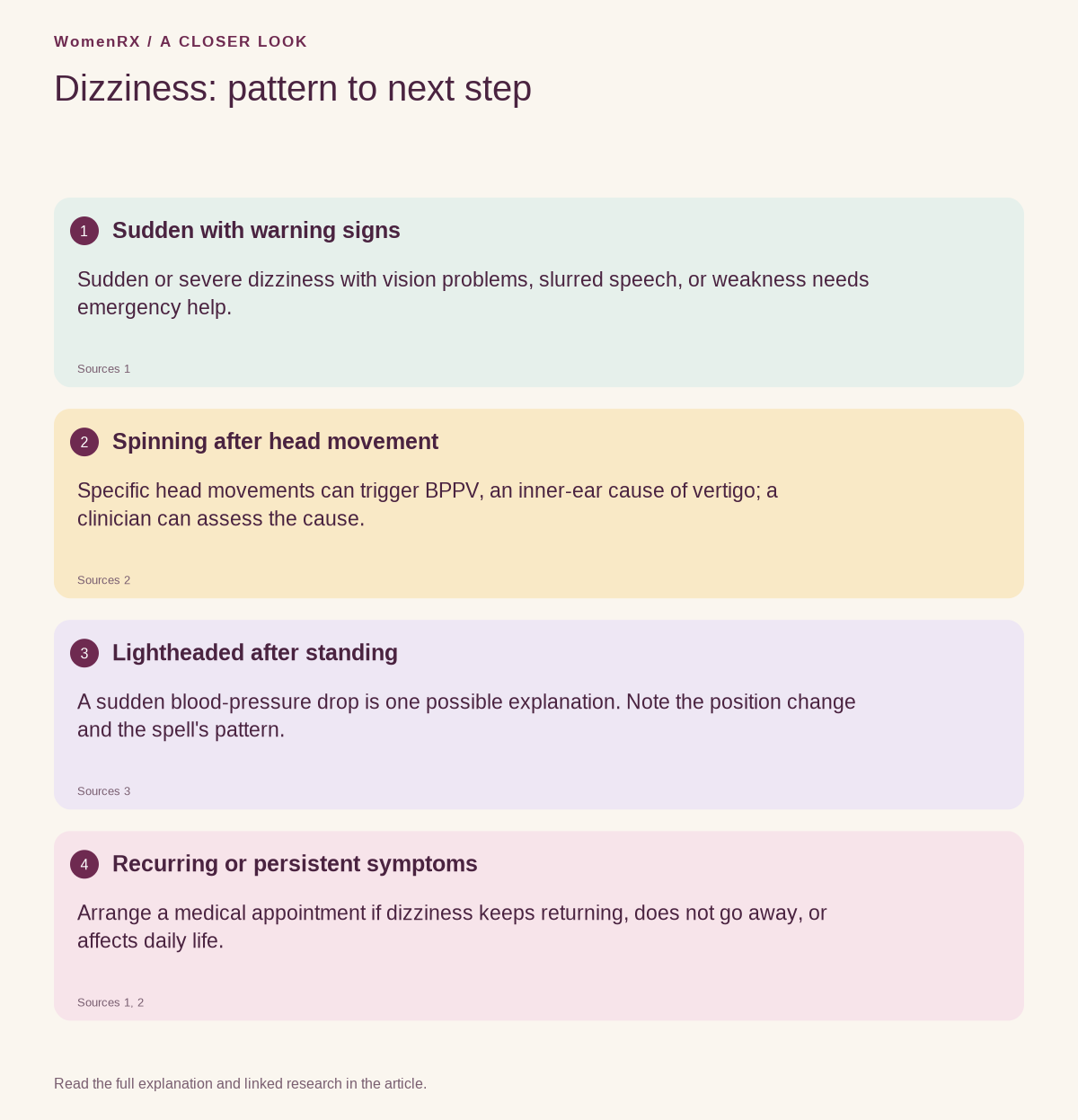
Dizziness: pattern to next step
Sudden with warning signs: Sudden or severe dizziness with vision problems, slurred speech, or weakness needs emergency help.1
Spinning after head movement: Specific head movements can trigger BPPV, an inner-ear cause of vertigo; a clinician can assess the cause.2
Lightheaded after standing: A sudden blood-pressure drop is one possible explanation. Note the position change and the spell's pattern.3
Recurring or persistent symptoms: Arrange a medical appointment if dizziness keeps returning, does not go away, or affects daily life.12
Read the figure as text
Use the trigger and accompanying symptoms to choose a sensible next step. These patterns are clues, not diagnoses.- Sudden with warning signs: Sudden or severe dizziness with vision problems, slurred speech, or weakness needs emergency help.1
- Spinning after head movement: Specific head movements can trigger BPPV, an inner-ear cause of vertigo; a clinician can assess the cause.2
- Lightheaded after standing: A sudden blood-pressure drop is one possible explanation. Note the position change and the spell's pattern.3
- Recurring or persistent symptoms: Arrange a medical appointment if dizziness keeps returning, does not go away, or affects daily life.12
More questions, answered
Does spinning always mean an inner-ear problem?
No. Inner-ear problems are common causes of vertigo, but migraine and other conditions can also cause dizziness or vertigo. The sensation alone doesn’t confirm the cause. 2 4 5
Sources you can check
- Dizziness | Vertigo | MedlinePlusAccessed 2026-09-25Return to first citation
- Vertigo - NHSAccessed 2026-09-25Return to first citation
- Dizziness - NHSAccessed 2026-09-25Return to first citation
- [Diagnosis and treatment of vestibular migraine - recent developments and future treatment strategies].Tarnutzer AA, Dlugaiczyk J. · Laryngo- rhino- otologie · 2026Return to first citation
- Diagnosis and treatment of vertigo and dizziness : Interdisciplinary guidance paper for clinical practice.Tarnutzer AA, Kerkeni H, Diener S, Kalla R, Candreia C, Piantanida R, Maire R, Welge-Lüssen A, Budweg J, Zwergal A, Dlugaiczyk J. · HNO · 2025Return to first citation