Dizziness: Warning Signs and When to Get Medical Advice
The way dizziness starts, what it feels like, and what comes with it can help you choose a sensible next step.
If sudden or severe dizziness comes with vision problems, slurred speech, or weakness, get emergency help now. 1 For dizziness that keeps returning, won’t settle, or comes with fainting, pulse changes, or other new symptoms, arrange medical advice. 3 A brief pattern log can help show whether episodes follow standing up, head movement, or a medicine change, but it can’t diagnose the cause.
First, name the feeling
“Dizzy” can mean several different things. Vertigo is a spinning sensation, as if you or the room is moving. Lightheadedness feels more like wooziness or being close to fainting. Imbalance means feeling unsteady on your feet. These distinctions aren’t diagnoses, but they give a useful starting point when you describe an episode. 13
Notice the pattern, too. Does it happen when you stand up, when you turn your head, or without an obvious trigger? Does it last briefly, continue, or keep returning? Dizziness after standing can be associated with a sudden blood-pressure drop; a new medicine can also be a clue. Spinning or unsteadiness with hearing changes or ringing may point toward an inner-ear problem, though symptoms alone can’t establish the cause. 3
When dizziness calls for emergency help
Get emergency help for sudden or severe dizziness or vertigo together with vision problems, slurred speech, or weakness. These can be signs of a serious problem, including stroke. 1 Sudden dizziness can sometimes be part of a stroke affecting the back of the brain, and those strokes may not look like the familiar face-and-arm symptoms people expect. 46
Don’t use a home checklist or a history of previous vertigo to rule out stroke. In one retrospective study of 301 emergency-department patients with vertigo, stroke was associated with findings such as weakness, difficulty swallowing, and poor coordination. That study describes associations in a selected hospital group; it isn’t a tool for deciding at home whether a particular episode is safe. 5
When to arrange prompt medical advice
Contact a medical professional promptly if dizziness won’t go away or keeps coming back. Do the same if you have fainted or collapsed, notice a change in your pulse, or develop other symptoms such as headache, nausea, or vision changes. 3 If you have vertigo with a severe headache, or vertigo with feeling very sick or being sick, seek urgent medical advice. 2
A clinician may ask when the episodes began, what brings them on, what else happens during them, and what medicines you take. Depending on the pattern, an assessment may include checking your balance, hearing, or walking. 12 If symptoms are sudden or severe, or come with the emergency warning signs above, don’t wait for a routine appointment.
If episodes are mild and pass, keep a short pattern log
For a recurring pattern without emergency warning signs, jot down what you were doing when it began, what the sensation was like, how long it lasted, and any symptoms that came with it. Note whether it followed standing, head movement, or a new prescription. This is a practical way to make the pattern easier to explain; it isn’t a validated test or a reason to delay care if symptoms worsen. Medicines and symptom timing can help a clinician investigate possible causes. 13
While you feel dizzy, sit or lie down, get up slowly, and avoid driving or other activities where losing balance could put you at risk. 23
Midlife is context, not a diagnosis
If dizziness starts during perimenopause or menopause, the timing alone doesn’t establish menopause as the cause. The type of sensation, its triggers, accompanying symptoms, and any recent medicine changes still matter. Dizziness has a range of possible causes, including blood-pressure changes, inner-ear problems, and medicine side effects. 137 Bring up the midlife timing as part of the story, but don’t let it replace attention to sudden or severe symptoms.
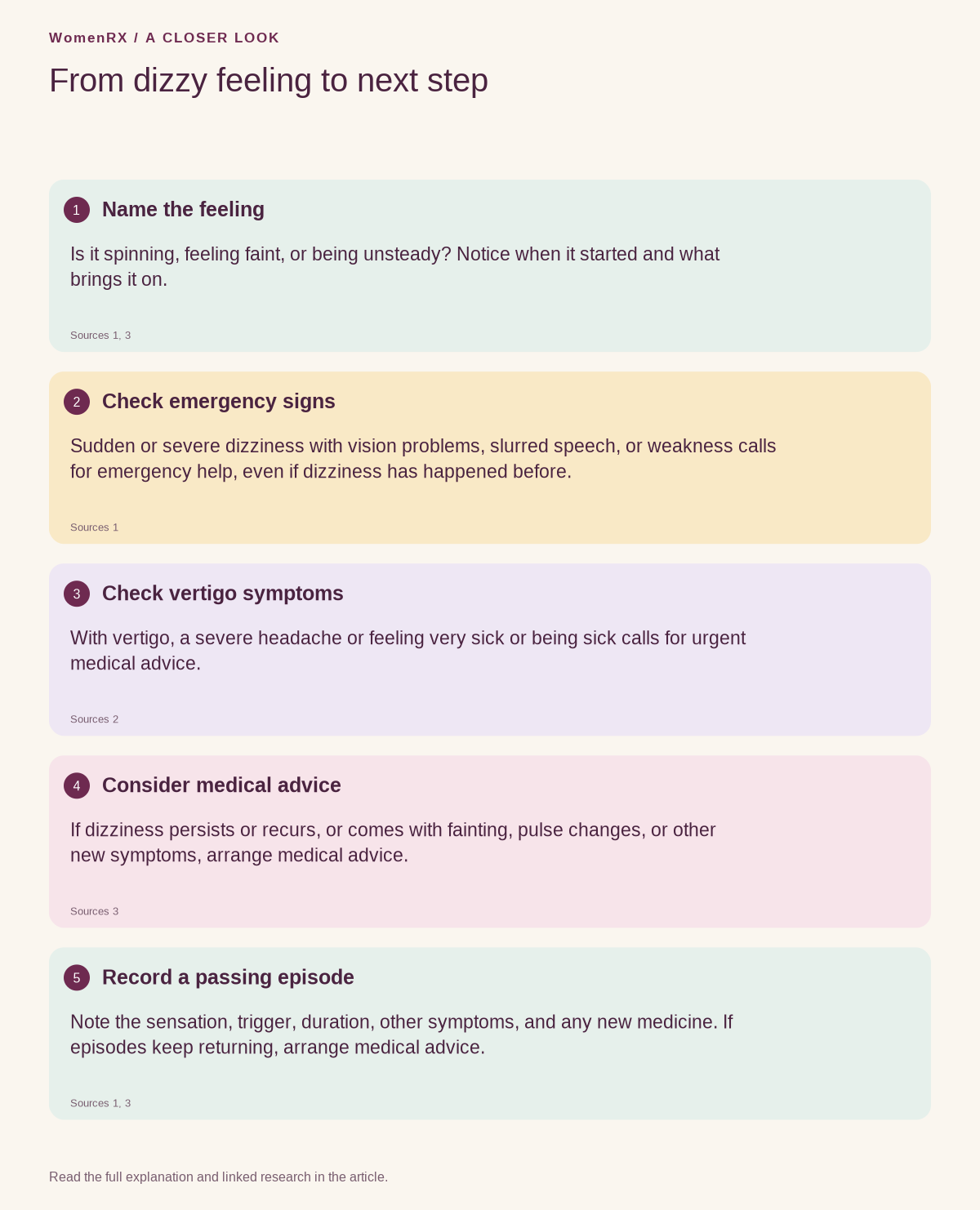
From dizzy feeling to next step
Name the feeling: Is it spinning, feeling faint, or being unsteady? Notice when it started and what brings it on.13
Check emergency signs: Sudden or severe dizziness with vision problems, slurred speech, or weakness calls for emergency help, even if dizziness has happened before.1
Check vertigo symptoms: With vertigo, a severe headache or feeling very sick or being sick calls for urgent medical advice.2
Consider medical advice: If dizziness persists or recurs, or comes with fainting, pulse changes, or other new symptoms, arrange medical advice.3
Record a passing episode: Note the sensation, trigger, duration, other symptoms, and any new medicine. If episodes keep returning, arrange medical advice.13
Read the figure as text
Name the sensation first. Then check for emergency warning signs before considering urgent advice or a pattern log; a recurring episode can also have warning signs.- Name the feeling: Is it spinning, feeling faint, or being unsteady? Notice when it started and what brings it on.13
- Check emergency signs: Sudden or severe dizziness with vision problems, slurred speech, or weakness calls for emergency help, even if dizziness has happened before.1
- Check vertigo symptoms: With vertigo, a severe headache or feeling very sick or being sick calls for urgent medical advice.2
- Consider medical advice: If dizziness persists or recurs, or comes with fainting, pulse changes, or other new symptoms, arrange medical advice.3
- Record a passing episode: Note the sensation, trigger, duration, other symptoms, and any new medicine. If episodes keep returning, arrange medical advice.13
More questions, answered
Should I drive while I’m dizzy?
No. Avoid driving while you feel dizzy, and avoid other activities where losing your balance could be dangerous. 3
Can I tell at home whether vertigo is from the inner ear or a stroke?
No. A spinning sensation doesn’t identify its cause by itself. One bedside examination clinicians may use, called HINTS, requires appropriate training and applies only to continuous dizziness with ongoing nystagmus, an involuntary eye movement. 6 Sudden or severe dizziness with vision problems, slurred speech, or weakness needs emergency attention. 1
Sources you can check
- Dizziness | Vertigo | MedlinePlusAccessed 2026-09-25Return to first citation
- Vertigo - NHSAccessed 2026-09-25Return to first citation
- Dizziness - NHSAccessed 2026-09-25Return to first citation
- Paramedic recognition of posterior circulation stroke: a vignette and focus group study.Devlin S, Bury G. · British paramedic journal · 2023Return to first citation
- Risk Factors and Risk Model Construction of Stroke in Patients with Vertigo in Emergency Department.Zhu Z, Li Q, Wang L, Xiao C, Wang H, Xu Y. · Computational and mathematical methods in medicine · 2022Return to first citation
- Pearls for the Emergency Clinician: Posterior Circulation Stroke.Pelletier J, Koyfman A, Long B. · The Journal of emergency medicine · 2023Return to first citation
- [A Practical Diagnostic Approach to Patients Presenting with "Dizziness": Evaluation and Differential Diagnosis Based on the ATTEST/TiTrATE Framework].Deguchi I. · Brain and nerve = Shinkei kenkyu no shinpo · 2026Return to first citation