Dizziness on Zepbound: What to Note and When to Get Help
Dizziness was reported in Zepbound weight-management trials; when it happens, what else you feel, and which medicines you take can help clarify the next step.
Dizziness and low blood pressure were reported more often with Zepbound than with placebo in weight-management trials. 1 If you feel lightheaded on standing, that may point toward a blood-pressure drop. Vomiting, diarrhea, difficulty drinking, and other medicines are also worth reviewing, but the trial figures can’t tell you which, if any, explains your dizziness. 12
What the Zepbound trial figures show
Dizziness was reported by 2% of placebo recipients and 4%, 5%, and 4% of adults taking Zepbound 5 mg, 10 mg, and 15 mg, respectively, in pooled weight-reduction trials. Low blood pressure, a category that included blood-pressure drops on standing, was reported by 0% on placebo and 1%, 1%, and 2% at those respective Zepbound doses. These are trial reports, not a way to tell what caused one person’s symptoms. The figures are for adults overall, not broken out by sex. 1
Dizziness can mean feeling faint or lightheaded, feeling off-balance, or feeling that you or the room is spinning. Those sensations can point to different things. A brief lightheaded spell when standing up is different from persistent spinning, for example, and neither description alone confirms a cause. 2
Look at the pattern, not just the injection
Start with when it happens. If you feel lightheaded just after standing, a sudden blood-pressure drop is one possible explanation. Tell your prescriber whether that pattern is new or keeps happening. 2
Then consider what else is going on. Nausea, vomiting, and diarrhea were reported in Zepbound trials. 1 If you’ve been vomiting or having diarrhea, especially if drinking has also been difficult, say so: those details help your prescriber assess possible fluid loss. If eating has been difficult, mention that too. None of these details, alone or together, proves why you feel dizzy.
A useful record can be simple: what the dizziness feels like; when it starts; whether you had just stood up; whether you had vomiting or diarrhea; and whether eating or drinking has been difficult. Include recent medication changes. You don’t need to track everything indefinitely. The goal is to give your prescriber a clear picture of the circumstances.
Review other medicines and possible causes
Bring your full medication list, including any medicines for blood pressure or blood sugar, to the conversation. Note if one was recently started or changed. Dizziness can occur after starting a prescription medicine, and lightheadedness on standing can fit a blood-pressure-drop pattern. 2 Your prescriber can assess those possibilities alongside your symptoms; the Zepbound trial figures do not establish a specific interaction with another treatment. 1
The Zepbound trial figures are more directly relevant to weight management than findings from tirzepatide trials in people with type 2 diabetes. A separate meta-analysis in people with type 2 diabetes reported an increased risk of dizziness with tirzepatide, but that population and indication are not the same as Zepbound weight-management trials. 13
When to get help
If you faint or collapse, seek medical attention. Contact your prescriber if dizziness keeps returning or does not go away, or if it comes with a change in your pulse. While you feel dizzy, sit or lie down, get up slowly, and avoid driving or other activities where losing your balance could be dangerous. 2
If you’re planning a pregnancy or think you could be pregnant, bring that up with your prescriber as a separate discussion about your treatment, not as an assumed explanation for dizziness.
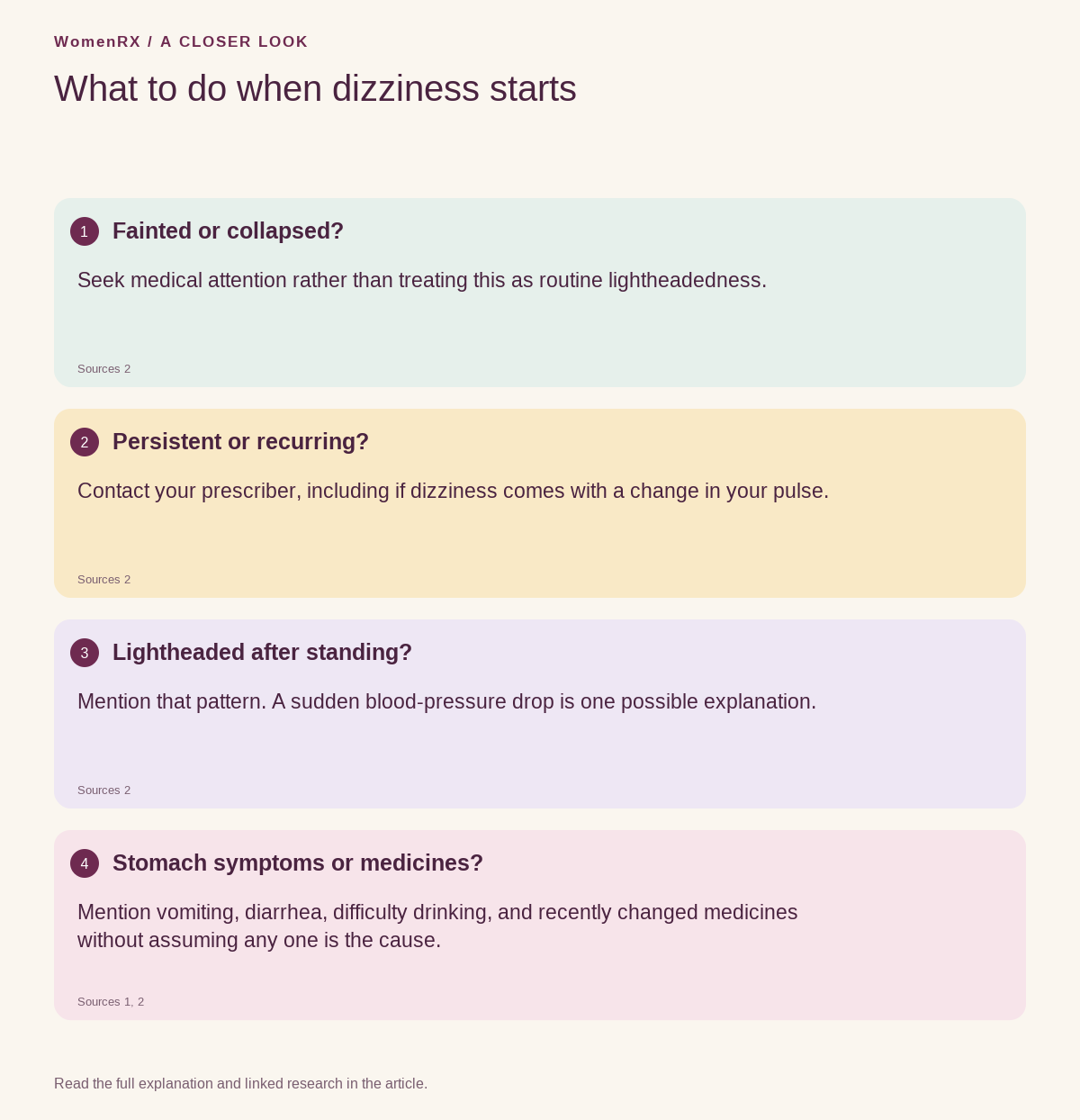
What to do when dizziness starts
Fainted or collapsed?: Seek medical attention rather than treating this as routine lightheadedness.2
Persistent or recurring?: Contact your prescriber, including if dizziness comes with a change in your pulse.2
Lightheaded after standing?: Mention that pattern. A sudden blood-pressure drop is one possible explanation.2
Stomach symptoms or medicines?: Mention vomiting, diarrhea, difficulty drinking, and recently changed medicines without assuming any one is the cause.12
Read the figure as text
Start with whether you need medical attention, then gather details that can help assess what’s happening.- Fainted or collapsed?: Seek medical attention rather than treating this as routine lightheadedness.2
- Persistent or recurring?: Contact your prescriber, including if dizziness comes with a change in your pulse.2
- Lightheaded after standing?: Mention that pattern. A sudden blood-pressure drop is one possible explanation.2
- Stomach symptoms or medicines?: Mention vomiting, diarrhea, difficulty drinking, and recently changed medicines without assuming any one is the cause.12
More questions, answered
Does dizziness mean Zepbound is causing low blood pressure?
Not necessarily. Low blood pressure, including drops on standing, was reported in Zepbound weight-management trials, but dizziness has other possible causes. Lightheadedness after standing is a useful pattern to mention; it doesn’t establish the cause by itself. 12
What if the dizziness keeps happening?
Contact your prescriber if it persists or keeps returning. Describe what it feels like, whether it follows standing, and any vomiting, diarrhea, difficulty eating or drinking, or recent medication changes. 12
Sources you can check
- ZEPBOUND (TIRZEPATIDE) INJECTION, SOLUTION ZEPBOUND (TIRZEPATIDE) INJECTION, SOLUTION ZEPBOUND KWIKPEN (TIRZEPATIDE) INJECTION, SOLUTION [ELI LILLY AND COMPANY] | US prescribing information and patient instructionsAccessed 2026-09-25Return to first citation
- Dizziness - NHSAccessed 2026-09-25Return to first citation
- Effect of Tirzepatide on arrhythmic, major cardiovascular, and neurological outcomes in patients with type 2 diabetes: A systematic review and meta-analysis.Wu R, Xing B, Zhou Z, Yu L, Wang H. · Neurological sciences : official journal of the Italian Neurological Society and of the Italian Society of Clinical Neurophysiology · 2025Return to first citation