Tirzepatide and Mood Changes: When to Get Help
Research hasn’t established that tirzepatide causes or prevents depression or anxiety, but new or worsening mood symptoms deserve attention.
A mood change while taking tirzepatide doesn’t, by itself, show the medicine caused it. One observational study found fewer recorded suicidal thoughts or attempts among tirzepatide users than among users of other weight-loss medicines, but it can’t establish cause and effect. Tell your prescriber about new or worsening symptoms. For crisis support, call or text 988; call 911 for an immediate emergency. 2 1
What the evidence can and can’t tell you
The available findings offer some reassurance, but they don’t settle what happens for every person taking tirzepatide. In a US retrospective study, researchers compared 16,321 matched pairs prescribed tirzepatide or non-GLP-1 weight-loss medicines. Over a median follow-up of 365 days, 17 people in the tirzepatide group and 33 in the comparison group had recorded suicidal thoughts or attempts. The lower observed risk in the tirzepatide group is an association, not proof that tirzepatide prevents these events. The study also excluded people with a documented history of suicidal thoughts or attempts, so it cannot answer every patient’s question. 2
A review of obesity interventions reports improved mental well-being in several GLP-1 medicine trials, while noting that long-term mental-health data remain limited. That broad summary doesn’t establish a tirzepatide-specific effect on anxiety or depression for an individual woman. 4
The same review says early pharmacovigilance data raised a possible concern about suicidality. Those reports can prompt safety monitoring, but they can’t by themselves show how often an event occurs or establish that a medicine caused it. The review says later cohort studies and meta-analyses did not support an association. 4
There are also individual case reports of mood changes after tirzepatide. A commentary describes one woman with bipolar disorder who developed lithium toxicity after starting tirzepatide, and a man with depression who developed mood lability, irritability, and aggression. Case reports can raise a safety question, but they can’t show how often something happens or prove the medicine caused it. The lithium report is a reason to tell your prescriber about your psychiatric medicines, not evidence that tirzepatide interacts with all such medicines. 3
Taken together, these findings don’t support saying that tirzepatide causes or prevents depression or anxiety. They do support taking a noticeable change seriously rather than deciding on your own that it’s either a side effect or unrelated.
Match your next step to how you feel
If symptoms are new or getting worse, but you feel safe: Contact the clinician who prescribes tirzepatide and describe what changed and when. Mention any mental-health diagnoses and treatments, including medicines such as lithium. If you’re postpartum or in perimenopause, include that context too; this research doesn’t establish how tirzepatide affects mood during either stage. Ask how to handle your treatment rather than making a medication change based only on a suspected connection.
If you’re thinking about suicide or aren’t sure you can stay safe: Get help right away. Call or text 988 to reach the Suicide & Crisis Lifeline. If there’s an immediate emergency, call 911. If you’re supporting someone else, MedlinePlus advises asking directly whether they’re thinking about killing themselves, staying with them, and helping connect them to crisis support. 1
You don’t need to prove what caused the change before asking for help. The useful next step is to share what you’re experiencing and get support that fits how urgent it feels.
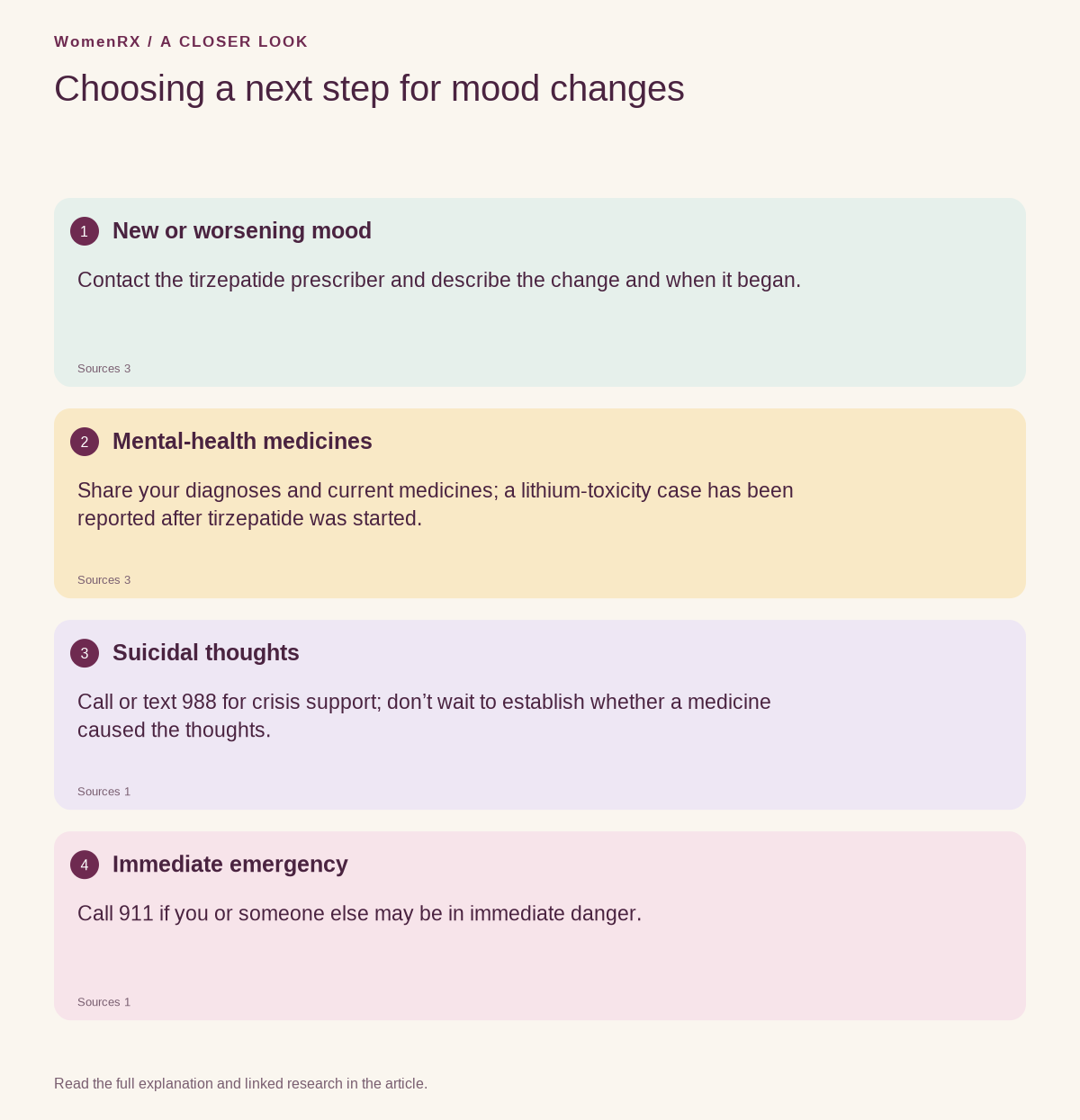
Choosing a next step for mood changes
New or worsening mood: Contact the tirzepatide prescriber and describe the change and when it began.3
Mental-health medicines: Share your diagnoses and current medicines; a lithium-toxicity case has been reported after tirzepatide was started.3
Suicidal thoughts: Call or text 988 for crisis support; don’t wait to establish whether a medicine caused the thoughts.1
Immediate emergency: Call 911 if you or someone else may be in immediate danger.1
Read the figure as text
Use the level of immediate safety concern, not a guess about the cause, to choose what to do next.- New or worsening mood: Contact the tirzepatide prescriber and describe the change and when it began.3
- Mental-health medicines: Share your diagnoses and current medicines; a lithium-toxicity case has been reported after tirzepatide was started.3
- Suicidal thoughts: Call or text 988 for crisis support; don’t wait to establish whether a medicine caused the thoughts.1
- Immediate emergency: Call 911 if you or someone else may be in immediate danger.1
More questions, answered
Does a mood change mean tirzepatide is the cause?
No. A change that begins during treatment is worth reporting, but timing alone can’t establish that the medicine caused it. The available cohort study was observational, and the individual case reports don’t prove cause and effect. 2 3
What if I take lithium or another mental-health medicine?
Tell your prescriber which medicines you take. A commentary describes a lithium-toxicity case after tirzepatide was started, but a single case doesn’t show that the same problem occurs broadly or establish a general interaction. 3
Sources you can check
- Suicide: MedlinePlusAccessed 2026-09-25Return to first citation
- Association of tirzepatide and the risk of suicide in a real-world cohort.Yu WS, Huang JY, Lo SC, Huang CN, Yang YS, Kornelius E. · Frontiers in psychiatry · 2025Return to first citation
- Commentary on the Risks of Prescription GLP-1 Agonists in Patients on Psychiatric Medications.Garakani A. · Journal of psychiatric practice · 2026Return to first citation
- Mental health outcomes in obesity interventions with GLP-1 receptor agonists: is it similar to other obesity interventions? A narrative review with systematic evidence synthesis.Osborne D, Abdelgadir E. · International journal of obesity (2005) · 2026Return to first citation