Tirzepatide, Anxiety, and Symptoms That Can Overlap
Current studies don’t establish that tirzepatide causes depression or anxiety, but new or worsening distress deserves attention either way.
Evidence so far is mixed and mostly observational: large real-world studies don’t show a consistent excess of depression or anxiety with tirzepatide, but comparisons differ and can’t prove cause and effect. Don’t wait to sort out the cause before taking symptoms seriously. Tell your prescriber what changed and when; seek immediate help if you may hurt yourself or can’t stay safe. 4 5 6 2
What the research can, and can’t, tell you
The available evidence doesn’t establish that tirzepatide causes depression or anxiety. A 2026 retrospective study compared new users of tirzepatide and semaglutide and found similar risks for a combined psychiatric outcome over two years. It did note a small, borderline higher anxiety signal for tirzepatide in the second year; the researchers cautioned that this finding could be due to the multiple comparisons they made. Because the study compared two medicines rather than tirzepatide with no treatment, it can’t settle whether either medicine changes an individual person’s mood. 5
Another US electronic-health-record study compared tirzepatide with different medicines. The direction of the findings depended on the comparison and group: tirzepatide was associated with lower rates of recorded depression and anxiety than naltrexone-bupropion, while among people without type 2 diabetes it was associated with higher anxiety diagnoses than semaglutide. These are observational associations, not proof that one medicine caused or prevented symptoms. Health differences between people taking different treatments can affect results, and diagnoses in records may not capture every person’s experience. 6
A 2026 review describes mental-health outcomes in GLP-1 medicine studies as an area with limited long-term data. Taken together, the research doesn’t justify either assuming tirzepatide is the cause of a mood change or dismissing the possibility just because a study didn’t find a consistent signal. 4 5 6
Earlier reports of psychiatric events also need careful interpretation. A European adverse-event database analysis counted 372 psychiatric reports among 31,444 reports for semaglutide, liraglutide, and tirzepatide combined. Those are reports about suspected events, not a count of users who developed symptoms: the database can’t tell how often symptoms occur among everyone taking the medicines or whether a medicine caused them. 7
One medication-related clue: low blood sugar
Anxiety, irritability, or a change in mood can also occur as part of low blood sugar. The Zepbound medication guide lists these among possible low-blood-sugar symptoms, along with signs such as shakiness, sweating, confusion, or a fast heartbeat. The guide says the risk can be higher when Zepbound is used with medicines such as insulin or a sulfonylurea. If you use one of those medicines and feel suddenly shaky, sweaty, confused, or unusually anxious, tell your care team about the combination and symptoms. 3
That overlap doesn’t mean every mood change is low blood sugar. A clinician can help assess the symptoms and their timing alongside your other medicines and health circumstances.
What to tell your prescriber
You don’t need to decide whether tirzepatide is responsible before asking for help. Share when the mood change began, whether it’s getting worse, and how it’s affecting sleep, work, relationships, or daily tasks. Mention any recent change in treatment, other medicines you take, and whether you have symptoms such as shakiness, sweating, or confusion. Those details can help distinguish a mood problem from symptoms that may have another explanation.
Also share relevant life context, including pregnancy, the postpartum period, or the transition toward menopause. These can matter when assessing mood, but the studies summarized here don’t establish a tirzepatide effect specific to women or report results for these life stages. Depression has multiple possible contributing factors, and anxiety that overwhelms daily activities is worth addressing in its own right. 1 2 5 6
If depression or anxiety is getting worse, interfering with daily life, or making it hard to manage basic activities, contact your prescriber or a mental-health provider promptly rather than waiting to see whether it passes. Depression can involve persistent low mood or loss of interest and may make everyday tasks difficult; anxiety can become overwhelming or disrupt daily functioning. 1 2
If you’re thinking about hurting yourself, or you don’t feel able to stay safe, get help right away. MedlinePlus advises calling 911 in an emergency. 2
Mood evidence and next steps
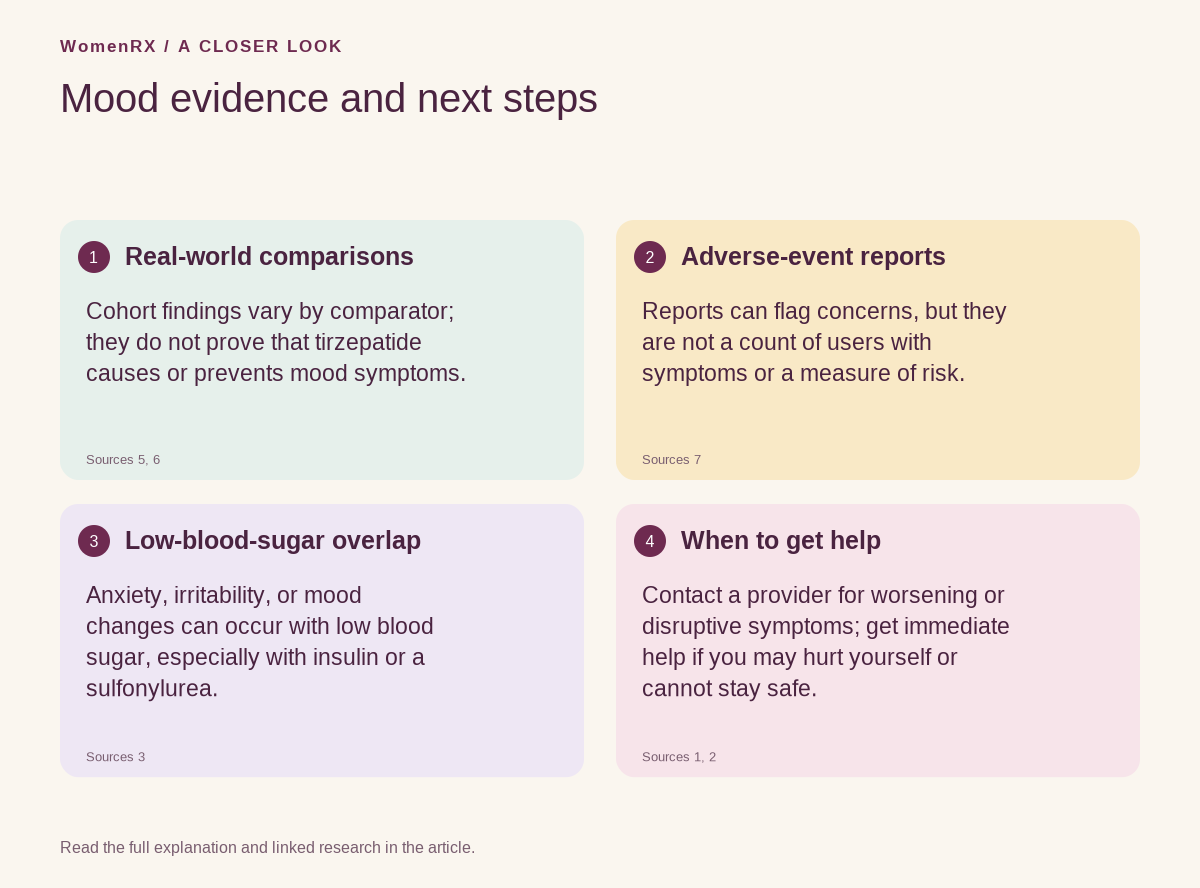
Real-world comparisons: Cohort findings vary by comparator; they do not prove that tirzepatide causes or prevents mood symptoms.56
Adverse-event reports: Reports can flag concerns, but they are not a count of users with symptoms or a measure of risk.7
Low-blood-sugar overlap: Anxiety, irritability, or mood changes can occur with low blood sugar, especially with insulin or a sulfonylurea.3
When to get help: Contact a provider for worsening or disruptive symptoms; get immediate help if you may hurt yourself or cannot stay safe.12
Read the figure as text
The evidence does not settle cause, but it can help separate medication signals, overlapping symptoms, and when to seek support.- Real-world comparisons: Cohort findings vary by comparator; they do not prove that tirzepatide causes or prevents mood symptoms.56
- Adverse-event reports: Reports can flag concerns, but they are not a count of users with symptoms or a measure of risk.7
- Low-blood-sugar overlap: Anxiety, irritability, or mood changes can occur with low blood sugar, especially with insulin or a sulfonylurea.3
- When to get help: Contact a provider for worsening or disruptive symptoms; get immediate help if you may hurt yourself or cannot stay safe.12
Sources you can check
- Anxiety: MedlinePlusAccessed 2026-09-25Return to first citation
- Depression: MedlinePlusAccessed 2026-09-25Return to first citation
- ZEPBOUND (TIRZEPATIDE) INJECTION, SOLUTION ZEPBOUND (TIRZEPATIDE) INJECTION, SOLUTION ZEPBOUND KWIKPEN (TIRZEPATIDE) INJECTION, SOLUTION [ELI LILLY AND COMPANY] | US prescribing information and patient instructionsAccessed 2026-09-25Return to first citation
- Mental health outcomes in obesity interventions with GLP-1 receptor agonists: is it similar to other obesity interventions? A narrative review with systematic evidence synthesis.Osborne D, Abdelgadir E. · International journal of obesity (2005) · 2026Return to first citation
- Neuropsychiatric Outcomes With Tirzepatide, Semaglutide, and Other GLP-1 Receptor Agonists.Chen SC, Wang TJ, Chou CK, Lee C. · Diabetes, obesity & metabolism · 2026Return to first citation
- Neuropsychiatric association of tirzepatide and semaglutide in obesity with and without type 2 diabetes.Huang YN, Liu KW, Li PH, Chen JC, Meyerowitz-Katz G, Su PH, Huang CC. · Communications medicine · 2026Return to first citation
- Psychiatric adverse events associated with semaglutide, liraglutide and tirzepatide: a pharmacovigilance analysis of individual case safety reports submitted to the EudraVigilance database.Tobaiqy M, Elkout H. · International journal of clinical pharmacy · 2024Return to first citation