Anxiety and Hormones: What Can We Actually Say?
Hormone transitions may shape mood for some women, but timing alone can’t prove what’s causing anxiety.
Anxiety can change during midlife, but research doesn’t show that a hormone shift alone causes it. A menopause review describes mood as influenced by menopause-related and other factors; a small sleep study found different links among hormones, sleep, and anxiety depending on whether participants had insomnia. These findings don’t make anxiety a menopause symptom by default, or establish hormone therapy as an anxiety treatment. 2 3 4
A change in timing isn’t proof of cause
If anxiety begins or feels different around menopause, the timing is worth noticing. It doesn’t, by itself, tell you why it’s happening. A review of midlife mood describes depression, sometimes with anxiety, as potentially shaped by both menopause-related and nonmenopause-related factors. That supports considering menopause as one possible influence, not treating it as a confirmed cause of anxiety. 2
Anxiety can also be a temporary response to stress. An anxiety disorder is different: fear or worry persists and can interfere with everyday activities. Its cause isn’t known, and factors such as biology, genetics, stress, and environment may play a role. 1
Sleep findings don’t point to one simple hormone explanation
A small laboratory study measured hormones and sleep in 33 perimenopausal women: 16 had a clinical insomnia diagnosis and 17 didn’t report sleep complaints. Researchers also included 11 younger premenopausal women without sleep complaints. Among the perimenopausal women with insomnia, amount of sleep was associated with anxiety and depression, but not with the hormone FSH. That’s a relationship observed at one point in time, not proof that poor sleep caused anxiety or that anxiety caused poor sleep. 3
The pattern differed in the perimenopausal participants without sleep complaints. In that group, FSH was associated with some measures of interrupted sleep. The contrast suggests that midlife sleep and mood can’t be reduced to one hormone explanation. The study was small and cross-sectional, so it can’t settle what drives these patterns or show that changing a hormone level would resolve anxiety or sleep problems. 3
For example, if anxiety and disrupted sleep are happening together, describe both rather than assuming one explains the other. Hot flashes, night sweats, and other symptoms may also be relevant context if you’re experiencing them, but this study doesn’t establish that they cause anxiety.
Don’t treat different reproductive stages as interchangeable
Hormonal exposures during the menstrual cycle, pregnancy, postpartum, lactation, and menopause differ, and may be associated with partly distinct symptom patterns. A review also notes that some women may be more vulnerable to hormonal shifts, though the reasons remain unclear. 5
That broad finding doesn’t tell us that ordinary cycle changes or pregnancy-related hormones cause anxiety in a particular person. It also doesn’t mean results from menopause research apply to pregnancy or the menstrual cycle. If you’re noticing a pattern around one stage, the timing is useful information, but it isn’t a diagnosis or proof of a hormone cause.
What to bring into the conversation
Start with the pattern you’re experiencing, not a verdict about its cause. You might describe when the anxiety began, whether it comes and goes or feels persistent, how it affects daily life, and whether sleep or a reproductive transition changed around the same time. Those details can help make room for hormone-related and non-hormonal explanations without assuming either one.
You don’t have to wait until the cause is certain to seek help if anxiety is overwhelming or interfering with work, relationships, or daily activities. Psychotherapy, medication, or both are among the main treatment approaches for anxiety disorders. 1
Hormone treatment is a separate question. Reviews discuss mood broadly and report mixed findings; a midlife review says using estradiol to prevent depressive symptoms needs further study. These findings don’t establish hormone therapy as a treatment for anxiety. 2 4
The practical takeaway: take the timing seriously, but don’t let timing stand in for an explanation. Sleep, life stage, and whether anxiety is persistent and disruptive are separate pieces of the picture.
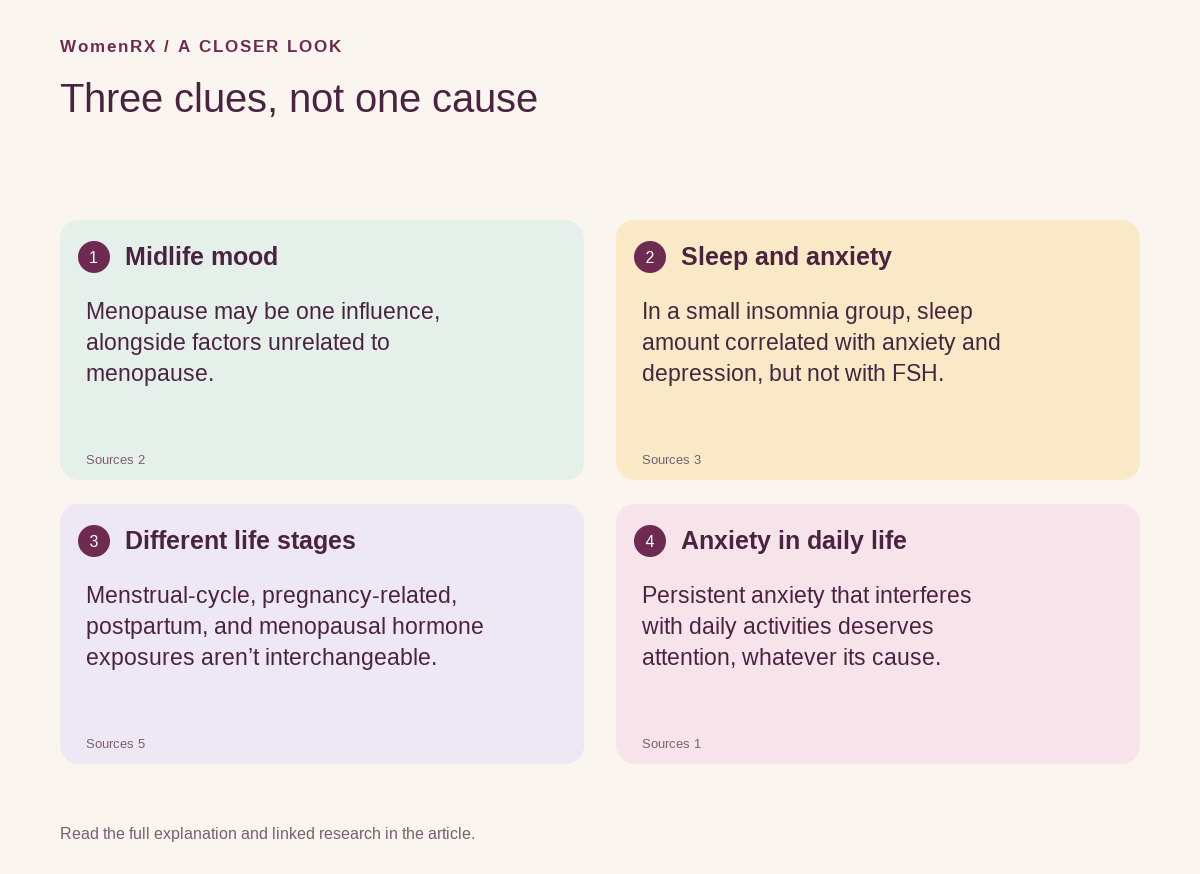
Three clues, not one cause
Midlife mood: Menopause may be one influence, alongside factors unrelated to menopause.2
Sleep and anxiety: In a small insomnia group, sleep amount correlated with anxiety and depression, but not with FSH.3
Different life stages: Menstrual-cycle, pregnancy-related, postpartum, and menopausal hormone exposures aren’t interchangeable.5
Anxiety in daily life: Persistent anxiety that interferes with daily activities deserves attention, whatever its cause.1
Read the figure as text
Compare what menopause, sleep research, and anxiety symptoms can each tell you without treating an association as proof.- Midlife mood: Menopause may be one influence, alongside factors unrelated to menopause.2
- Sleep and anxiety: In a small insomnia group, sleep amount correlated with anxiety and depression, but not with FSH.3
- Different life stages: Menstrual-cycle, pregnancy-related, postpartum, and menopausal hormone exposures aren’t interchangeable.5
- Anxiety in daily life: Persistent anxiety that interferes with daily activities deserves attention, whatever its cause.1
Sources you can check
- Anxiety: MedlinePlusAccessed 2026-09-25Return to first citation
- Taking a fresh look at mood, hormones, and menopause.Soares CN. · Menopause (New York, N.Y.) · 2020Return to first citation
- Interaction between reproductive hormones and physiological sleep in women.de Zambotti M, Colrain IM, Baker FC. · The Journal of clinical endocrinology and metabolism · 2015Return to first citation
- Steroids, reproductive endocrine function, and affect. A review.Frye CA. · Minerva ginecologica · 2009Return to first citation
- Neuroendocrine Networks and Functionality.Altemus M. · The Medical clinics of North America · 2019Return to first citation