Perimenopause Anxiety: What to Expect and When to Get Help
Anxiety can change during the menopause transition, but studies can’t predict how long it will last for you.
There’s no reliable countdown for anxiety that starts or worsens in perimenopause. In a 10-year study, anxiety symptoms varied by menopause stage for some women, while women who began with high anxiety continued to report it at high rates. Those group patterns can’t predict when one person’s symptoms will ease. If anxiety feels overwhelming, you can seek support without waiting for menopause to end. 3 1
There isn’t a personal timetable
Anxiety may rise during perimenopause, but research can’t give you a dependable number of months or years to expect. Symptoms can vary across the transition, and a pattern seen across a group of women can’t tell you when an individual’s anxiety will settle. Anxiety isn’t guaranteed to disappear after menopause, either.
One 10-year study followed 2,956 women from multiple racial and ethnic groups, ages 42 to 52 at the start. Among women who began with low anxiety, high-anxiety symptoms were more likely during early or late perimenopause and after menopause than before the transition. Women who began with high anxiety continued to report high symptom levels across follow-up, without a difference tied to a particular menopause stage. The study measured symptoms, not anxiety-disorder diagnoses, and it doesn’t provide a personal forecast. 3
That distinction matters: a change in symptoms by menopause stage doesn’t mean menopause is the only cause, or that your experience will match someone else’s.
Hormones may be one part of the picture
Perimenopause involves reproductive and hormonal changes, and anxiety symptoms can increase during the transition. But that timing alone doesn’t show that hormones caused your anxiety. In the long-term study, the association between menopause stage and anxiety symptoms remained after researchers accounted for factors including upsetting life events, financial strain, perceived health, and hot flashes. Those factors can provide context, but the study doesn’t identify the cause of any one person’s symptoms. 3 4
If you’re trying to make sense of what’s happening, notice whether anxiety seems to shift during stressful periods or alongside other changes. That may help you describe the pattern, but it won’t diagnose the cause. An assessment can include questions about your symptoms and medical history; a clinician may also consider an exam or tests to check whether another health issue could be contributing. 1
When anxiety deserves attention
Anxiety can be a normal response to stress. It deserves attention when it feels overwhelming rather than temporary, or when it keeps returning. Anxiety disorders have different patterns. For example, MedlinePlus describes generalized anxiety disorder as excessive worry about everyday matters almost every day for at least six months. That description isn’t a reason to wait six months before asking for help. 1
You can reach out to a primary care clinician or mental health professional if anxiety feels overwhelming or is difficult to manage. You don’t need to wait for a particular menopause stage to pass. Sharing when it began, how it changes, and what else is going on in your life can help put the symptoms in context.
Support can address anxiety directly
Psychotherapy, including cognitive behavioral therapy (CBT), is one treatment option for anxiety disorders. Medicines may also be considered, alone or alongside therapy. Which approach fits depends on the type of anxiety and your circumstances, so an assessment can help clarify the options. 1
Hormone therapy is a separate conversation. The North American Menopause Society’s position statement identifies it as an effective treatment for bothersome hot flashes and other specified menopause-related indications; that statement doesn’t establish hormone therapy as an anxiety treatment. If hot flashes are bothering you, they’re worth discussing in their own right. 2
The practical takeaway: perimenopause may be part of the story, but there’s no set duration you need to endure. If anxiety is overwhelming, support can start now.
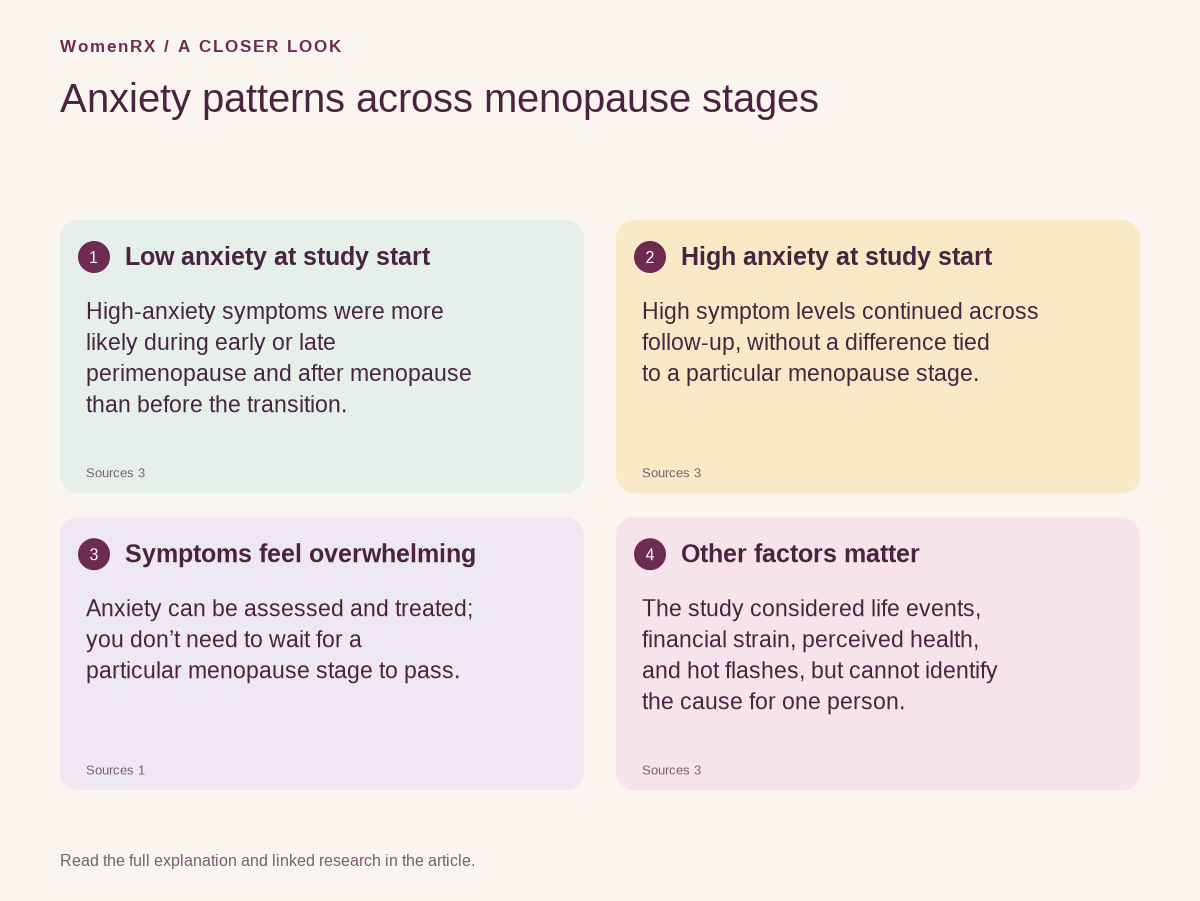
Anxiety patterns across menopause stages
Low anxiety at study start: High-anxiety symptoms were more likely during early or late perimenopause and after menopause than before the transition.3
High anxiety at study start: High symptom levels continued across follow-up, without a difference tied to a particular menopause stage.3
Symptoms feel overwhelming: Anxiety can be assessed and treated; you don’t need to wait for a particular menopause stage to pass.1
Other factors matter: The study considered life events, financial strain, perceived health, and hot flashes, but cannot identify the cause for one person.3
Read the figure as text
These study findings describe group patterns, not a countdown for one person. The comparison helps separate symptom course from the decision to seek support.- Low anxiety at study start: High-anxiety symptoms were more likely during early or late perimenopause and after menopause than before the transition.3
- High anxiety at study start: High symptom levels continued across follow-up, without a difference tied to a particular menopause stage.3
- Symptoms feel overwhelming: Anxiety can be assessed and treated; you don’t need to wait for a particular menopause stage to pass.1
- Other factors matter: The study considered life events, financial strain, perceived health, and hot flashes, but cannot identify the cause for one person.3
More questions, answered
Does anxiety usually stop after menopause?
There’s no reliable individual timetable, and anxiety isn’t guaranteed to stop after menopause. In a 10-year study, symptoms varied by menopause stage for women who began with low anxiety, while women who began with high anxiety reported high symptom levels across follow-up. 3
Should I wait six months before asking for help?
No. Six months is part of MedlinePlus’s description of generalized anxiety disorder, not a waiting period before seeking support. If anxiety feels overwhelming, you can ask for help sooner. 1
Sources you can check
- Anxiety: MedlinePlusAccessed 2026-09-25Return to first citation
- The 2022 hormone therapy position statement of The North American Menopause Society.“The 2022 Hormone Therapy Position Statement of The North American Menopause Society” Advisory Panel. · Menopause (New York, N.Y.) · 2022Return to first citation
- Does risk for anxiety increase during the menopausal transition? Study of women's health across the nation.Bromberger JT, Kravitz HM, Chang Y, Randolph JF, Avis NE, Gold EB, Matthews KA. · Menopause (New York, N.Y.) · 2013Return to first citation
- Perimenopause: From Research to Practice.Santoro N. · Journal of women's health (2002) · 2016Return to first citation