Does Anxiety Change After Perimenopause?
Your period history can help identify your menopause stage, but anxiety doesn’t follow a reliable stage-by-stage pattern.
Perimenopause is the transition when periods may become irregular or be skipped; postmenopause follows 12 consecutive months without a period. Anxiety can occur in either stage. Studies comparing the stages don’t give you a dependable rule for when anxiety will be worse, so use your menstrual history to understand your stage and consider anxiety on its own terms. 2 1
If anxiety started around the time your periods changed, the timing may feel like a clue. It is a clue worth noticing, but it can’t tell you by itself whether you’re in perimenopause, whether you’ve reached postmenopause, or what’s causing the anxiety. 2 1
Periods identify the stage; anxiety doesn’t
Perimenopause is the transition when menstrual cycles may become irregular or you may skip a period. Postmenopause is the stage after 12 consecutive months without a menstrual period. Anxiety is reported in both stages, so the presence or intensity of anxious feelings isn’t a substitute for menstrual history. 2
| If you notice… | What it helps you understand |
|---|---|
| Periods becoming irregular or skipped | This can fit perimenopause. Anxiety occurring at the same time doesn’t establish its cause. 2 |
| More than 12 months without a period | This fits the study’s definition of postmenopause. Anxiety can still occur after periods stop. 2 |
| Anxiety that persists or disrupts daily life | This needs attention regardless of your menopause stage. 1 |
The distinction matters because a change in cycle pattern answers a different question from a change in how you feel. For example, if your periods have become unpredictable and you’ve also begun feeling tense or fearful, both observations are useful. Neither proves that the other caused it.
Do studies show a different anxiety pattern?
Not a pattern you can reliably apply to yourself. In a 2025 cross-sectional analysis of midlife women, researchers looked at how symptoms related to one another within perimenopause and postmenopause groups. Mood change was a key symptom in the perimenopause network; anxiety was a key symptom in the postmenopause network. But the formal comparisons did not find significant differences in overall network strength, network structure, or the reported centrality comparison between groups. A symptom’s position in a network does not tell you that it is more common or more severe in that stage. The study was also a snapshot, not a record of how the same women’s anxiety changed over time. 2
A separate survey of 131 perimenopausal and 127 postmenopausal participants found greater reported anxiety burden in the perimenopause group. In that survey, 86.1% of participants reported current cannabis use, and 78.7% endorsed using medical cannabis for menopause-related symptoms. That makes the group a limited basis for predicting what any given woman will experience. The survey measured anxiety burden, while the network study examined relationships among symptoms; their findings aren’t opposing measures of the same thing. 3 2
When the stage isn’t the whole explanation
Anxiety can feel like fear, dread, restlessness, tension, or a rapid heartbeat. Stress can contribute, and physical conditions including thyroid problems and arrhythmia can also be associated with anxiety symptoms. That’s why a new racing-heart sensation, for example, shouldn’t automatically be put down to menopause or dismissed as “just anxiety.” 1
If worry or fear is hard to control, persists, or interferes with work, relationships, or ordinary activities, you don’t need to wait for your periods to settle before addressing it. An assessment can look at your symptoms and health history and, when appropriate, check for another health problem. Psychotherapy, medication, or both are established approaches for anxiety disorders. The useful next question isn’t only Which menopause stage am I in? It’s also What is this anxiety doing to my life, and what else might be contributing? 1
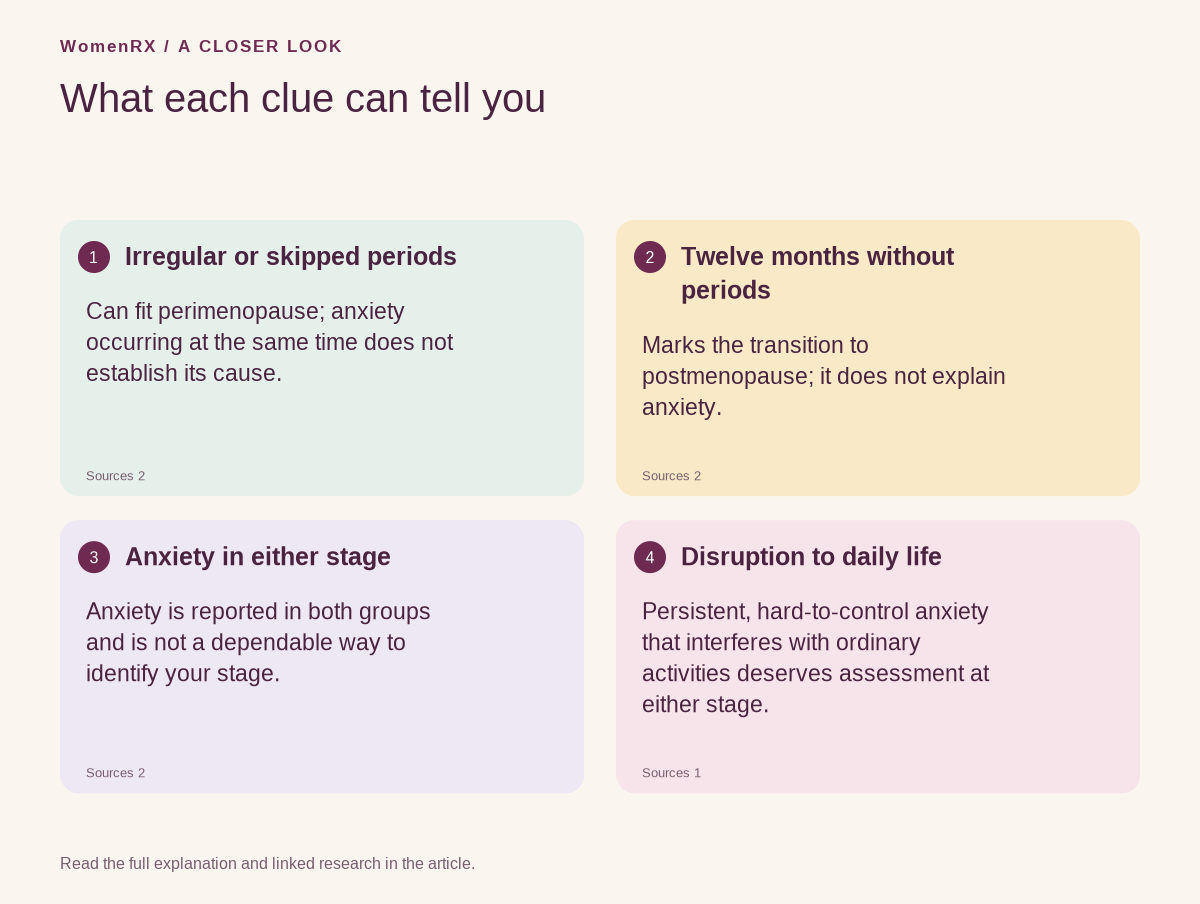
What each clue can tell you
Irregular or skipped periods: Can fit perimenopause; anxiety occurring at the same time does not establish its cause.2
Twelve months without periods: Marks the transition to postmenopause; it does not explain anxiety.2
Anxiety in either stage: Anxiety is reported in both groups and is not a dependable way to identify your stage.2
Disruption to daily life: Persistent, hard-to-control anxiety that interferes with ordinary activities deserves assessment at either stage.1
Read the figure as text
Cycle changes help distinguish menopause stages. Anxiety symptoms tell you something about how you feel, but not which stage caused it.- Irregular or skipped periods: Can fit perimenopause; anxiety occurring at the same time does not establish its cause.2
- Twelve months without periods: Marks the transition to postmenopause; it does not explain anxiety.2
- Anxiety in either stage: Anxiety is reported in both groups and is not a dependable way to identify your stage.2
- Disruption to daily life: Persistent, hard-to-control anxiety that interferes with ordinary activities deserves assessment at either stage.1
Sources you can check
- Anxiety: MedlinePlusAccessed 2026-09-25Return to first citation
- Comparison of Symptoms Between Midlife Women in Perimenopause and Postmenopause Using Network Comparison Test.Min SH, Yang Q, Docherty SL, Lee C. · Western journal of nursing research · 2025Return to first citation
- A survey of medical cannabis use during perimenopause and postmenopause.Dahlgren MK, El-Abboud C, Lambros AM, Sagar KA, Smith RT, Gruber SA. · Menopause (New York, N.Y.) · 2022Return to first citation