Can Anxiety Happen During Perimenopause?
Anxiety can show up during this life stage, but cycle changes alone can’t tell you what’s causing it.
Yes. Anxiety is among symptoms reported during perimenopause, but its timing alongside cycle changes does not establish a cause. 5 Note when anxiety happens, how you’re sleeping, and whether it’s affecting everyday life. Seek support if it persists, worsens, or interferes with work or relationships. 2 3
Anxiety can happen, but it isn’t a diagnosis of perimenopause
Anxiety is among symptoms reported during perimenopause. 5 A change in your periods alongside new anxiety may feel connected. It could be useful to notice whether the two seem to occur around the same time, but that pattern can’t establish the cause. Anxiety can also be a temporary response to stress. When it becomes persistent, hard to control, or disruptive to daily life, it may need attention in its own right. 3
A small cognitive behavioral therapy (CBT) case series included people in perimenopause or postmenopause who reported mood symptoms. It did not assess whether anxiety becomes more common during the transition, follows a cycle pattern, or is caused by hormonal changes. 4
So, if your anxiety is new or worsening, it’s reasonable to consider it alongside cycle changes, but not to assume that perimenopause explains it. A clinician can ask about your symptoms and medical history, and may use an exam or lab tests to check whether another health problem could be contributing. 3
Look for a pattern, and also check the impact
For a few weeks, jot down a brief note when anxiety occurs. You don’t need a perfect diary or a special app. The point is to make it easier to describe what’s happening and whether it’s changing.
- Anxiety: When it started, how long it lasted, and whether it felt manageable or hard to control.
- Cycle: Bleeding dates or other changes you’ve noticed. This is context, not a test for menopause-related anxiety.
- Sleep and stress: Note sleep changes and any obvious stressful situations. Changes in sleeping habits and feeling unusually worried or scared can be signs worth discussing. 2
- Daily impact: Record whether anxiety is affecting work, relationships, or activities you’ve begun avoiding. Interference with everyday life is a reason to seek help. 3
The pattern may be unclear, and that’s okay. Anxiety can vary over time, and a record is useful even if it doesn’t show a clear link to your cycle. Don’t wait until you’ve tracked for weeks if symptoms are severe or already interfering with daily life. 2 3
Support can address anxiety without settling its cause
A primary care provider can be a starting point, or you can seek help from a mental health professional. Anxiety disorders are commonly treated with psychotherapy, medication, or both. CBT is one type of therapy that can help change how you respond to anxious thoughts and situations. 1 3
The CBT case series reported lower anxiety scores by the end of the program. It tested general CBT, not a treatment tailored to perimenopause, and the authors called for a larger clinical trial. 4
If you’re having thoughts of suicide, call or text 988 for the Suicide & Crisis Lifeline. You don’t need to wait for a cycle pattern or an appointment to reach out. 1
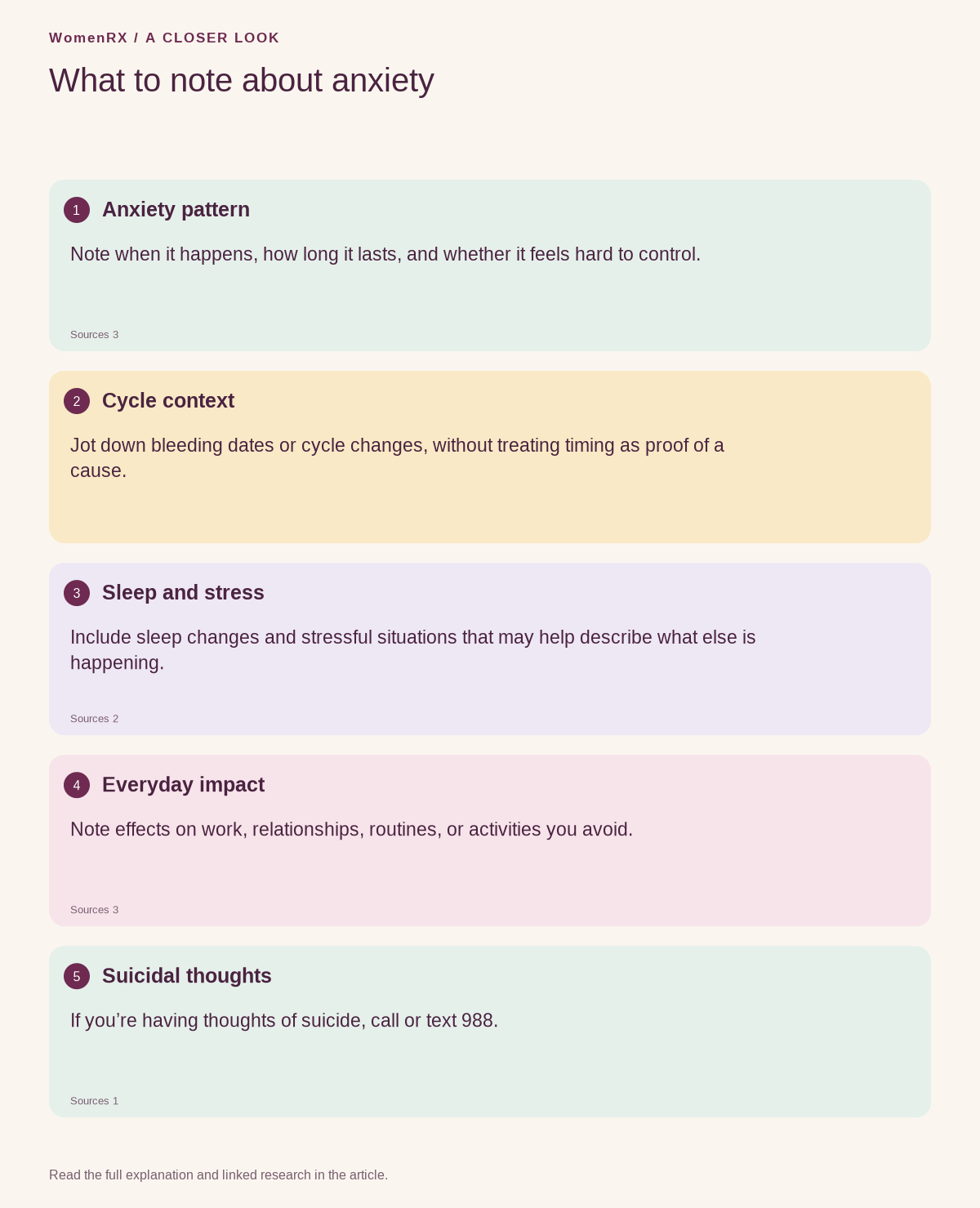
What to note about anxiety
Anxiety pattern: Note when it happens, how long it lasts, and whether it feels hard to control.3
Cycle context: Jot down bleeding dates or cycle changes, without treating timing as proof of a cause.
Sleep and stress: Include sleep changes and stressful situations that may help describe what else is happening.2
Everyday impact: Note effects on work, relationships, routines, or activities you avoid.3
Suicidal thoughts: If you’re having thoughts of suicide, call or text 988.1
Read the figure as text
Use these prompts to describe anxiety and its impact. They can help organize a conversation, but they don’t diagnose perimenopause or identify a cause.- Anxiety pattern: Note when it happens, how long it lasts, and whether it feels hard to control.3
- Cycle context: Jot down bleeding dates or cycle changes, without treating timing as proof of a cause.
- Sleep and stress: Include sleep changes and stressful situations that may help describe what else is happening.2
- Everyday impact: Note effects on work, relationships, routines, or activities you avoid.3
- Suicidal thoughts: If you’re having thoughts of suicide, call or text 988.1
More questions, answered
Does anxiety that starts with cycle changes mean I’m in perimenopause?
No. Cycle changes can be useful context, but they don’t establish why anxiety is happening. A provider can consider your symptoms and history and check whether another health issue may be involved. 3
When is anxiety interfering enough to seek help?
Consider reaching out when worry is hard to control, persists or worsens, leads you to avoid everyday activities, or affects work or relationships. You don’t need to wait until it becomes overwhelming. 3
Sources you can check
- NIMH: Women and mental healthAccessed 2026-09-25Return to first citation
- Mental Health: MedlinePlusAccessed 2026-09-25Return to first citation
- Anxiety: MedlinePlusAccessed 2026-09-25Return to first citation
- Eight-session manualized cognitive behavioral therapy for anxiety and depression symptoms in perimenopause and postmenopause: a pilot study.Hantsoo L, Friedman-Wheeler DG, Lofland G, Harrison SA, Smith G, Shen W. · Menopause (New York, N.Y.) · 2026Return to first citation
- Microbiota-Host Interactions in Perimenopausal Syndrome: Mechanisms and Therapeutic Strategies (Review).Guo Q, Liang F, Chen P, Zhang Y, Xie M, Wan X, Mao J, Chen H, Wu W, Jiang D, Wu S. · International journal of women's health · 2026Return to first citation