Anxiety in Perimenopause: Patterns, Causes, and Support
Anxiety can show up during perimenopause, but hormones aren’t the only possible explanation, and your symptom pattern can help guide what to try next.
Anxiety may change during the menopausal transition, but a new or worsening feeling of worry isn’t proof that hormones are its sole cause. Sleep disruption, hot flashes, life stress, mental health history, and physical health conditions can all matter. Notice when anxiety occurs and what else is happening, then consider support for anxiety itself as well as any menopause symptoms affecting sleep or daily life. 123
Start with the pattern, not a single explanation
Perimenopause can bring changes in sleep and other symptoms, and anxiety may occur alongside them. But an association or overlap doesn’t show what’s causing anxiety for one person. Anxiety can also relate to life experiences, stress, family history, lifestyle, or physical health conditions; thyroid problems and heart rhythm problems are among the conditions that can produce anxiety-like symptoms. 123
A brief, practical record can help you see what tends to happen together. For example, note when anxiety appears, how you slept, whether you had hot flashes or night sweats, and whether the worry affected work, relationships, or everyday activities. Include changes in your menstrual pattern if they seem relevant. This isn’t a diagnostic test, and it can’t prove that one symptom caused another. It’s a way to bring a clearer pattern into a care conversation.
Choose support for the problem you want to ease
If worry is hard to control, keeps returning, or is interfering with daily life, anxiety deserves attention in its own right. Cognitive behavioral therapy (CBT) is one type of talk therapy used for anxiety; it helps you change how you respond to troubling thoughts and situations. A menopause-focused systematic review found that psychological approaches, especially CBT and CBT for insomnia, were generally associated with improvements in psychological or sleep-related symptoms. The studies varied, so results aren’t a promise that one approach will work for everyone. 23
Medication can also be part of anxiety treatment. The choice depends on the kind of anxiety and your circumstances; some medicines used for anxiety are antidepressants. If you’re considering medication, discuss its possible benefits and downsides with the person treating you rather than assuming a menopause treatment and an anxiety treatment are interchangeable. 2
If night sweats or hot flashes are disrupting sleep, bring those symptoms up separately. Menopausal hormone therapy is an effective treatment for bothersome vasomotor symptoms, and its balance of benefits and risks depends on personal factors. That evidence supports treating hot flashes and night sweats; it does not establish hormone therapy as a treatment for anxiety itself. 5
Make the next conversation specific
You could describe what has changed, when it happens, and what it’s getting in the way of. For example: “My worry is strongest after nights when I wake repeatedly,” or “It’s present even when I’m sleeping well.” Mention prior anxiety or depression, major stressors, and any physical symptoms that concern you. If anxiety feels new or different, a clinician can ask about your symptoms and health history and assess whether a physical condition might be contributing. 12
The aim isn’t to decide for yourself whether anxiety is “hormonal.” It’s to make room for several possible contributors and choose support that matches what you’re experiencing. If the distress is severe, or you have thoughts of harming yourself or can’t keep yourself safe, seek immediate help rather than waiting for a routine appointment.
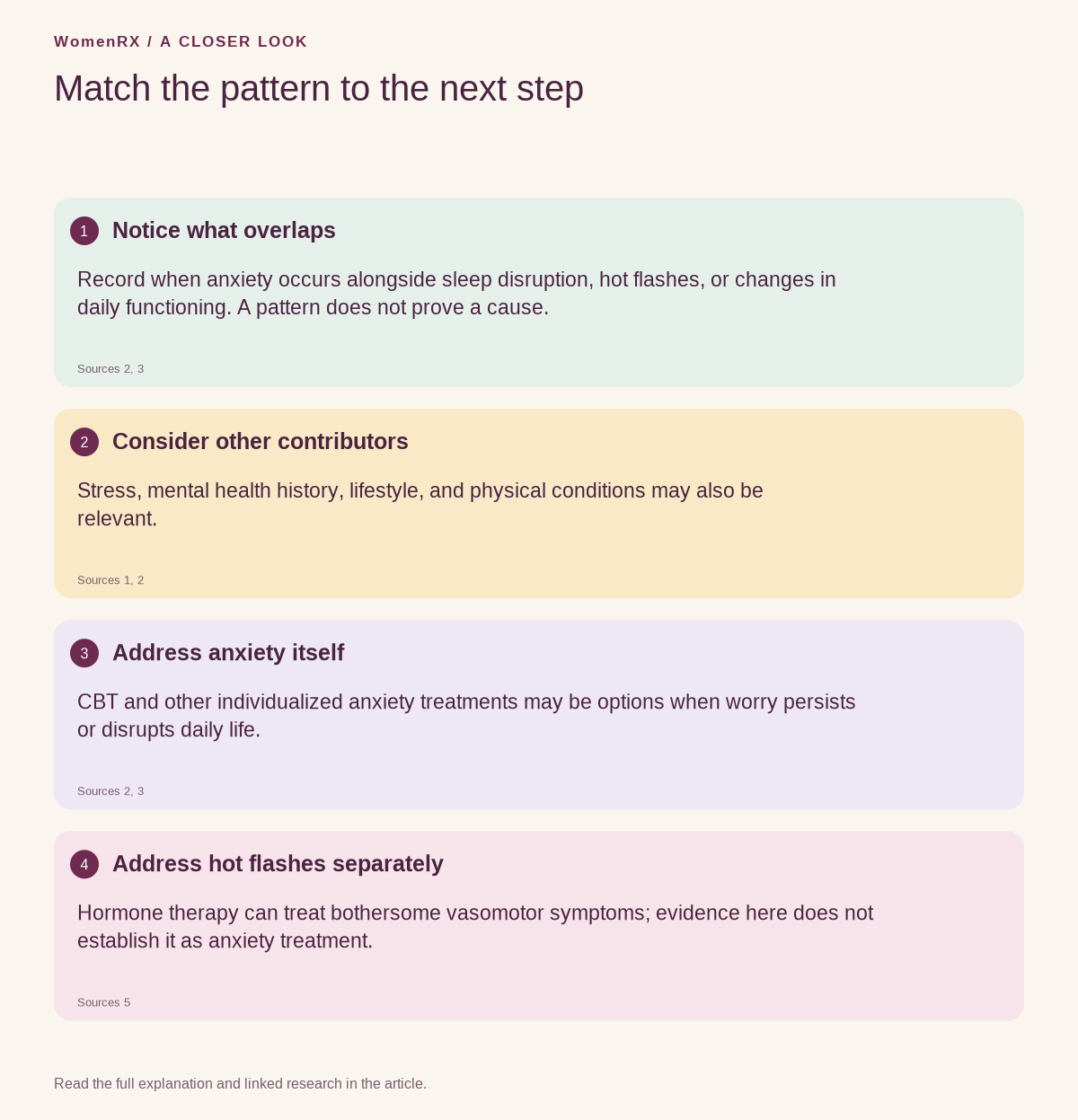
Match the pattern to the next step
Notice what overlaps: Record when anxiety occurs alongside sleep disruption, hot flashes, or changes in daily functioning. A pattern does not prove a cause.23
Consider other contributors: Stress, mental health history, lifestyle, and physical conditions may also be relevant.12
Address anxiety itself: CBT and other individualized anxiety treatments may be options when worry persists or disrupts daily life.23
Address hot flashes separately: Hormone therapy can treat bothersome vasomotor symptoms; evidence here does not establish it as anxiety treatment.5
Read the figure as text
This flow separates noticing related symptoms from deciding what kind of support to seek.- Notice what overlaps: Record when anxiety occurs alongside sleep disruption, hot flashes, or changes in daily functioning. A pattern does not prove a cause.23
- Consider other contributors: Stress, mental health history, lifestyle, and physical conditions may also be relevant.12
- Address anxiety itself: CBT and other individualized anxiety treatments may be options when worry persists or disrupts daily life.23
- Address hot flashes separately: Hormone therapy can treat bothersome vasomotor symptoms; evidence here does not establish it as anxiety treatment.5
More questions, answered
Does anxiety during perimenopause mean I have an anxiety disorder?
Not necessarily. Anxiety can be a normal response to stress. An anxiety disorder involves anxiety that doesn’t go away or worsens and interferes with daily activities; an evaluation can help clarify what’s going on. 2
Can exercise help anxiety during perimenopause?
Evidence is less clear for anxiety during the transition than for some other outcomes. A review of exercise studies found a reduction in anxiety symptoms in its postmenopausal subgroup, but not in the menopausal-transition subgroup. The anxiety findings came from a limited set of studies, so exercise shouldn’t be treated as a substitute for anxiety care. 4
Sources you can check
- Mental Health: MedlinePlusAccessed 2026-09-25Return to first citation
- Anxiety: MedlinePlusAccessed 2026-09-25Return to first citation
- Cognitive-behavioral, acceptance-based, and mindfulness-based interventions for psychological and sleep-related symptoms during menopause: a systematic review.de Dios Tapia A, Rueda-Extremera M, Cantero-García M. · Acta psychologica · 2026Return to first citation
- Effects of physical activity on depressive and anxiety symptoms of women in the menopausal transition and menopause: a comprehensive systematic review and meta-analysis of randomized controlled trials.Yue H, Yang Y, Xie F, Cui J, Li Y, Si M, Li S, Yao F. · The international journal of behavioral nutrition and physical activity · 2025Return to first citation
- The 2022 hormone therapy position statement of The North American Menopause Society.“The 2022 Hormone Therapy Position Statement of The North American Menopause Society” Advisory Panel. · Menopause (New York, N.Y.) · 2022Return to first citation