What to Do During a Panic Attack
Panic can feel like a medical emergency, so start with a safety check, then use a simple way to respond to familiar symptoms.
First, check for symptoms that need medical attention. Severe trouble breathing, a heavy or tight chest, or pain spreading to your arm, back, neck, or jaw calls for emergency care, even if you think it might be panic. If your symptoms are familiar from a previously assessed attack, try naming what you feel and questioning your most frightening prediction. Repeated attacks deserve follow-up; cognitive behavioral therapy (CBT) is one treatment option. 124
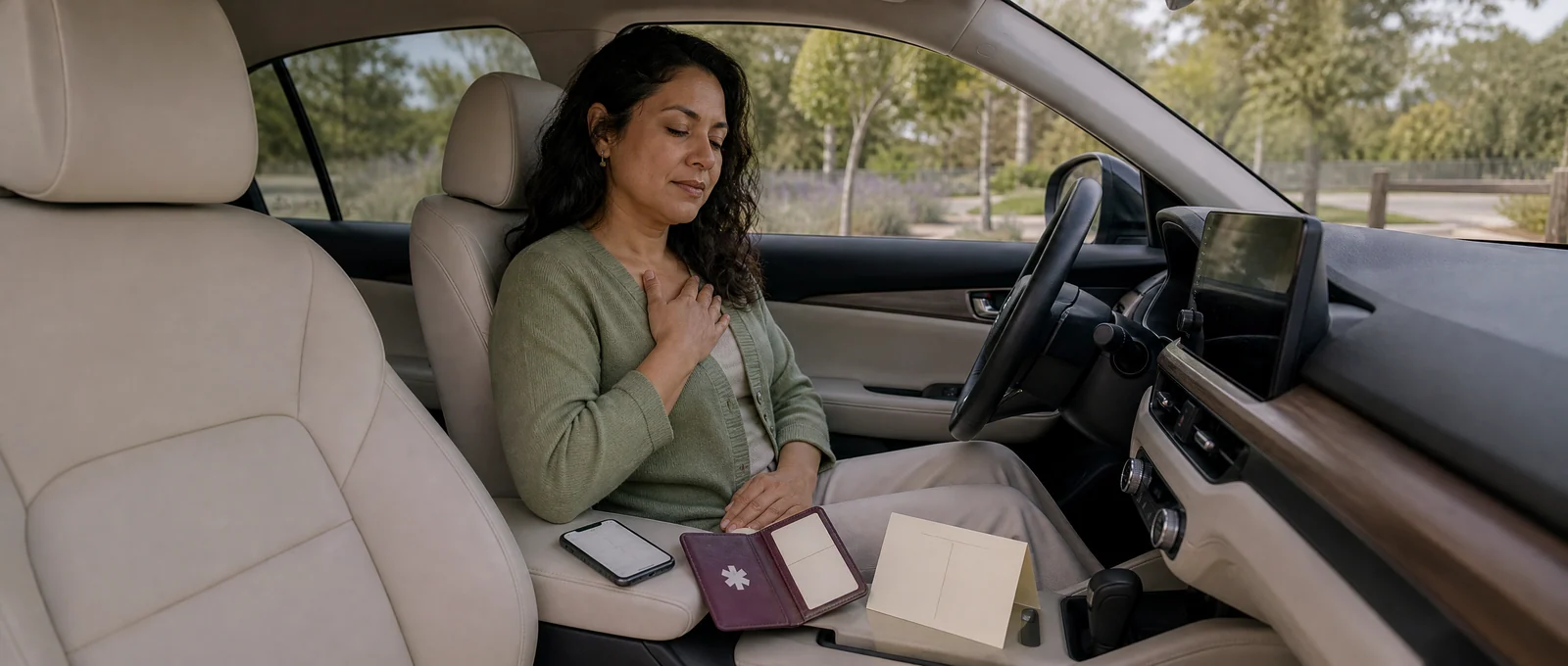
Check the physical symptoms first
A panic attack can bring a pounding heart, dizziness, trouble breathing, nausea, and chest pain. Those sensations are real. They also aren't enough, on their own, to tell you what's causing them. An assessment of anxiety symptoms may include checking for another health problem. 23
Get emergency care if you're gasping or can't get words out, your chest feels heavy or tight, or pain spreads to your arm, back, neck, or jaw. Very pale, blue, or gray lips or skin are another emergency sign. Don't wait to see whether a calming exercise makes these symptoms go away. 1
If you have difficulty breathing, seek medical advice rather than assuming panic is the cause, even if you don't have the emergency signs above. 1
If this feels like a familiar, assessed attack
Give yourself a moment to notice what's happening rather than trying to settle the diagnosis while you're frightened. You might put it into words: “My heart is racing, and I'm afraid something terrible is about to happen.” Then ask, “What am I predicting? Is there another explanation for this familiar sensation?” This is a simplified version of the realistic-thought work used in CBT for panic disorder, not a test that can rule out a medical problem. If you have any of the emergency signs above, get emergency care instead. 43
You don't need to make yourself more afraid to get through the moment. In a randomized trial of 124 people diagnosed with panic disorder and agoraphobia, adding exercises intended to heighten fear during exposure-based CBT did not improve outcomes at four-month follow-up compared with exposure-based CBT without that addition. That study concerns structured treatment, not what to do in an unassessed episode, but it offers no reason to push yourself to intensify frightening sensations on your own. 5
Panic attacks may last a few minutes or more than an hour. Knowing that they can pass may help you put a familiar episode in context, but duration isn't a safety test: don't wait out the emergency signs above. 21
If attacks keep happening
One attack does not mean you have panic disorder. Some people have only one or two attacks. Follow-up becomes especially useful if attacks recur, you're worried about the next one, or you've started avoiding places or activities because you fear another attack. A clinician can review the symptoms and your health history, consider other possible causes, and discuss treatment. 23
CBT is different from trying to calm yourself during one episode. It works on the pattern around attacks, including frightening interpretations of body sensations and avoidance of situations you want to return to. Treatment for panic disorder can also include medication. In CBT, exposure to feared sensations or situations may be part of a structured plan; it isn't a reason to provoke symptoms yourself, especially when the cause of physical symptoms has not been assessed. 234
If you're pregnant or postpartum, you can mention that when describing the episode and any physical symptoms. Don't assume panic is the cause.
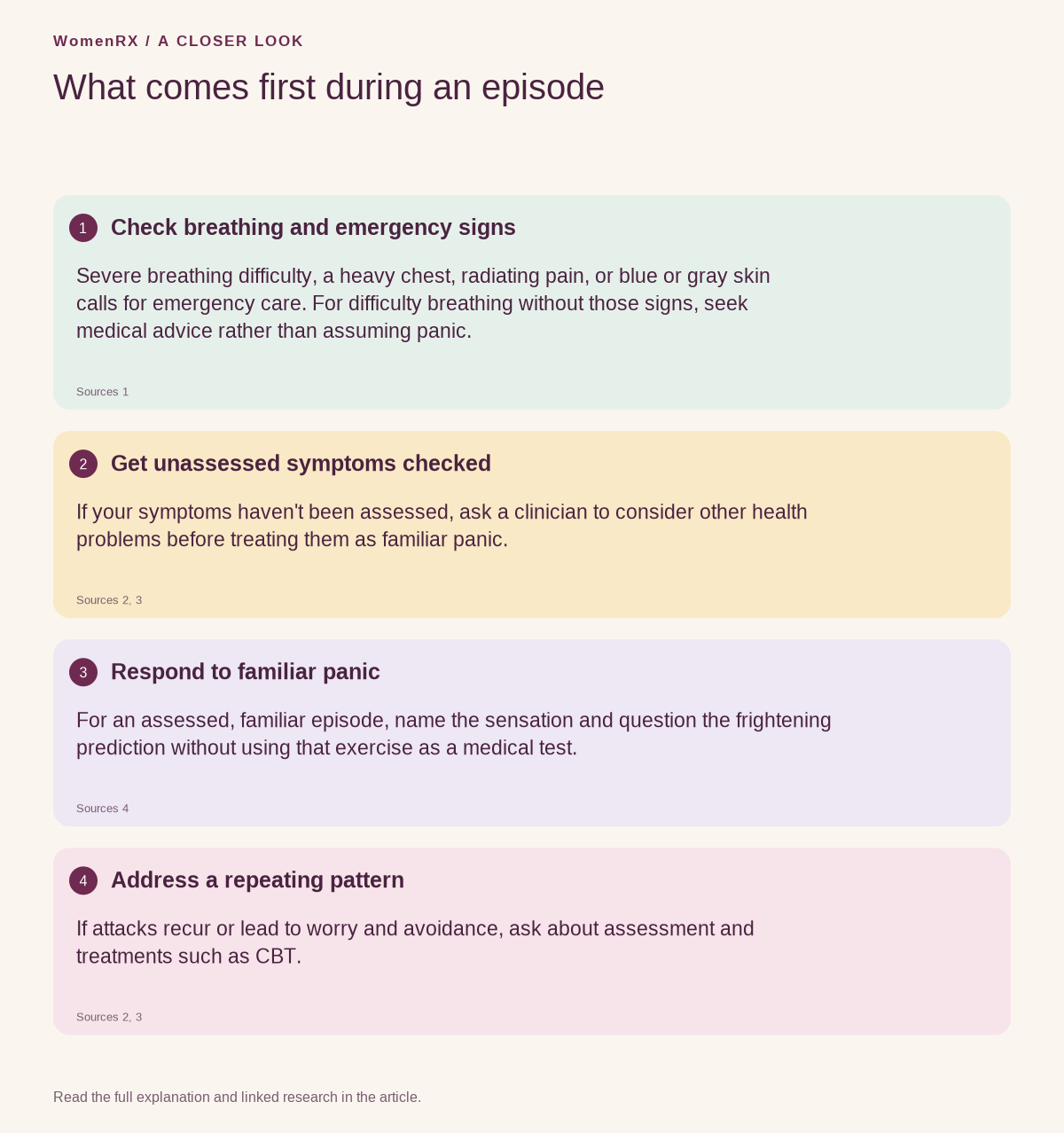
What comes first during an episode
Check breathing and emergency signs: Severe breathing difficulty, a heavy chest, radiating pain, or blue or gray skin calls for emergency care. For difficulty breathing without those signs, seek medical advice rather than assuming panic.1
Get unassessed symptoms checked: If your symptoms haven't been assessed, ask a clinician to consider other health problems before treating them as familiar panic.23
Respond to familiar panic: For an assessed, familiar episode, name the sensation and question the frightening prediction without using that exercise as a medical test.4
Address a repeating pattern: If attacks recur or lead to worry and avoidance, ask about assessment and treatments such as CBT.23
Read the figure as text
Use the safety check before treating physical symptoms as familiar panic.- Check breathing and emergency signs: Severe breathing difficulty, a heavy chest, radiating pain, or blue or gray skin calls for emergency care. For difficulty breathing without those signs, seek medical advice rather than assuming panic.1
- Get unassessed symptoms checked: If your symptoms haven't been assessed, ask a clinician to consider other health problems before treating them as familiar panic.23
- Respond to familiar panic: For an assessed, familiar episode, name the sensation and question the frightening prediction without using that exercise as a medical test.4
- Address a repeating pattern: If attacks recur or lead to worry and avoidance, ask about assessment and treatments such as CBT.23
More questions, answered
Does having a panic attack mean I have panic disorder?
No. Panic disorder involves repeated attacks and often worry about another attack or avoidance of places associated with attacks. Some people have one or two panic attacks without developing the disorder. 2
Sources you can check
- Shortness of breath - NHSAccessed 2026-09-25Return to first citation
- Panic Disorder: MedlinePlusAccessed 2026-09-25Return to first citation
- Anxiety: MedlinePlusAccessed 2026-09-25Return to first citation
- Videoconferencing Cognitive Behavioral Therapy for Panic Disorder in an Emergency Room in Mexico: A Multiple Baseline Design.Monroy-Robles DM, Del Campo-Galván P, de la Rosa-Gómez A, García-Palacios A, Manolov R, Guerra-Anlén A, Colín-Mendiola KP, Landa-Ramírez E. · Journal of clinical psychology in medical settings · 2026Return to first citation
- Instructed increase in fear activation during exposure exercises does not enhance treatment effects of cognitive behavioral therapy for panic disorder and agoraphobia.Richter J, Hamm AO, Lang T, Gerlach AL, Melzig CA, Helms A, Droste KL, Goerigk S, Straube B, Kircher T, Rief W, Lueken U, Alpers GW, Helbig-Lang S. · Behaviour research and therapy · 2026Return to first citation