Tinnitus During Menopause: What to Check and What May Help
Ringing that disrupts sleep or concentration deserves an ear and hearing check, whether it starts during perimenopause or after menopause.
If you notice tinnitus during perimenopause or after menopause, don’t assume hormones are the cause. Hearing loss, certain medicines and treatable ear problems may be relevant. An assessment can check your ears and hearing, while a medicine review and a clear description of how tinnitus affects your day can help guide relief options. Seek urgent assessment if it comes with sudden hearing loss or other warning signs. 1 2
Tinnitus means hearing a sound that isn’t coming from outside you. It can be ringing, buzzing, hissing or clicking, in one or both ears. The sound may come and go, but even a quiet sound can be hard to ignore when you’re trying to fall asleep or concentrate. 1 2
Treat menopause as context, not the explanation
If the sound began during perimenopause or after menopause, that timing is worth mentioning when you seek care. It doesn’t, on its own, tell you why the tinnitus started. Hearing loss is often linked to tinnitus, and loud-noise exposure and certain medicines are among its possible causes. An ear check may also find something treatable, such as wax buildup or an infection. 1 2
Hormone therapy has established uses for menopause symptoms such as hot flashes and genitourinary symptoms, and for preventing bone loss in appropriate circumstances. Those uses don’t tell us whether it will relieve tinnitus. If you’re making a decision about menopause treatment, consider the ringing as a separate concern that needs its own assessment. 3
Start with the sound, your ears and your hearing
A useful first step is to describe what you hear and what has changed: whether it’s in one or both ears, whether it comes and goes, and whether you’ve noticed difficulty hearing. An initial assessment may include looking in your ears for wax or infection and checking for hearing loss. Further testing or specialist assessment may be considered depending on what’s found. 1 2
Ask for a review of the medicines you take, including any you started around the time the sound appeared. Certain medicines can cause tinnitus, so the timing may be useful to discuss. This is a way to investigate a possible contributor, not a reason to assume a medicine is responsible. 1
Choose support for the problem tinnitus is causing
Tell the person assessing you what tinnitus is doing to your day. For example, is it most noticeable at bedtime, breaking your concentration at work, or making you feel anxious? Sleep and concentration problems are reasons to seek help even if you’re unsure how loud the sound is. 1 2
If hearing loss is present, hearing aids may be recommended. If the sound stands out in a quiet room, soft music or other gentle background sound may distract you from it. Neither approach is a promised cure, but each addresses a different part of the problem. 1 2
Tinnitus-focused cognitive behavioral therapy (CBT) is another option when the sound is distressing. It works on your response to tinnitus and can help reduce anxiety; it isn’t a treatment that simply switches the sound off. Tinnitus counseling can help you understand the sound and find ways to cope with it. 2
Know when not to wait
Seek urgent medical assessment if tinnitus occurs with sudden hearing loss, weakness in the muscles of your face or a spinning sensation called vertigo, or if it starts after a head injury. 2
Otherwise, arrange an assessment if the tinnitus is getting worse or affecting your sleep, concentration or mood. Checking for an ear or hearing issue and explaining what’s hardest for you gives that conversation a more useful starting point than attributing the sound to menopause alone. 2
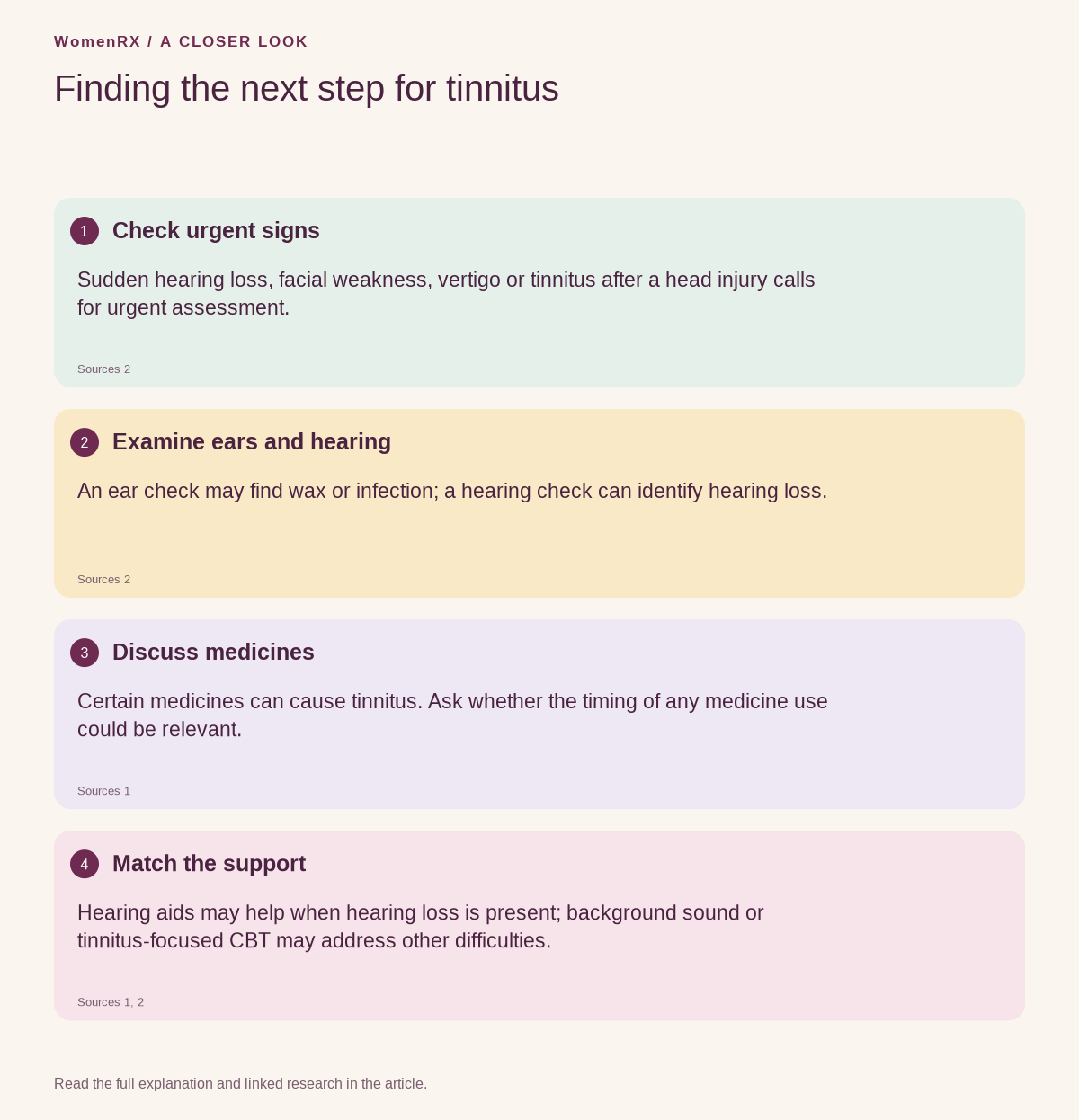
Finding the next step for tinnitus
Check urgent signs: Sudden hearing loss, facial weakness, vertigo or tinnitus after a head injury calls for urgent assessment.2
Examine ears and hearing: An ear check may find wax or infection; a hearing check can identify hearing loss.2
Discuss medicines: Certain medicines can cause tinnitus. Ask whether the timing of any medicine use could be relevant.1
Match the support: Hearing aids may help when hearing loss is present; background sound or tinnitus-focused CBT may address other difficulties.12
Read the figure as text
The features of the sound, your hearing and its effect on daily life help direct the next conversation.- Check urgent signs: Sudden hearing loss, facial weakness, vertigo or tinnitus after a head injury calls for urgent assessment.2
- Examine ears and hearing: An ear check may find wax or infection; a hearing check can identify hearing loss.2
- Discuss medicines: Certain medicines can cause tinnitus. Ask whether the timing of any medicine use could be relevant.1
- Match the support: Hearing aids may help when hearing loss is present; background sound or tinnitus-focused CBT may address other difficulties.12
Sources you can check
- Tinnitus | Tinnitus Treatment | MedlinePlusAccessed 2026-09-25Return to first citation
- Tinnitus - NHSAccessed 2026-09-25Return to first citation
- The 2022 hormone therapy position statement of The North American Menopause Society.“The 2022 Hormone Therapy Position Statement of The North American Menopause Society” Advisory Panel. · Menopause (New York, N.Y.) · 2022Return to first citation