Tinnitus Around Menopause: What Needs Checking?
Ringing that begins around menopause deserves attention to its sound, timing, and hearing changes, rather than an assumption about hormones.
Seek urgent medical care if tinnitus starts after a head injury or comes with sudden hearing loss, facial weakness, or a spinning sensation. 2 If the sound keeps time with your heartbeat, arrange an assessment; pulsatile tinnitus may need imaging. 3 4 Persistent or worsening noise also merits a check, including a look in your ears and an assessment of hearing. 2
Menopause timing doesn’t tell you the cause
Tinnitus is hearing a sound that doesn’t come from an outside source. It might ring, buzz, hiss, or roar, and you might hear it in one ear, both ears, or your head. If it first appears during perimenopause or after menopause, that timing is worth mentioning, but it doesn’t show that changing hormones caused it. 1 2
Hearing loss, loud-noise exposure, ear or sinus infections, blood-vessel problems, and certain medicines are recognized possible contributors. An examination can sometimes find a treatable problem, such as earwax buildup or an infection, and a hearing check can show whether hearing loss needs further assessment. 1 2
Menopause hormone therapy has established uses for symptoms such as hot flashes and genitourinary symptoms, but tinnitus isn’t an established treatment target in the North American Menopause Society’s hormone therapy guidance. Don’t count on a hormone treatment decision to explain or resolve a new ear sound. 5
The sound and accompanying symptoms change the next step
Get urgent medical care for tinnitus after a head injury, or for tinnitus with sudden hearing loss, facial weakness, or a spinning sensation. These combinations shouldn’t wait for a routine hearing appointment. 2
Arrange an assessment if the sound follows your heartbeat. This pattern is called pulsatile tinnitus. Its possible causes differ from those of a steady ring or hiss, and an examination alone may not identify the cause. A tinnitus guideline recommends imaging for pulsatile tinnitus, with the evaluation tailored to what the clinician finds. 3 4
Pay attention to hearing differences between ears. Tell the person assessing you if hearing seems poorer on one side, even if the noise itself is hard to locate. A guideline recommends imaging for asymmetric hearing loss. That is not the same as saying every one-sided tinnitus sound requires a scan. 3
Book a routine assessment if tinnitus is regular, constant, or getting worse. The first steps may be an ear examination and a hearing check, followed by further assessment if the findings call for it. 2
Bring a short description, not a diagnosis
You don’t need to work out what the sound means before seeking care. A few details can make the assessment more focused:
- Onset: When did it begin? Was the change sudden or gradual?
- Location: Is it in the left ear, right ear, both ears, or hard to place?
- Rhythm: Does it keep time with your heartbeat?
- Other changes: Has your hearing changed? Is there ear fullness, a spinning sensation, or a recent head injury?
- Possible contributors: Was there loud-noise exposure or a recent medicine change? Some medicines, including certain antibiotics and nonsteroidal anti-inflammatory drugs, can be associated with tinnitus. 1 2 4
For example, “I’ve had a steady sound in both ears for months” gives a different starting point from “I hear a new whooshing sound in my left ear that matches my pulse.” The details help direct the assessment; neither description identifies the cause on its own. 2 4
If hearing loss is found, hearing aids may be an option. If the noise is disrupting sleep or daily life, ask about support aimed at reducing its impact, such as cognitive behavioral therapy. Those options address what’s found and how tinnitus affects you, rather than treating menopause timing as the diagnosis. 2 3
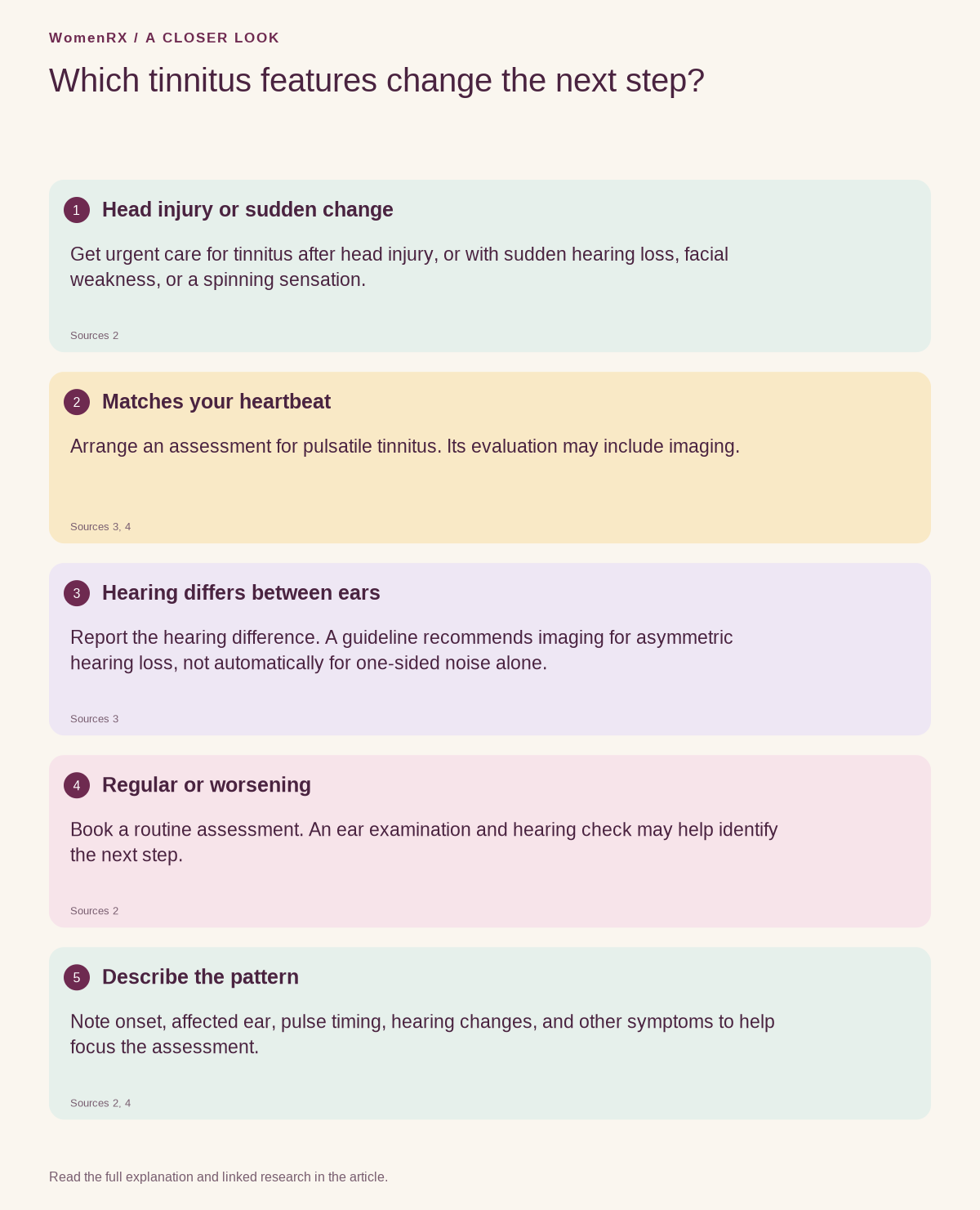
Which tinnitus features change the next step?
Head injury or sudden change: Get urgent care for tinnitus after head injury, or with sudden hearing loss, facial weakness, or a spinning sensation.2
Matches your heartbeat: Arrange an assessment for pulsatile tinnitus. Its evaluation may include imaging.34
Hearing differs between ears: Report the hearing difference. A guideline recommends imaging for asymmetric hearing loss, not automatically for one-sided noise alone.3
Regular or worsening: Book a routine assessment. An ear examination and hearing check may help identify the next step.2
Describe the pattern: Note onset, affected ear, pulse timing, hearing changes, and other symptoms to help focus the assessment.24
Read the figure as text
Start with accompanying symptoms, then describe the sound and any hearing change. Each branch points to an assessment priority, not a diagnosis.- Head injury or sudden change: Get urgent care for tinnitus after head injury, or with sudden hearing loss, facial weakness, or a spinning sensation.2
- Matches your heartbeat: Arrange an assessment for pulsatile tinnitus. Its evaluation may include imaging.34
- Hearing differs between ears: Report the hearing difference. A guideline recommends imaging for asymmetric hearing loss, not automatically for one-sided noise alone.3
- Regular or worsening: Book a routine assessment. An ear examination and hearing check may help identify the next step.2
- Describe the pattern: Note onset, affected ear, pulse timing, hearing changes, and other symptoms to help focus the assessment.24
More questions, answered
Does tinnitus mean I need a scan?
Not necessarily. A tinnitus guideline recommends imaging for pulsatile tinnitus or asymmetric hearing loss. It does not say that everyone with tinnitus, including everyone who hears it on one side, needs imaging. 3
Sources you can check
- Tinnitus | Tinnitus Treatment | MedlinePlusAccessed 2026-09-25Return to first citation
- Tinnitus - NHSAccessed 2026-09-25Return to first citation
- Clinical Practice Guideline for the Diagnosis and Management of Tinnitus in Korea.Park E, Lee HY, Kim HJ, Lee JM, An YH, Cho AR, Han W, Chung JH, Han JS, Jung DJ, Lee KY. · Clinical and experimental otorhinolaryngology · 2026Return to first citation
- Pulsatile Tinnitus: A Comprehensive Clinical Approach to Diagnosis and Management.Pacheco-López S, Martínez-Barbero JP, Busquier-Hernández H, García-Valdecasas-Bernal J, Espinosa-Sánchez JM. · Journal of clinical medicine · 2025Return to first citation
- The 2022 hormone therapy position statement of The North American Menopause Society.“The 2022 Hormone Therapy Position Statement of The North American Menopause Society” Advisory Panel. · Menopause (New York, N.Y.) · 2022Return to first citation