Vaginal Discharge After Menopause: What Needs Checking?
Discharge can still happen after menopause, but any blood or pink or brown staining needs medical assessment, even if it happens once.
Some vaginal fluid is normal at any age, and dryness or irritation can also develop after menopause as estrogen falls. A change in discharge’s smell, color, texture, or amount may need checking, but it can’t identify an infection by itself. If you see blood, pink fluid, or brown staining after 12 months without a period, contact a clinician for assessment, even if it’s slight or one-time. 1 2 3
Start with the color, not a guess at the cause
Vaginal discharge is fluid or mucus that helps keep the vagina moist and clean. Some discharge can be normal at any age. It’s less concerning when it doesn’t have a strong or unpleasant smell and is slippery and wet. Those features are a general guide, though, not a way to diagnose what’s happening after menopause. 2
After menopause, lower estrogen can cause vaginal dryness and irritation. Thinning of the vaginal or uterine lining is also among the recognized causes of bleeding after menopause. So a change may be related to menopause, but that possibility doesn’t tell you whether a particular discharge is harmless. 1 3
If there’s any blood, get it checked
Once you’ve gone 12 months without a period, blood from the vagina counts as postmenopausal bleeding. That includes a small spot, one episode, or pink or brown discharge when you’re unsure whether it’s blood. Arrange an assessment with a clinician, such as a primary care clinician or gynecologist. Don’t write it off as a menopause symptom or wait to see whether it happens repeatedly. 1
There are several possible causes. Thinning or inflammation of the vaginal lining or uterine lining and noncancerous polyps are common causes; a thickened uterine lining is another possibility. Cancer is a less common cause, but it’s one reason bleeding needs assessment rather than a guess at home. 1
If you use vaginal estrogen, mention it when you contact your clinician. Bleeding can occur as an early side effect, but that doesn’t establish that the medicine caused your bleeding or remove the need to have postmenopausal bleeding checked. 1 3
When discharge changes without blood
A new or persistent change in color, smell, texture, or amount is worth discussing with a clinician, particularly if you also have itching, soreness, or pain when urinating. Changes can be a sign of infection, but appearance alone can’t reliably tell you which infection, or whether an infection is the cause. Avoid self-diagnosing from a symptom chart. 2
For example, discharge that smells fishy, is thick and white, or is green, yellow, or frothy can occur with different infections. These are clues a clinician may consider, not proof of a specific cause. Discharge with pelvic pain or bleeding is another reason to seek assessment. 2
Dryness and irritation without unusual discharge may fit menopause-related vaginal changes. Vaginal estrogen is one treatment used for menopause-related dryness and irritation; a clinician can discuss whether it fits your symptoms. It’s not a substitute for checking blood-stained discharge. 1 3
Make the appointment more useful
Before you call or go in, note when the change began; whether it has happened once or keeps returning; its color, texture, smell, and amount; and whether you’ve noticed blood, itching, soreness, pelvic pain, or pain when urinating. Mention vaginal estrogen or a pessary if you use one. These details help describe what’s changed, but they shouldn’t delay assessment of blood after menopause.
The useful dividing line is simple: discharge that seems familiar and has no strong or unpleasant smell may be ordinary, while a new or persistent change deserves attention. Any blood, pink fluid, or brown staining after menopause needs assessment, even when there’s very little.
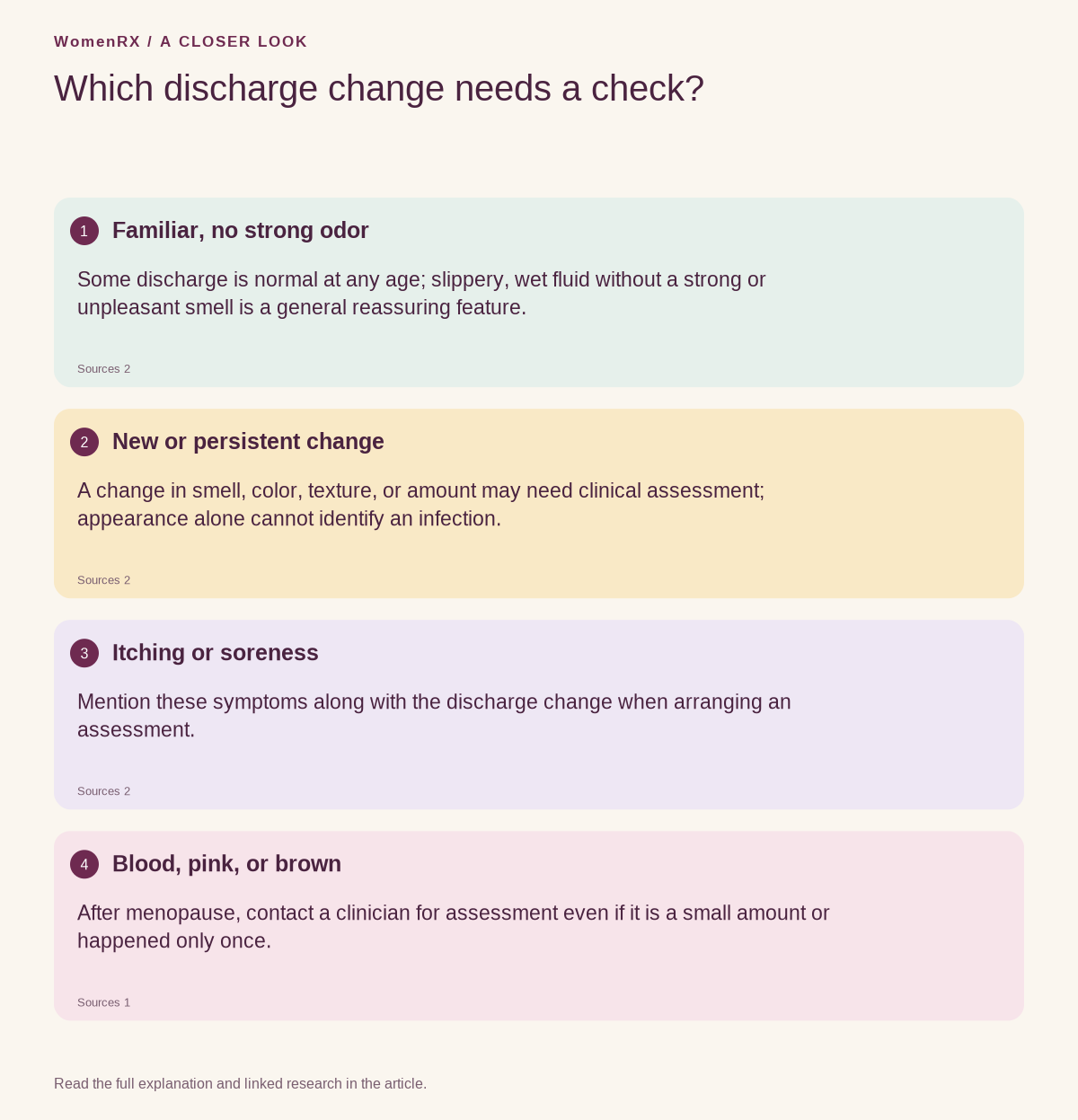
Which discharge change needs a check?
Familiar, no strong odor: Some discharge is normal at any age; slippery, wet fluid without a strong or unpleasant smell is a general reassuring feature.2
New or persistent change: A change in smell, color, texture, or amount may need clinical assessment; appearance alone cannot identify an infection.2
Itching or soreness: Mention these symptoms along with the discharge change when arranging an assessment.2
Blood, pink, or brown: After menopause, contact a clinician for assessment even if it is a small amount or happened only once.1
Read the figure as text
Use the features below to choose a sensible next step. A visual description cannot diagnose an infection or explain bleeding.- Familiar, no strong odor: Some discharge is normal at any age; slippery, wet fluid without a strong or unpleasant smell is a general reassuring feature.2
- New or persistent change: A change in smell, color, texture, or amount may need clinical assessment; appearance alone cannot identify an infection.2
- Itching or soreness: Mention these symptoms along with the discharge change when arranging an assessment.2
- Blood, pink, or brown: After menopause, contact a clinician for assessment even if it is a small amount or happened only once.1
More questions, answered
Does unusual discharge automatically mean an infection?
No. A change in smell, color, or texture can be a sign of infection, but the appearance alone doesn’t identify the cause. A clinician can assess it, especially if you also have itching, soreness, pelvic pain, or pain when urinating. 2
Sources you can check
- Postmenopausal bleeding - NHSAccessed 2026-09-25Return to first citation
- Vaginal discharge - NHSAccessed 2026-09-25Return to first citation
- About vaginal oestrogen - NHSAccessed 2026-09-25Return to first citation