After Menopause: What Can Continue, and What Needs Checking?
Hot flashes and vaginal symptoms can continue after periods end, but vaginal bleeding after menopause needs assessment.
Menopause doesn’t set an end date for symptoms. Hot flashes may remain bothersome, while vaginal dryness or irritation may continue and need a different kind of care. 2 7 Bleeding is different: even one episode after menopause should be checked. Tell the clinician about any hormone treatment or hysterectomy, including whether the surgery was subtotal if you know. 1 6
Symptoms don’t have to stop when periods do
Your final period marks a change, not a deadline for feeling better. Hot flashes can remain bothersome after menopause. Menopause Society guidance recognizes persistent hot flashes as a reason to revisit treatment decisions over time, rather than assuming treatment must end on a fixed date. 7
Vaginal symptoms can have a different course. Lower estrogen can contribute to dryness and irritation, and menopause-related genital and urinary symptoms may include pain with sex and urinary urgency. Pain with sex can also have other contributors, including pelvic floor or skin conditions, so it’s worth describing where and when it hurts instead of assuming every kind of pain has the same cause. 2 4 5
Choose care for the symptom you have
For vaginal dryness or irritation, moisturizers and lubricants may help. Low-dose vaginal estrogen is another option for bothersome symptoms. It works locally and does not treat hot flashes, mood changes, or sleep problems. If symptoms return after stopping it, that’s a reason to revisit the care plan, not a sign that you’ve done something wrong. 2 3 7
Hot flashes call for a separate conversation. Hormone therapy is the most effective treatment for them, but its benefits and risks depend on factors including age, time since menopause, and the type of treatment. Evidence-supported nonhormone options also exist, including certain prescription medicines and cognitive-behavioral therapy. The useful question is which approach fits your symptoms and health history now. 7 8
Treat bleeding as a new question
If you’ve gone through menopause, arrange an assessment for any vaginal bleeding, even if it happens only once or you aren’t sure it’s blood. Bleeding is often caused by thinning of the vaginal or uterine lining or by a polyp. Other possibilities include a thickened uterine lining and, less commonly, cancer. You can’t tell which cause applies from the amount of blood alone. 1
Mention any hormone treatment you use, including vaginal estrogen. Bleeding can occur as an early side effect of vaginal estrogen, but that possibility doesn’t establish the cause of bleeding in your case. 1 2
An assessment may include an examination, a vaginal ultrasound, or a look inside the uterus with a tissue sample. Which tests make sense depends on your history and what the initial assessment finds; not everyone needs every test. 1
If you’ve had a hysterectomy, say which kind
The familiar marker of menopause, more than a year without a period, isn’t a useful way to date menopause if you no longer have periods because of a hysterectomy. Tell the clinician about the surgery when reporting new vaginal bleeding. If you know it was a subtotal hysterectomy, mention that specifically: persistent cyclic vaginal bleeding has been reported after that type of surgery. That history may help make sense of a bleeding pattern, but it isn’t a reason to dismiss new or unexplained bleeding without assessment. 1 6
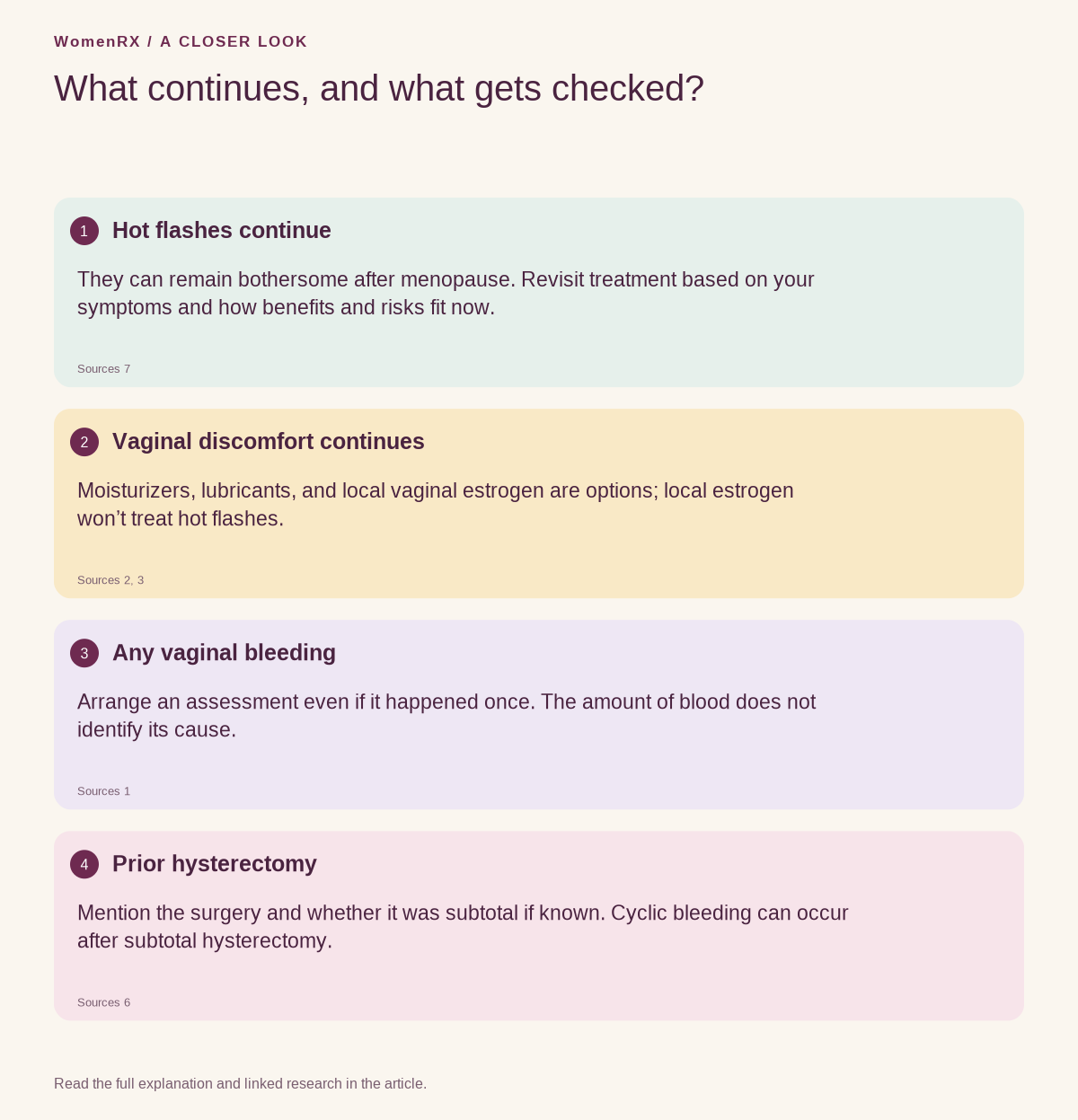
What continues, and what gets checked?
Hot flashes continue: They can remain bothersome after menopause. Revisit treatment based on your symptoms and how benefits and risks fit now.7
Vaginal discomfort continues: Moisturizers, lubricants, and local vaginal estrogen are options; local estrogen won’t treat hot flashes.23
Any vaginal bleeding: Arrange an assessment even if it happened once. The amount of blood does not identify its cause.1
Prior hysterectomy: Mention the surgery and whether it was subtotal if known. Cyclic bleeding can occur after subtotal hysterectomy.6
Read the figure as text
Use the symptom or change to decide whether to revisit ongoing care or arrange an assessment for bleeding.- Hot flashes continue: They can remain bothersome after menopause. Revisit treatment based on your symptoms and how benefits and risks fit now.7
- Vaginal discomfort continues: Moisturizers, lubricants, and local vaginal estrogen are options; local estrogen won’t treat hot flashes.23
- Any vaginal bleeding: Arrange an assessment even if it happened once. The amount of blood does not identify its cause.1
- Prior hysterectomy: Mention the surgery and whether it was subtotal if known. Cyclic bleeding can occur after subtotal hysterectomy.6
More questions, answered
Can vaginal estrogen help with hot flashes?
No. Vaginal estrogen is used for local symptoms such as dryness and irritation. Hot flashes need their own treatment discussion. 2 7
Sources you can check
- Postmenopausal bleeding - NHSAccessed 2026-09-25Return to first citation
- About vaginal oestrogen - NHSAccessed 2026-09-25Return to first citation
- Common questions about vaginal oestrogen - NHSAccessed 2026-09-25Return to first citation
- Assessment and management of dyspareunia in peri- and postmenopausal women: A phenotype-based gynecologic approach.Broul M, Vančo M, Banýrová J, Hujová A. · International journal of gynaecology and obstetrics: the official organ of the International Federation of Gynaecology and Obstetrics · 2026Return to first citation
- Case-Based Perspectives on the Management of Genitourinary Syndrome of Menopause.Cyriac J, Sood R. · Clinics and practice · 2026Return to first citation
- Systematic review of the limited evidence for different surgical techniques at benign hysterectomy: A clinical guideline initiated by the Danish Health Authority.Sloth SB, Schroll JB, Settnes A, Gimbel H, Rudnicki M, Topsoee MF, Joergensen A, Nortvig H, Moeller C. · European journal of obstetrics, gynecology, and reproductive biology · 2017Return to first citation
- The 2022 hormone therapy position statement of The North American Menopause Society.“The 2022 Hormone Therapy Position Statement of The North American Menopause Society” Advisory Panel. · Menopause (New York, N.Y.) · 2022Return to first citation
- The 2023 nonhormone therapy position statement of The North American Menopause Society.Menopause (New York, N.Y.) · 2023Return to first citation