What Changes After Menopause, and What Can Continue?
Postmenopause has no symptom deadline: hot flashes may persist, while vaginal and urinary concerns can remain or become more noticeable.
Postmenopause is a continuing life stage, not the day every symptom stops. Hot flashes and night sweats can persist, and vaginal or urinary concerns may continue or become more noticeable. Neither pattern tells you what’s causing a symptom or how long it will last for you. The useful next step is to consider each concern separately, because the treatment options differ. 1 3
The final period doesn’t set a symptom deadline
Hot flashes and night sweats, also called vasomotor symptoms, can continue after menopause. There’s no single date by which they must end. The North American Menopause Society’s hormone therapy guidance recognizes persistent hot flashes as a possible reason for continued treatment, with periodic reassessment of its benefits and risks. That’s different from saying everyone will need treatment, or that a hot flash has only one possible cause. 1
Vaginal and urinary concerns can follow a different course. In a longitudinal study of 616 women from an urban Chinese community, moderate-to-severe genitourinary symptoms were more common in later reproductive-aging stages, including postmenopause. Women’s reported concerns included vaginal dryness and stress urinary incontinence. Those group findings aren’t a forecast for you, and a new or worsening urinary symptom shouldn’t automatically be put down to menopause. 3
That distinction matters in everyday life. If night sweats are disrupting your sleep, relief from hot flashes is the immediate question. If dryness makes sex uncomfortable, or urinary symptoms are changing what you do, those concerns deserve attention in their own right. You don’t need to wait for them to pass simply because your periods have ended.
Match the options to the concern
Menopausal hormone therapy is the most effective treatment for hot flashes and night sweats. There are also evidence-supported nonhormonal options, including cognitive behavioral therapy and certain prescription medicines. The 2023 North American Menopause Society statement does not recommend supplements or herbal remedies as treatments for vasomotor symptoms. That comparison can help if you’re weighing an advertised remedy against an option with better evidence. 1 2
For bothersome genitourinary symptoms that haven’t improved with over-the-counter therapies, the 2022 guidance describes low-dose vaginal estrogen and other treatments as options in certain circumstances. A discussion about vaginal symptoms therefore needn’t be the same discussion as one about treatment for hot flashes. 1
Age and treatment history matter when considering hormone therapy. Its risks vary by treatment type, dose, duration, route, timing, and whether a progestogen is used. The guidance describes a more favorable benefit-risk balance for treating bothersome hot flashes or preventing bone loss in women younger than 60 or within 10 years of menopause onset who have no contraindications. Starting therapy later has a less favorable balance on average. These are factors for an individual decision, not a cutoff for when symptoms count. 1
If your menopause followed surgery, don’t assume a study of reproductive-aging stages describes your personal symptom timeline. Bring the operation and any past or current treatment into the discussion of what you’re experiencing now.
Think beyond symptoms, without lumping everything together
Postmenopause also brings health decisions that aren’t about whether a symptom has ended. Hormone therapy has been shown to prevent bone loss and fracture, and preventing bone loss can be a reason to consider it for some women. Whether it makes sense depends on the individual balance of benefits and risks, including age and time since menopause. 1
The clearest way to think about this stage is not “Is menopause over?” but “Which concern am I dealing with?” Persistent hot flashes, vaginal discomfort, urinary changes, and bone health don’t share one timeline or one treatment decision.
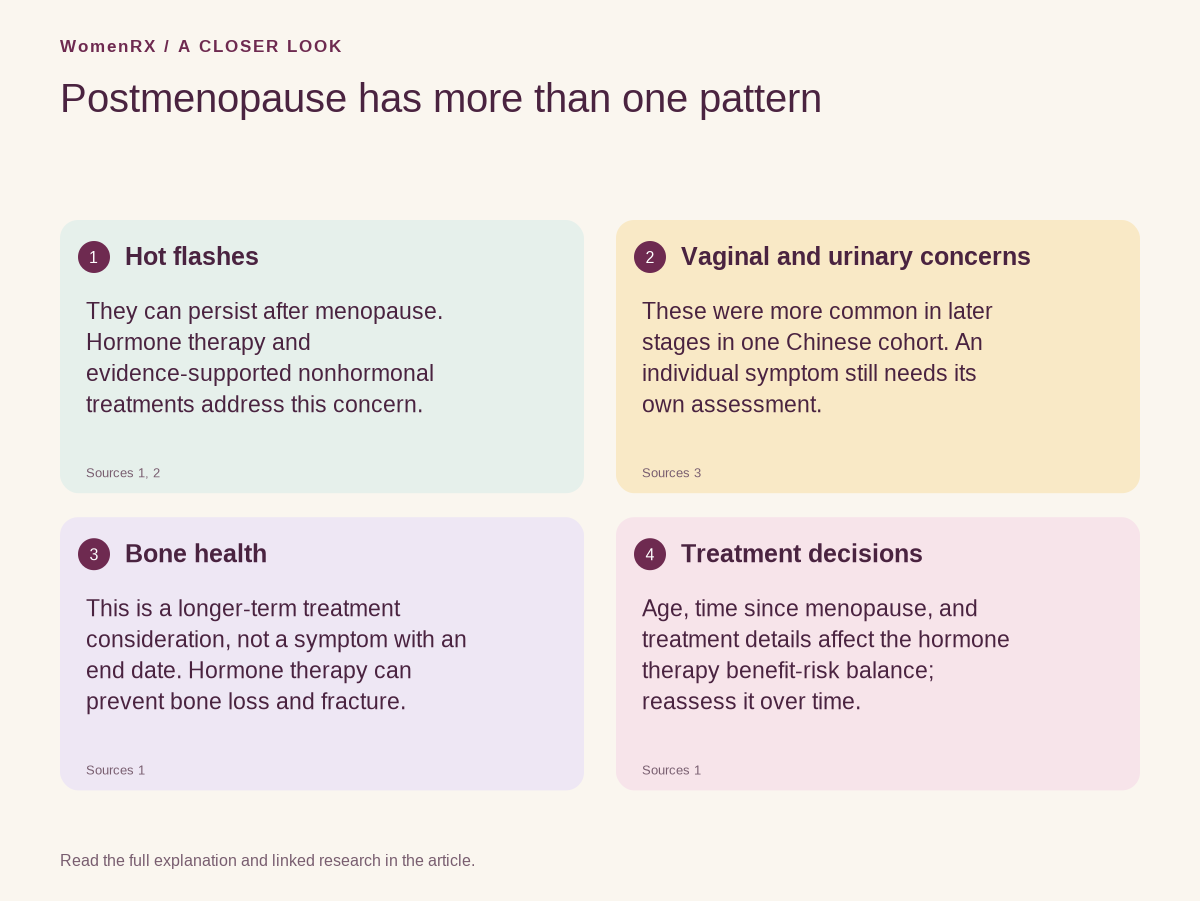
Postmenopause has more than one pattern
Hot flashes: They can persist after menopause. Hormone therapy and evidence-supported nonhormonal treatments address this concern.12
Vaginal and urinary concerns: These were more common in later stages in one Chinese cohort. An individual symptom still needs its own assessment.3
Bone health: This is a longer-term treatment consideration, not a symptom with an end date. Hormone therapy can prevent bone loss and fracture.1
Treatment decisions: Age, time since menopause, and treatment details affect the hormone therapy benefit-risk balance; reassess it over time.1
Read the figure as text
Compare concerns that may continue after the final period without assuming they share a cause or an end date.- Hot flashes: They can persist after menopause. Hormone therapy and evidence-supported nonhormonal treatments address this concern.12
- Vaginal and urinary concerns: These were more common in later stages in one Chinese cohort. An individual symptom still needs its own assessment.3
- Bone health: This is a longer-term treatment consideration, not a symptom with an end date. Hormone therapy can prevent bone loss and fracture.1
- Treatment decisions: Age, time since menopause, and treatment details affect the hormone therapy benefit-risk balance; reassess it over time.1
Sources you can check
- The 2022 hormone therapy position statement of The North American Menopause Society.“The 2022 Hormone Therapy Position Statement of The North American Menopause Society” Advisory Panel. · Menopause (New York, N.Y.) · 2022Return to first citation
- The 2023 nonhormone therapy position statement of The North American Menopause Society.Menopause (New York, N.Y.) · 2023Return to first citation
- Genitourinary syndrome of menopause among Chinese women during the menopausal transition and postmenopause: findings from a longitudinal cohort study.Fan Y, Huang J, Huang F, Tang R, Feng P, Yang X, Xie Z, Yang L, Ma X, Yang K, Chen R. · Climacteric : the journal of the International Menopause Society · 2025Return to first citation