Menopause Symptoms: What Can Change and When to Ask
Hot flashes, broken sleep, mood changes, and vaginal or urinary concerns can overlap, but they don’t follow a set schedule.
Hot flashes and night sweats, disrupted sleep, mood symptoms, and genitourinary concerns are all associated with menopause. Sleep problems become more common during perimenopause and postmenopause, but a hot flash isn’t the cause of every waking. Bring up changes that affect daily life, and have bleeding that starts or returns after menopause assessed rather than assuming it’s another menopause symptom. 1258
Menopause isn’t one symptom or one predictable sequence. You might notice hot flashes first, have trouble sleeping without obvious night sweats, or be more bothered by vaginal or urinary changes. The useful question is not whether your experience matches a standard list. It’s what has changed, what it’s doing to your life, and whether something besides menopause might explain it. 258
Hot flashes and sleep: connected, but not identical
Hot flashes and night sweats are called vasomotor symptoms. They can be bothersome on their own, and a nighttime episode may coincide with waking. If you’re sleeping poorly, it helps to distinguish a waking with a hot flash from one without one. That observation gives you something more useful to describe than “I’m not sleeping,” though it won’t diagnose the cause. 16
Sleep disruption can mean repeated waking, poor-quality sleep, or insomnia. It’s reported more often during perimenopause and postmenopause than before menopause. But night sweats aren’t the whole story: insomnia, obstructive sleep apnea, and restless legs syndrome can also be relevant, as can mood symptoms and other stresses. If broken sleep is your main concern, it deserves attention even when you don’t have hot flashes. 58
Mood and genitourinary changes deserve their own description
Mood symptoms can occur alongside sleep problems and hot flashes. For example, if you’re feeling low and waking repeatedly, mention both changes rather than assuming one fully explains the other. Research describes this overlap; it doesn’t show that every new mood symptom in midlife is caused by menopause. 78
Vaginal and urinary concerns are often grouped under genitourinary syndrome of menopause. They’re a different treatment conversation from hot flashes. For bothersome genitourinary symptoms that haven’t improved with over-the-counter approaches, menopause guidance identifies local treatment options, including low-dose vaginal estrogen, for women who don’t need systemic hormone therapy. Describing the specific concern helps keep it from getting lost in a general conversation about menopause symptoms. 2
Bleeding after menopause needs a separate look. Persistent or recurring unexpected genital bleeding after menopause should be assessed rather than written off as part of the transition. 1
Your stage adds context, not a timetable
During perimenopause and after menopause, sleep disruption is reported more often than before menopause, but its frequency varies with how sleep is measured and whether vasomotor symptoms are present. That finding doesn’t predict when your symptoms will start or how long they’ll last. 5
Surgery and cancer treatment also matter when you describe what’s happening. Clinical trials have studied vasomotor symptoms associated with natural or surgical menopause and with endocrine treatment for breast cancer. Those are distinct circumstances, not evidence that everyone in any one group follows the same symptom pattern. If symptoms began around surgery or treatment, say so: it changes the context for discussing possible causes and options. 4
When to bring it up, and what options exist
You don’t have to wait until a symptom feels severe. Broken sleep that leaves you struggling through the day, hot flashes that interrupt work, or a vaginal or urinary concern that affects everyday life are all reasonable starting points for a conversation. Describe what happens and what it interrupts. For sleep, include whether nighttime waking comes with heat or sweating; that distinction can help keep other sleep problems from being overlooked. 58
There are treatments for bothersome hot flashes and night sweats. Hormone therapy is the most effective option for vasomotor symptoms, though its benefits and risks depend on the person and the treatment. Evidence-supported nonhormonal options include cognitive-behavioral therapy, clinical hypnosis, and several prescription treatments. If you’ve had breast cancer or are receiving endocrine treatment, make that part of the discussion rather than assuming the same options fit every situation. 234
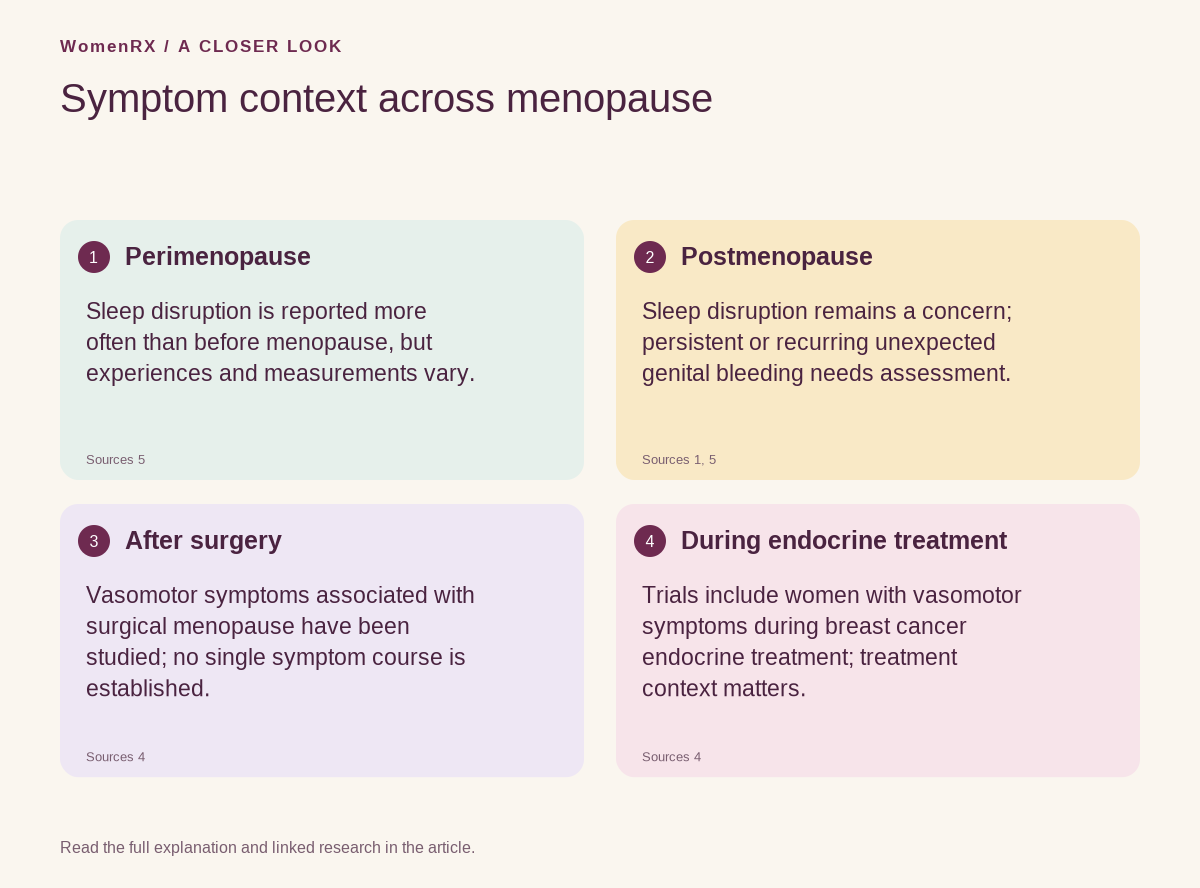
Symptom context across menopause
Perimenopause: Sleep disruption is reported more often than before menopause, but experiences and measurements vary.5
Postmenopause: Sleep disruption remains a concern; persistent or recurring unexpected genital bleeding needs assessment.15
After surgery: Vasomotor symptoms associated with surgical menopause have been studied; no single symptom course is established.4
During endocrine treatment: Trials include women with vasomotor symptoms during breast cancer endocrine treatment; treatment context matters.4
Read the figure as text
These broad distinctions help place symptoms in context without suggesting a fixed order or duration.- Perimenopause: Sleep disruption is reported more often than before menopause, but experiences and measurements vary.5
- Postmenopause: Sleep disruption remains a concern; persistent or recurring unexpected genital bleeding needs assessment.15
- After surgery: Vasomotor symptoms associated with surgical menopause have been studied; no single symptom course is established.4
- During endocrine treatment: Trials include women with vasomotor symptoms during breast cancer endocrine treatment; treatment context matters.4
Sources you can check
- CLIMARA (ESTRADIOL) PATCH [BAYER HEALTHCARE PHARMACEUTICALS INC.] | US prescribing information and patient instructionsAccessed 2026-09-25Return to first citation
- The 2022 hormone therapy position statement of The North American Menopause Society.“The 2022 Hormone Therapy Position Statement of The North American Menopause Society” Advisory Panel. · Menopause (New York, N.Y.) · 2022Return to first citation
- The 2023 nonhormone therapy position statement of The North American Menopause Society.Menopause (New York, N.Y.) · 2023Return to first citation
- Consistency of efficacy and safety of elinzanetant for vasomotor symptoms and sleep disturbance associated with menopause across different populations: a review of the OASIS clinical trial program.Pinkerton JV, Simon JA, Panay N, Nappi RE, Brennan DJ, Donders G, Soares CN, Maki P, Caetano C, Haberland C, Laapas K, Zuurman L, Cardoso F. · Maturitas · 2026Return to first citation
- Sleep Disruption in the Menopausal Transition and Postmenopause: A Narrative Review.Lyu AC, Kravitz HM. · Obstetrics and gynecology · 2026Return to first citation
- Effect of fezolinetant on sleep, health-related quality of life and work productivity.Cano A, Neal Perry G, Martins K, Morga A, Schild A, Nappi RE, Shapiro M, Santoro N. · Climacteric : the journal of the International Menopause Society · 2026Return to first citation
- Estradiol transdermal spray for menopausal symptom management: From RCT to real-world evidence.Hirschberg AL, Stute P, Águas F, Fait T, Polo-Kantola P, Amorim FG, Rézette I, Hadji P. · Maturitas · 2026Return to first citation
- Sleep disturbances in midlife women: prevalence, correlates, and treatments.Jakubowski K. · Menopause (New York, N.Y.) · 2026Return to first citation