How Menopause Can Change Your Bone Health
Bone loss often speeds up in late perimenopause, but symptoms alone don’t tell you whether you need a bone-density test.
Bone density tends to change little in early perimenopause, then decline more quickly in late perimenopause and continue falling during the first postmenopausal years. The pace varies. A study found that night sweats did not indicate two-year bone-density change, but it did not establish what hot flashes or other symptoms indicate. Age and personal risk factors help inform whether a scan may be worth discussing. 4 5
Bone loss can pick up before periods stop
Bone is living tissue: your body continually breaks down old bone and replaces it. When breakdown outpaces replacement, bone density falls. 1 Across the menopause transition, this process isn’t necessarily steady. In a multiethnic study following 1,902 women, researchers found little change in bone density during pre- and early perimenopause, followed by faster loss in late perimenopause. Loss continued at a similar pace in the first postmenopausal years. 5
That pattern helps explain why the transition can matter even before menopause is complete. But it doesn’t mean every woman in perimenopause has osteoporosis, or that the rate of bone loss is the same for everyone. Low bone density and osteoporosis are related, but they aren’t interchangeable: a scan can show low density, while osteoporosis describes weakened bones with a greater likelihood of fracture. 1 2
Symptoms aren’t a bone-density test
Night sweats don’t measure how much bone density has changed. In a prospective study of 1,570 Canadian women aged 43 to 63, night sweats weren’t significantly associated with two-year changes in bone density at the spine, hip, or femoral neck. The study examined night sweats specifically, so it can’t establish what hot flashes or other menopause symptoms indicate about bone health. 4
In practical terms, having noticeable symptoms doesn’t by itself establish that you need a scan, and having few symptoms doesn’t establish that your bones are at low risk. Bone density scans measure bone; personal history and risk assessment help put the result in context. 1 2
What makes your personal risk different
Age and menopause stage are part of the picture, but other factors matter too. A parent with osteoporosis or a hip fracture, smoking, long-term heavy alcohol use, physical inactivity or prolonged bed rest, and anorexia nervosa are among factors associated with greater osteoporosis risk. Some hormone changes and other health circumstances can matter as well. A prior broken bone is also relevant medical history to mention during an evaluation. 2
Body weight also affected the pace of bone-density loss in the multiethnic menopause-transition study: during late perimenopause and postmenopause, loss was slower among women in the study’s highest body-weight group than among those in its lowest group. That is a study finding, not a recommendation to gain weight or a way to predict an individual woman’s fracture risk. 5
When an assessment may be worth discussing
In its discussion of osteoporosis diagnosis, MedlinePlus identifies women 65 and older, and postmenopausal women younger than 65 who have factors that increase their chance of osteoporosis, as groups for whom evaluation may include a bone-density scan. This description doesn’t say that every woman in perimenopause needs testing. A parent’s history of osteoporosis or hip fracture may make a discussion more relevant, depending on your age and overall health. 2
A useful question is not just “Am I in perimenopause?” but “Given my age and history, would measuring bone density change what I do next?” A clinician can consider your personal risk and whether a scan is appropriate. Bone-density scans measure bone health; fracture-risk assessment considers the chance of breaking a bone. 1 2
What you can do while considering a scan
Everyday habits can support bone health, though they can’t tell you whether you already have low bone density. MedlinePlus recommends a healthy diet that includes calcium and vitamin D, regular physical activity, limiting alcohol, and not smoking as ways to help keep bones strong. If you’re concerned about your diet or activity, bring up what’s realistic for you rather than assuming a supplement or a particular exercise program is necessary. 1
Menopausal hormone therapy has been shown to prevent bone loss and fracture, but that doesn’t make it an automatic choice for everyone in perimenopause. Its benefits and risks vary with factors such as age, timing, treatment type, and individual health; decisions should be individualized. 3
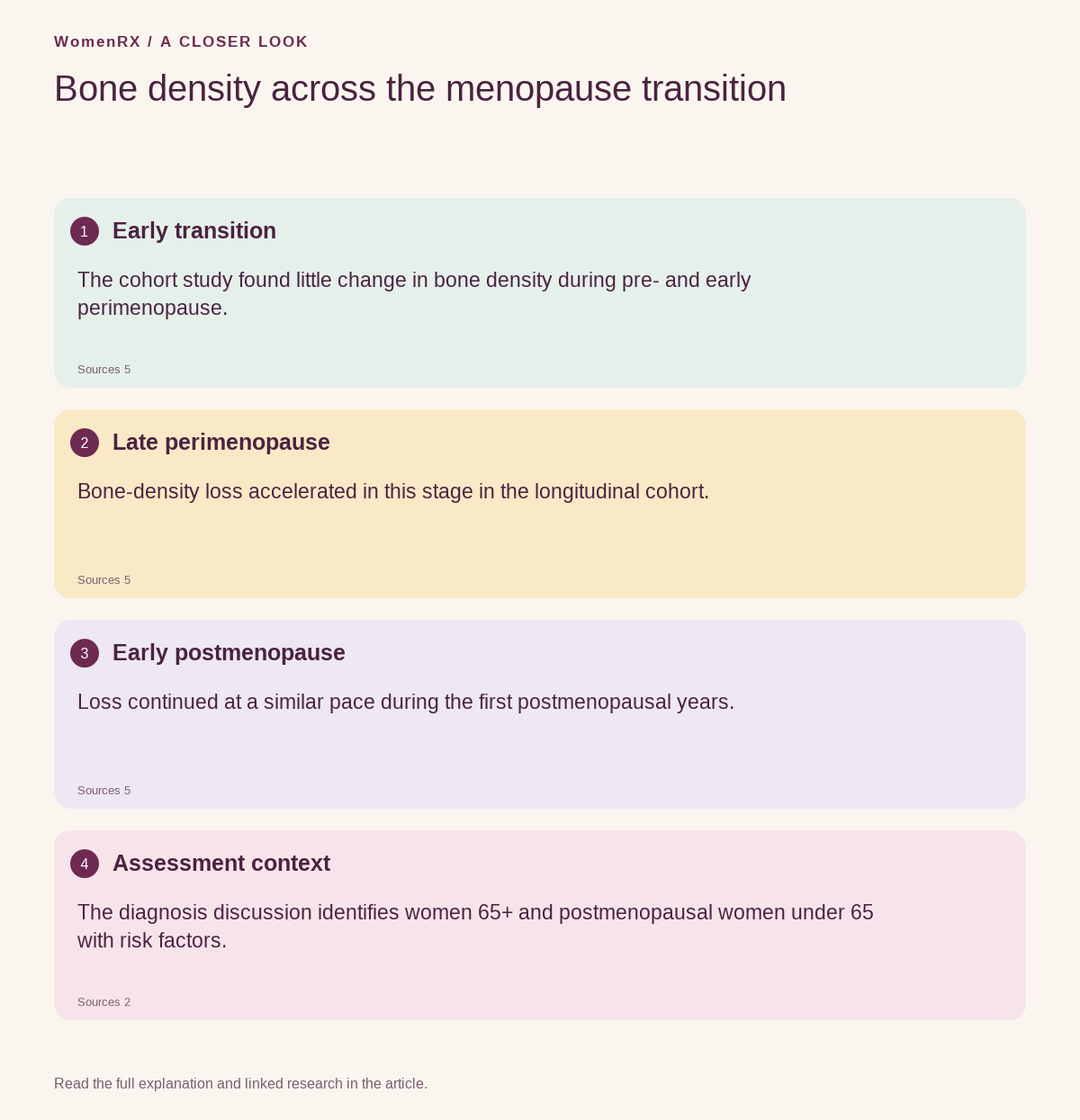
Bone density across the menopause transition
Early transition: The cohort study found little change in bone density during pre- and early perimenopause.5
Late perimenopause: Bone-density loss accelerated in this stage in the longitudinal cohort.5
Early postmenopause: Loss continued at a similar pace during the first postmenopausal years.5
Assessment context: The diagnosis discussion identifies women 65+ and postmenopausal women under 65 with risk factors.2
Read the figure as text
The usual study pattern is not a sudden change on the day periods stop. Age and personal risk assessment help determine whether testing may be worth discussing.- Early transition: The cohort study found little change in bone density during pre- and early perimenopause.5
- Late perimenopause: Bone-density loss accelerated in this stage in the longitudinal cohort.5
- Early postmenopause: Loss continued at a similar pace during the first postmenopausal years.5
- Assessment context: The diagnosis discussion identifies women 65+ and postmenopausal women under 65 with risk factors.2
More questions, answered
Does having hot flashes mean I need a bone scan?
Not on its own. Age and risk factors are relevant to deciding whether to assess bone health. A study found no significant link between night sweats and two-year bone-density change, but it did not establish what hot flashes indicate. 2 4
Is hormone therapy prescribed just to protect bones?
Hormone therapy can prevent bone loss and fracture, but whether it’s suitable depends on individual benefits and risks. Menopausal symptoms or concern about bones don’t automatically mean it’s the right option. 3
Sources you can check
- Bone Density | Bone Mineral Density | BMD | MedlinePlusAccessed 2026-09-25Return to first citation
- Osteoporosis | MedlinePlusAccessed 2026-09-25Return to first citation
- The 2022 hormone therapy position statement of The North American Menopause Society.“The 2022 Hormone Therapy Position Statement of The North American Menopause Society” Advisory Panel. · Menopause (New York, N.Y.) · 2022Return to first citation
- Women's Mid-Life Night Sweats and 2-Year Bone Mineral Density Changes: A Prospective, Observational Population-Based Investigation from the Canadian Multicentre Osteoporosis Study (CaMos).Wong EMM, Tomlinson G, Pinto MM, Berger C, Cheung AM, Prior JC. · International journal of environmental research and public health · 2018Return to first citation
- Bone mineral density changes during the menopause transition in a multiethnic cohort of women.Finkelstein JS, Brockwell SE, Mehta V, Greendale GA, Sowers MR, Ettinger B, Lo JC, Johnston JM, Cauley JA, Danielson ME, Neer RM. · The Journal of clinical endocrinology and metabolism · 2008Return to first citation