Can You Feel Osteoporosis Before a Bone Breaks?
Osteoporosis usually has no early symptoms, so age, menopause-related risk and fracture history matter more than aches when deciding whether to assess bone health.
Usually, no. Osteoporosis can weaken bones without causing symptoms, and a broken bone may be the first sign.5 In the US, screening is recommended for women 65 and older and for postmenopausal women under 65 who have risk factors.5 If you think you broke a bone, get medical care right away; care for the injury comes before a conversation about bone-density testing.3
Why you may feel fine while bone is changing
Bone is living tissue: your body removes old bone and replaces it with new bone. When more bone is removed than replaced, bone density can fall. Osteoporosis also involves changes in bone structure and strength, making a break more likely.15
You generally can’t feel that process happening. Osteoporosis is often called a silent disease because it usually causes no symptoms before a fracture. An ache on its own isn’t a reliable early warning sign of low bone density, and feeling well doesn’t rule it out.5
A possible fracture is different from screening
For example, if you fall and then have intense pain or trouble moving an injured arm, the immediate question is whether the bone is broken. A clinician may use an X-ray or other imaging to check the injury. If you think you’ve broken a bone, get medical care right away.3
A bone-density scan answers a different question: whether bone mass is low and how that relates to future fracture risk. Low bone density and osteoporosis make fractures more likely, but a painful injury needs assessment on its own terms. After an injury is assessed, a break following a relatively minor event is useful history to raise when discussing your bone health. The screening trials reviewed for primary care included adults without known osteoporosis or medical conditions associated with bone metabolism. The review does not establish a complete evaluation plan for someone who has already had a fragility fracture.4
When testing enters the conversation
For women 65 and older, US screening recommendations support testing even if nothing hurts. For postmenopausal women younger than 65, risk factors determine whether screening is recommended. A clinician may use a short fracture-risk assessment to estimate the chance of a break over the next 10 years and help decide on bone-density testing.5
Menopause matters because the drop in estrogen can speed bone-density loss. Risk isn’t determined by a birthday alone: a parent with osteoporosis or a hip fracture, early menopause, and a prolonged absence of periods associated with over-exercising or restrictive dieting are examples of history that can change the conversation.25 If you’re under 65 and one of those examples fits, you don’t need to wait for an ache to ask whether a risk assessment makes sense. That doesn’t mean every younger woman needs the same testing schedule.
Osteoporosis can also affect men and younger people. It’s more common in women after menopause and in older adults, but neither sex nor age alone tells the whole story.25
What a density result can tell you
A bone-density scan measures bone mass. It can identify low bone density, including osteopenia, which means density is low but not low enough to be called osteoporosis. It can also help estimate fracture risk.1 It doesn’t replace an X-ray or other evaluation when the question is whether you’ve broken a bone today.13
The useful distinction is this: don’t wait for symptoms to decide whether routine screening applies to you, and don’t treat a possible fracture as a routine screening question. Your age and risk history guide the first conversation; a suspected break calls for prompt injury care.35
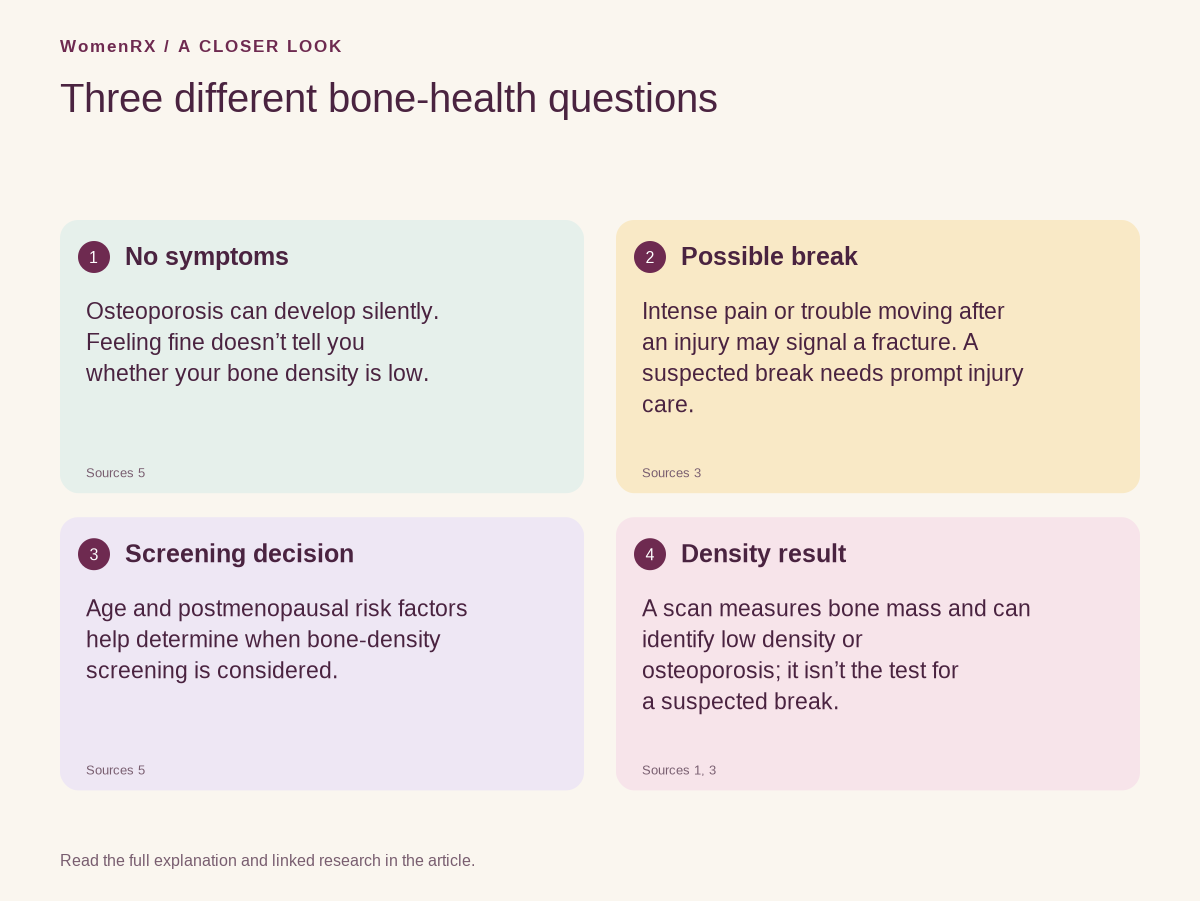
Three different bone-health questions
No symptoms: Osteoporosis can develop silently. Feeling fine doesn’t tell you whether your bone density is low.5
Possible break: Intense pain or trouble moving after an injury may signal a fracture. A suspected break needs prompt injury care.3
Screening decision: Age and postmenopausal risk factors help determine when bone-density screening is considered.5
Density result: A scan measures bone mass and can identify low density or osteoporosis; it isn’t the test for a suspected break.13
Read the figure as text
The next step depends on whether you’re considering screening, dealing with an injury or making sense of a density result.- No symptoms: Osteoporosis can develop silently. Feeling fine doesn’t tell you whether your bone density is low.5
- Possible break: Intense pain or trouble moving after an injury may signal a fracture. A suspected break needs prompt injury care.3
- Screening decision: Age and postmenopausal risk factors help determine when bone-density screening is considered.5
- Density result: A scan measures bone mass and can identify low density or osteoporosis; it isn’t the test for a suspected break.13
More questions, answered
Is osteopenia the same as osteoporosis?
No. Osteopenia describes bone density that is lower than normal but not low enough to be classified as osteoporosis. A bone-density result can help distinguish the two and inform a discussion of fracture risk.1
Sources you can check
- Bone Density | Bone Mineral Density | BMD | MedlinePlusAccessed 2026-09-25Return to first citation
- Osteoporosis - Causes - NHSAccessed 2026-09-25Return to first citation
- Fracture | MedlinePlusAccessed 2026-09-25Return to first citation
- Screening for Osteoporosis to Prevent Fractures: An Evidence Review for the U.S. Preventive Services Task ForceKahwati LC, Kistler CE, Booth G, Sathe N, Gordon R, Cox A, Okah E, Wines RC, Viswanathan M. · 2025Return to first citation
- Osteoporosis | MedlinePlusAccessed 2026-09-25Return to first citation