Planning a Pregnancy With Osteoporosis or Low Bone Density
A preconception review can separate questions about your ability to conceive from questions about fractures, treatment and bone health during breastfeeding.
Osteoporosis is a diagnosis about bone strength and fracture risk, not a measure of fertility. Before trying to conceive, review why your bone density is low, whether you’ve had a fracture, and what treatment you’re taking. Pregnancy and especially breastfeeding can change bone density, so the useful question is how those changes might affect your bones and care plan. 14
Start with the diagnosis you already have
A bone density result tells you about the mineral content of your bones and helps assess fracture risk. It doesn’t tell you whether you can become pregnant. Low bone density and osteoporosis also aren’t interchangeable: osteoporosis is associated with greater bone weakness and fracture risk. 1
That distinction matters when you’re planning a pregnancy. For example, someone whose scan showed low bone density but who has never broken a bone has a different question from someone recovering from a spine or hip fracture. Bring the scan results and the details of any fractures to a preconception visit, including which bone broke and when. The aim is to understand your starting point, not to assume pregnancy is off the table. 12
Ask why your bone density is low
A number on a scan is only part of the story. Family history, not building much bone mass when younger, and prolonged inactivity are among the factors linked with low bone density. 1 Ask whether the explanation for your result is clear and whether anything that affects your bone health still needs attention before pregnancy. That question is especially useful if you’ve had a fracture.
It’s also worth separating an existing diagnosis from pregnancy and lactation-associated osteoporosis, sometimes called PLO. PLO describes an uncommon condition in which bone injury or fractures become apparent during pregnancy or after birth. Much of the published detail comes from case reports and series, so it cannot predict what will happen to an individual who already has low bone density. 45
What pregnancy and breastfeeding can mean for bones
Your body handles calcium differently during pregnancy and breastfeeding. During pregnancy, increased calcium absorption helps meet fetal needs. During breastfeeding, calcium can be drawn from the maternal skeleton to help supply milk. Studies of bone density change during pregnancy have produced inconsistent findings; bone loss during lactation is more consistently documented. 4
For most women, this isn’t the same as permanent bone loss. A review of the research reports that bone density generally recovers after breastfeeding ends, with most studies indicating recovery by about 12 months after weaning. That general pattern is not a promise that someone with osteoporosis or a prior fracture will return to her own pre-pregnancy measurement. 4
This is why it helps to discuss breastfeeding as part of the bone-health plan before birth. You can ask how your fracture history and current bone health might shape follow-up after delivery, rather than trying to make that decision from a general statement about recovery.
Review treatment before changing it
Bring a complete list of prescribed treatments and supplements to the visit. Ask what each is treating, whether the plan needs to change while you’re trying to conceive, and who will coordinate any change. Reports about pregnancy and lactation-associated osteoporosis describe different treatment approaches for women with that condition. 46
Nutrition belongs in the conversation too. Calcium, vitamin D and physical activity are part of general bone-health advice. 2 If you’re choosing a prenatal vitamin, check what it actually contains: prenatal multivitamins vary, and multivitamins often contain only small amounts of calcium. A prenatal vitamin shouldn’t be assumed to cover every bone-health need. 3
Questions that make the visit more useful
You don’t need a perfect plan before the appointment. These questions can help you and your care team build one around your circumstances:
- What does my scan show, and how does any previous fracture change the assessment? 12
- Do we understand why my bone density is low, or is there something else to evaluate? 1
- Which of my current treatments and supplements should we discuss before conception?
- How will we consider bone health during breastfeeding and after weaning? 4
If you develop severe new back or hip pain during pregnancy or after delivery, seek a medical assessment rather than assuming it’s an ordinary pregnancy ache. Spine and hip fractures are reported in pregnancy and lactation-associated osteoporosis, although that condition is uncommon. 45
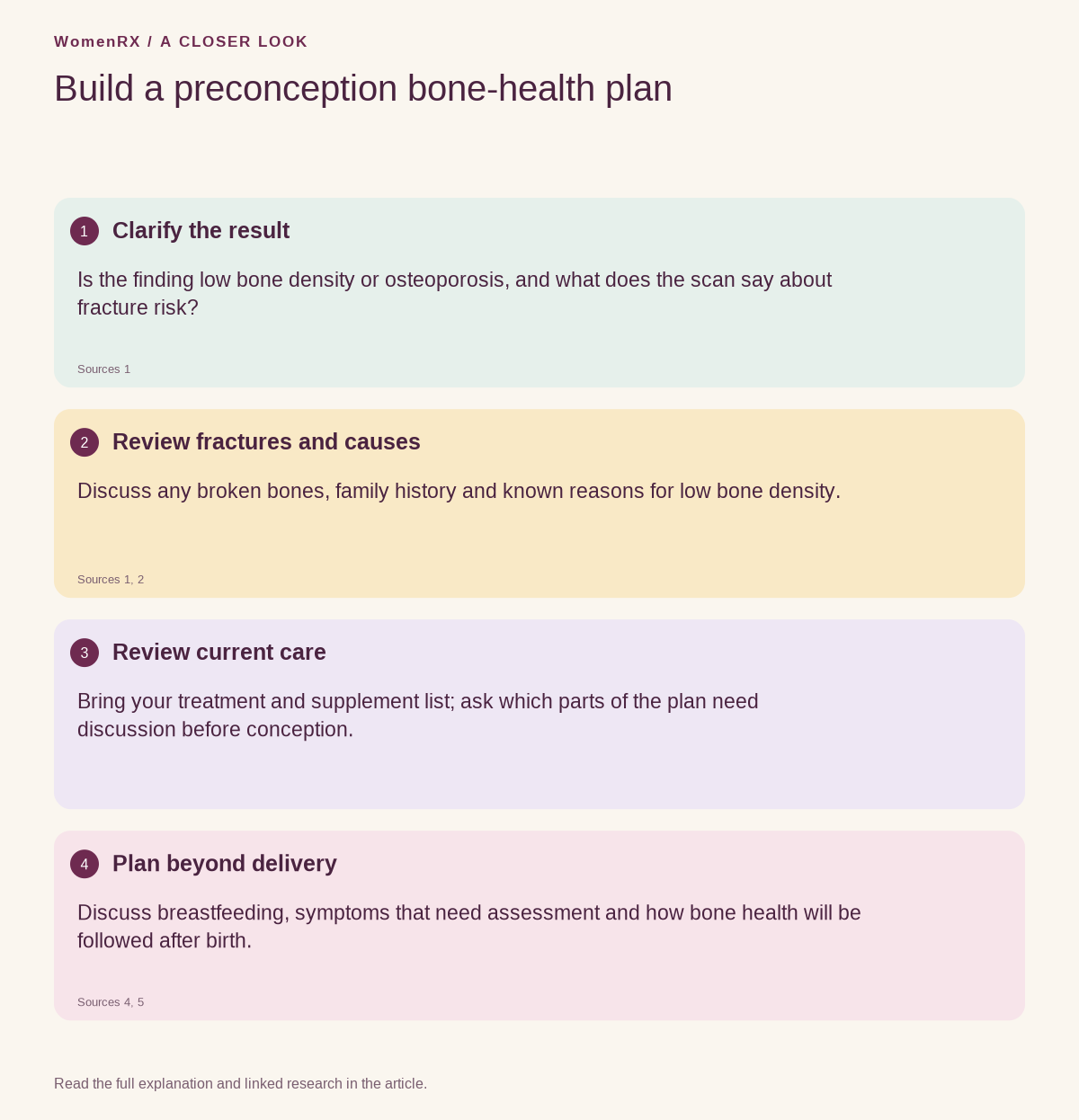
Build a preconception bone-health plan
Clarify the result: Is the finding low bone density or osteoporosis, and what does the scan say about fracture risk?1
Review fractures and causes: Discuss any broken bones, family history and known reasons for low bone density.12
Review current care: Bring your treatment and supplement list; ask which parts of the plan need discussion before conception.
Plan beyond delivery: Discuss breastfeeding, symptoms that need assessment and how bone health will be followed after birth.45
Read the figure as text
Four connected questions turn a bone density diagnosis into a more specific conversation about pregnancy.- Clarify the result: Is the finding low bone density or osteoporosis, and what does the scan say about fracture risk?1
- Review fractures and causes: Discuss any broken bones, family history and known reasons for low bone density.12
- Review current care: Bring your treatment and supplement list; ask which parts of the plan need discussion before conception.
- Plan beyond delivery: Discuss breastfeeding, symptoms that need assessment and how bone health will be followed after birth.45
More questions, answered
Does a low bone density scan mean I’ll have trouble conceiving?
A bone density scan measures bone health and helps assess fracture risk; it isn’t a fertility test. Your preconception discussion should address your bone diagnosis and pregnancy plans as related but distinct questions. 1
Will breastfeeding permanently lower my bone density?
Bone density commonly falls during lactation and generally recovers after weaning. A review reports that most studies indicate recovery by about 12 months after weaning, but that pattern cannot guarantee recovery to a particular measurement for someone who already has osteoporosis. 4
Sources you can check
- Bone Density | Bone Mineral Density | BMD | MedlinePlusAccessed 2026-09-25Return to first citation
- Fracture | MedlinePlusAccessed 2026-09-25Return to first citation
- Multivitamin/mineral Supplements - Health Professional Fact SheetAccessed 2026-09-25Return to first citation
- Pregnancy and Lactation Associated Osteoporosis of the Hip: A Systematic Review.Weckerly ML, Feingold CL, Singh NK, Fatehi MK, Abrahams R, Mirzai DA, Cohen A, Cooper A. · Calcified tissue international · 2026Return to first citation
- Osteoporosis associated with pregnancy and lactation (PLO): can REMS have a role in prevention and follow-up?Al Refaie A, Mondillo C, Baldassini L, Tarquini R, Gennari L, Gonnelli S, Caffarelli C. · Endocrinology, diabetes & metabolism case reports · 2026Return to first citation
- Pregnancy and lactation-associated osteoporosis: insights from an online self-reported patient survey.Tuzun S, Aygun E. · Archives of osteoporosis · 2026Return to first citation