Planning Pregnancy With Osteoporosis: Bone Medicine Questions
Planning pregnancy with osteoporosis calls for a look at your fracture history and the exact bone medicine you’ve taken.
Yes, you can become pregnant if you have osteoporosis. A study of pregnancies in women taking bisphosphonates reported that all were being treated for osteoporosis; it does not establish how osteoporosis affects fertility. 6 If you are planning pregnancy, review your fracture risk and the exact bone medicine you’ve taken. For alendronate or another bisphosphonate, exposure before or during pregnancy raises a separate question: small human studies have not shown a clear pattern of major harm, but cannot establish safety for a particular medicine or set a waiting interval. 2 6 7
One diagnosis, three different questions
“Osteoporosis and pregnancy” can refer to different situations: you may have been diagnosed before trying to conceive; you may have taken an osteoporosis medicine around conception; or fragility fractures may arise late in pregnancy or after birth and require evaluation for pregnancy- and lactation-associated osteoporosis (PLO) and other causes. Those situations don’t have the same treatment questions.
Osteoporosis means weakened bones that are more likely to fracture. 1 It does not automatically prevent pregnancy: a study of pregnancies in women taking bisphosphonates reported that all were being treated for osteoporosis. The study did not assess fertility. 6 For pregnancy planning, a diagnosis is a starting point, not a complete picture. Your previous fractures and treatment matter because osteoporosis treatment decisions take fracture risk and injury history into account. 2
If osteoporosis came first
Before pregnancy, make sure your care team knows both your plans and the details of your bone health. Osteoporosis medicines differ: for example, bisphosphonates slow bone breakdown, while parathyroid hormone treatments stimulate cells that form bone. 2 The question isn’t just whether you have osteoporosis. It’s what treatment is protecting you from fractures and what is known about that particular medicine in pregnancy.
Alendronate is a bisphosphonate. Medicines in this class can remain in bone for years after treatment ends, so the last dose does not, by itself, settle the exposure question. That persistence does not establish that a pregnancy will be harmed, and it does not provide a universal waiting interval before conception. 7 If you’re taking a bone medicine, discuss any change with the clinician managing your osteoporosis rather than stopping it on your own; decisions about medicines around pregnancy weigh the risks of treatment against the risks of leaving a condition untreated. 5
What human pregnancy studies can tell us
The findings so far offer some reassurance, with an important limit. In a prospective study, researchers followed 21 women who had taken a bisphosphonate during pregnancy or within three months before it, alongside 21 matched women without known teratogen exposure. Outcomes in the exposed group included 18 live births, two spontaneous abortions and one therapeutic abortion; the study did not find a statistically significant difference in the reported pregnancy outcomes between groups. A group this small cannot rule out less common risks or predict an individual pregnancy’s outcome. 6
A review of reports published through May 2014 identified 65 mother-child pairs with bisphosphonate use before or during pregnancy, including exposure to alendronate and several other drugs in the class. It described some outcomes possibly attributable to exposure, including temporary newborn electrolyte abnormalities, while reporting no long-term infant health consequences in those publications. Because these were limited reports involving different medicines and exposure histories, they cannot establish that alendronate, or bisphosphonates as a group, are safe throughout pregnancy. 7
If you’re planning pregnancy or have already had an exposure, the useful details are the medicine’s name, when you took it, why it was prescribed and whether you’ve had a fracture. Those details help separate the question of possible pregnancy exposure from the question of how to protect your bones if treatment changes. 2 6 7
PLO fractures around pregnancy are different
Pregnancy- and lactation-associated osteoporosis is a rare condition in which fragility fractures occur in late pregnancy or during the postpartum or lactation period. Vertebral fractures are the most commonly reported fractures in a systematic review. The studies included in that review also reported fractures recurring in 7% to 28% of women in the included cohorts in subsequent pregnancies; those figures come from limited observational evidence, not a precise prediction for an individual. 3
Tell your pregnancy care team about new or worsening back pain in late pregnancy or after birth, rather than assuming it’s routine pregnancy pain. Back pain is common around pregnancy, which can make fractures harder to recognize. Fragility fractures, often in the spine, are central to PLO diagnosis; other causes of bone disease also need to be considered. 4
PLO isn’t simply the same as osteoporosis diagnosed years earlier. It calls for evaluation of the new symptoms and possible fractures, plus a careful look at other contributors to bone health. Breastfeeding decisions and treatment belong in that individualized discussion. Evidence on the benefits and harms of osteoporosis medicines in PLO remains limited, so a case report or small study should not be treated as a universal treatment plan. 3 4
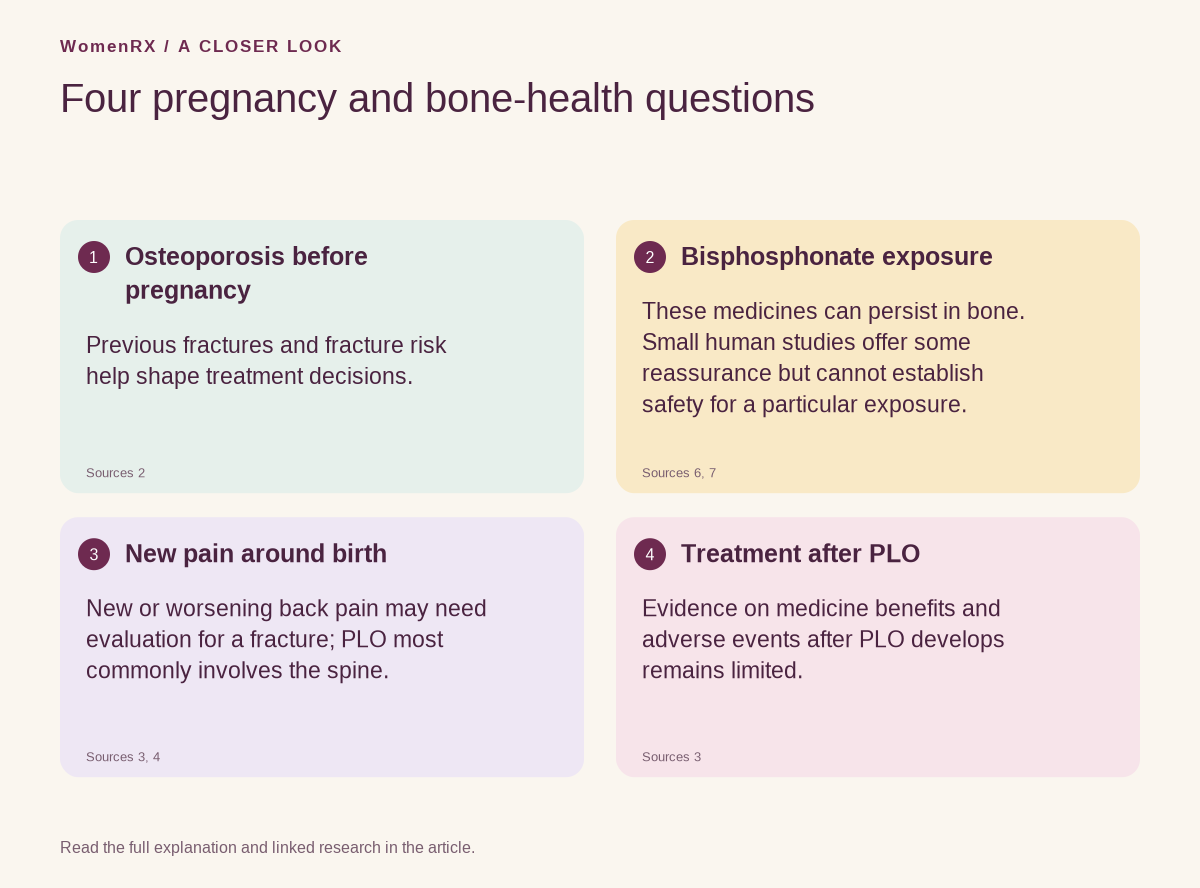
Four pregnancy and bone-health questions
Osteoporosis before pregnancy: Previous fractures and fracture risk help shape treatment decisions.2
Bisphosphonate exposure: These medicines can persist in bone. Small human studies offer some reassurance but cannot establish safety for a particular exposure.67
New pain around birth: New or worsening back pain may need evaluation for a fracture; PLO most commonly involves the spine.34
Treatment after PLO: Evidence on medicine benefits and adverse events after PLO develops remains limited.3
Read the figure as text
The same osteoporosis question can call for a fracture-risk review, an assessment of a specific medicine exposure, or evaluation of a new fracture.- Osteoporosis before pregnancy: Previous fractures and fracture risk help shape treatment decisions.2
- Bisphosphonate exposure: These medicines can persist in bone. Small human studies offer some reassurance but cannot establish safety for a particular exposure.67
- New pain around birth: New or worsening back pain may need evaluation for a fracture; PLO most commonly involves the spine.34
- Treatment after PLO: Evidence on medicine benefits and adverse events after PLO develops remains limited.3
More questions, answered
What if I took alendronate before realizing I was pregnant?
Having taken it does not, by itself, tell you that harm occurred. Alendronate was among the bisphosphonates in a review of 65 reported mother-child pairs, but that review cannot predict the outcome of a particular exposure. Share the medicine name and when you took it with your pregnancy care team, and discuss any treatment change with the clinician managing your bones. 7 5
Sources you can check
- Osteoporosis | MedlinePlusAccessed 2026-09-25Return to first citation
- Osteoporosis - Treatment - NHSAccessed 2026-09-25Return to first citation
- Pregnancy and Lactation Associated Osteoporosis: A Systematic Review.Issa Z, Saad R, Lama Y, Ammar S, Akiki V, Kovacs CS, El-Hajj Fuleihan G, Chakhtoura M. · Calcified tissue international · 2026Return to first citation
- Osteoporosis associated with pregnancy and lactation (PLO): can REMS have a role in prevention and follow-up?Al Refaie A, Mondillo C, Baldassini L, Tarquini R, Gennari L, Gonnelli S, Caffarelli C. · Endocrinology, diabetes & metabolism case reports · 2026Return to first citation
- Pregnancy and Medicines | MedlinePlusAccessed 2026-09-25Return to first citation
- Pregnancy outcome following in utero exposure to bisphosphonates.Levy S, Fayez I, Taguchi N, Han JY, Aiello J, Matsui D, Moretti M, Koren G, Ito S. · Bone · 2009Return to first citation
- Effects of maternal bisphosphonate use on fetal and neonatal outcomes.Green SB, Pappas AL. · American journal of health-system pharmacy : AJHP : official journal of the American Society of Health-System Pharmacists · 2014Return to first citation