Can Osteoporosis Be Reversed? What Treatment Can Change
Bone density can improve, but the goal is to lower fracture risk, not promise a complete return to your previous bone strength.
Osteoporosis treatment may improve bone density, and its broader goal is to help prevent fractures. But a higher scan result isn’t the whole story: fracture history, age, falls, and other risk factors also matter. Food, exercise, and fall prevention support bone health; they don’t automatically replace medication when your overall fracture risk makes treatment worthwhile. 2 3 5
“Reversed” can mean more than one thing
Osteoporosis develops when bone is broken down faster than it is replaced, weakening the skeleton and making fractures more likely. A bone-density scan measures one part of that picture. Treatment may improve bone density, but the practical aim is to reduce the chance of breaking a bone, not to guarantee that bones return to their former condition. 2 5
That distinction matters because bone density and fracture risk aren’t interchangeable. Bone structure, previous fractures, and factors such as falls and impaired balance can affect whether a person breaks a bone. Two people with similar scan results may have different overall risk. 2 4 5
Lifestyle supports bones; treatment targets fracture risk
A balanced diet with enough calcium, vitamin D, and protein supports bone health. Weight-bearing and resistance exercise can help maintain or improve bone density and strength. If you’ve been diagnosed with osteoporosis, choose an exercise plan that suits your abilities and condition rather than assuming every high-impact activity is appropriate. 1 2
Fall prevention addresses a different part of the problem: whether a fall happens and whether it leads to a fracture. Removing hazards at home and considering balance, mobility, and vision are practical parts of prevention. These steps complement, rather than replace, assessment of bone strength and fracture risk. 3 4
Medication may be recommended when your risk warrants it. Osteoporosis medicines are used to strengthen bones, with treatment intended to help prevent fractures. A cross-sectional study of people hospitalized with hip fractures did not test medication effects, but its background describes therapies as increasing bone density and reducing fracture risk. The choice depends on your health and risk profile. Lifestyle measures alone shouldn’t be assumed to offer the same fracture protection as prescribed treatment. 2 3 5
Menopause isn’t the only factor
Women can lose bone more rapidly in the first years after menopause. Risk is also higher when menopause happens early or the ovaries have been removed. But osteoporosis isn’t limited to postmenopausal women: factors such as anorexia and long periods of inactivity or bed rest can also contribute to bone loss. 2 3
If you’re younger and have a low-density result, those other possible contributors are worth discussing rather than assuming menopause-related bone loss is the explanation. If your result or a fracture arose during pregnancy or breastfeeding, mention the timing when you discuss your bone health. The menopause-related pattern above doesn’t, by itself, explain your situation.
Make the decision about your risk, not one number
A scan result is useful, but it isn’t the whole treatment decision. A clinician may consider your medical history, previous fractures, bone-density results, and an estimate of your chance of fracture. Treatment decisions can depend on that combined picture. 2 3
If you’re reviewing a diagnosis or scan, useful questions include:
- What does my result mean alongside my age and fracture history?
- Have I had a fracture that changes my future risk?
- What factors might be contributing to my bone loss?
- What benefit should I expect from medication compared with lifestyle steps alone?
- How will we judge whether my overall fracture risk is changing, not just my scan result?
A fracture after a fall or other low-impact event is worth raising as part of your osteoporosis assessment. A previous fracture can be an important clue to future risk, even when the next step isn’t obvious from a scan result alone. 2 5
The useful middle ground is neither “food and exercise will reverse it” nor “a scan number decides everything.” Build the lifestyle habits that support bones and reduce falls, then weigh medication against your individual chance of fracture.
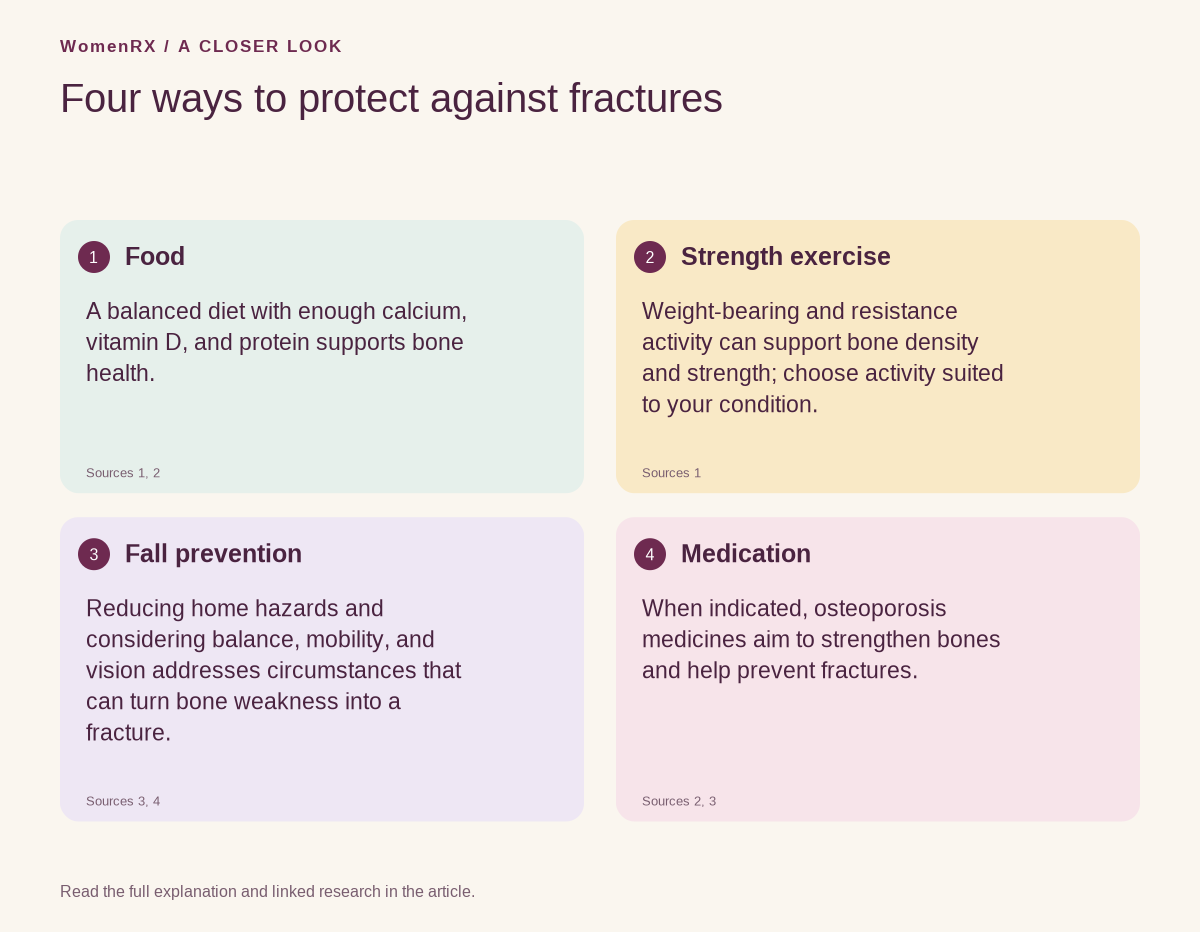
Four ways to protect against fractures
Food: A balanced diet with enough calcium, vitamin D, and protein supports bone health.12
Strength exercise: Weight-bearing and resistance activity can support bone density and strength; choose activity suited to your condition.1
Fall prevention: Reducing home hazards and considering balance, mobility, and vision addresses circumstances that can turn bone weakness into a fracture.34
Medication: When indicated, osteoporosis medicines aim to strengthen bones and help prevent fractures.23
Read the figure as text
Each approach addresses a different part of bone health or fracture risk; lifestyle steps and medication aren’t interchangeable.- Food: A balanced diet with enough calcium, vitamin D, and protein supports bone health.12
- Strength exercise: Weight-bearing and resistance activity can support bone density and strength; choose activity suited to your condition.1
- Fall prevention: Reducing home hazards and considering balance, mobility, and vision addresses circumstances that can turn bone weakness into a fracture.34
- Medication: When indicated, osteoporosis medicines aim to strengthen bones and help prevent fractures.23
More questions, answered
Does osteopenia always turn into osteoporosis?
No. Osteopenia means bone density is below average but not low enough to meet the osteoporosis threshold; it doesn’t always progress. Whether treatment is considered depends on bone strength and fracture risk, not the label alone. 3
Does osteoporosis cause pain before a fracture?
Osteoporosis usually doesn’t cause symptoms on its own. A fracture, including one in the spine, can cause pain. 2 3
Sources you can check
- Osteoporosis - Prevention - NHSAccessed 2026-09-25Return to first citation
- Osteoporosis | MedlinePlusAccessed 2026-09-25Return to first citation
- Osteoporosis - NHSAccessed 2026-09-25Return to first citation
- Beyond bone density: toward an integrated bone- muscle-function framework for fragility fracture prevention.Lu S, Liu C, Gou Y, Liu H. · Frontiers in medicine · 2026Return to first citation
- Estimating the Extent of Missed Opportunities for Osteoporosis Treatment Before Hip Fracture Occurrence.Arcidiacono GP, Torres MO, Ceolin C, Giantin M, Tripepi G, Camozzi V, Bertocco A, Falb MP, Diogo M, Guidolin F, Voltan G, Rodà MG, Pala E, Angelini A, Boemo DG, Nesoti MV, Campello... · Calcified tissue international · 2026Return to first citation