How Osteoporosis Is Diagnosed and When DXA Helps
A DXA scan measures bone density; your fracture history and other risks help show what that result means for you.
Osteoporosis is evaluated using your health and fracture history, risk factors, and usually a DXA bone-density scan. A separate fracture-risk assessment can estimate your chance of breaking a bone in the next 10 years. Testing is recommended for women 65 and older and for younger postmenopausal women with risk factors; a fracture or other concerns may prompt evaluation earlier. 2
Three questions, not one test
Osteoporosis often has no symptoms until a bone breaks. So an evaluation is not just a scan: it brings together your bone density, your personal fracture history, and other factors that affect the chance of a future break. 2
A DXA scan, sometimes called DEXA, measures bone mineral density. Its result helps classify bone density, but it does not show the whole picture of your future fracture risk. That is why an assessment may also consider your history and estimate your chance of breaking a bone over the next 10 years. 23
When screening is usually considered
MedlinePlus describes screening for women age 65 and older, and for postmenopausal women under 65 who have factors that increase their chance of osteoporosis. 2 Menopause can be relevant because osteoporosis is more common after menopause, and bone loss can be faster in the first few years after it. Earlier menopause and other health or lifestyle factors may also matter. 23
That age guidance is a starting point, not a rule that makes risk irrelevant before 65. A clinician may consider your history and risks when deciding whether evaluation makes sense sooner. Examples of risk factors in the guidance include older age, smoking, long-term heavy alcohol use, physical inactivity or extended bedrest, and an eating disorder such as anorexia. 2 The decision can also be relevant outside menopause, since anyone can develop osteoporosis. 2
A fracture can change the conversation
A broken bone may be the first sign of osteoporosis. If you have a fracture, the immediate question is whether the bone is broken, which is generally assessed with an X-ray or other imaging. The separate bone-health question is whether weakened bones contributed and whether you need osteoporosis evaluation. 123
A fracture history is part of an osteoporosis assessment, and a fracture-risk calculation may help put the DXA result in context. 2 A fracture does not mean a DXA scan is the test to diagnose the break; nor does a density result alone describe every factor that affects future fracture risk. If you have broken a bone, it is reasonable to ask whether bone-health evaluation should be part of follow-up. 12
What the result can and cannot tell you
A DXA result provides information about bone density. A fracture-risk assessment adds a different kind of information: an estimate of the chance of a future break, often expressed over 10 years. 2 Your previous fractures and other relevant history help interpret both. 24
This distinction matters when discussing next steps. Treatment decisions are not based only on the scan; fracture risk and previous injury history also contribute. 4 A lower-than-average bone-density result does not automatically mean osteoporosis: osteopenia describes density below the usual range but not low enough to meet the osteoporosis classification. 3 The finding is one part of the assessment, not a complete forecast of what will happen.
A useful question for your next visit
If you are nearing or past menopause, are 65 or older, or have had a fracture, ask: “Would a DXA scan help assess my bone density, and should my fracture history or other risks also be included?” That question separates the measurement from the broader risk assessment, so the result can be considered in context. 24
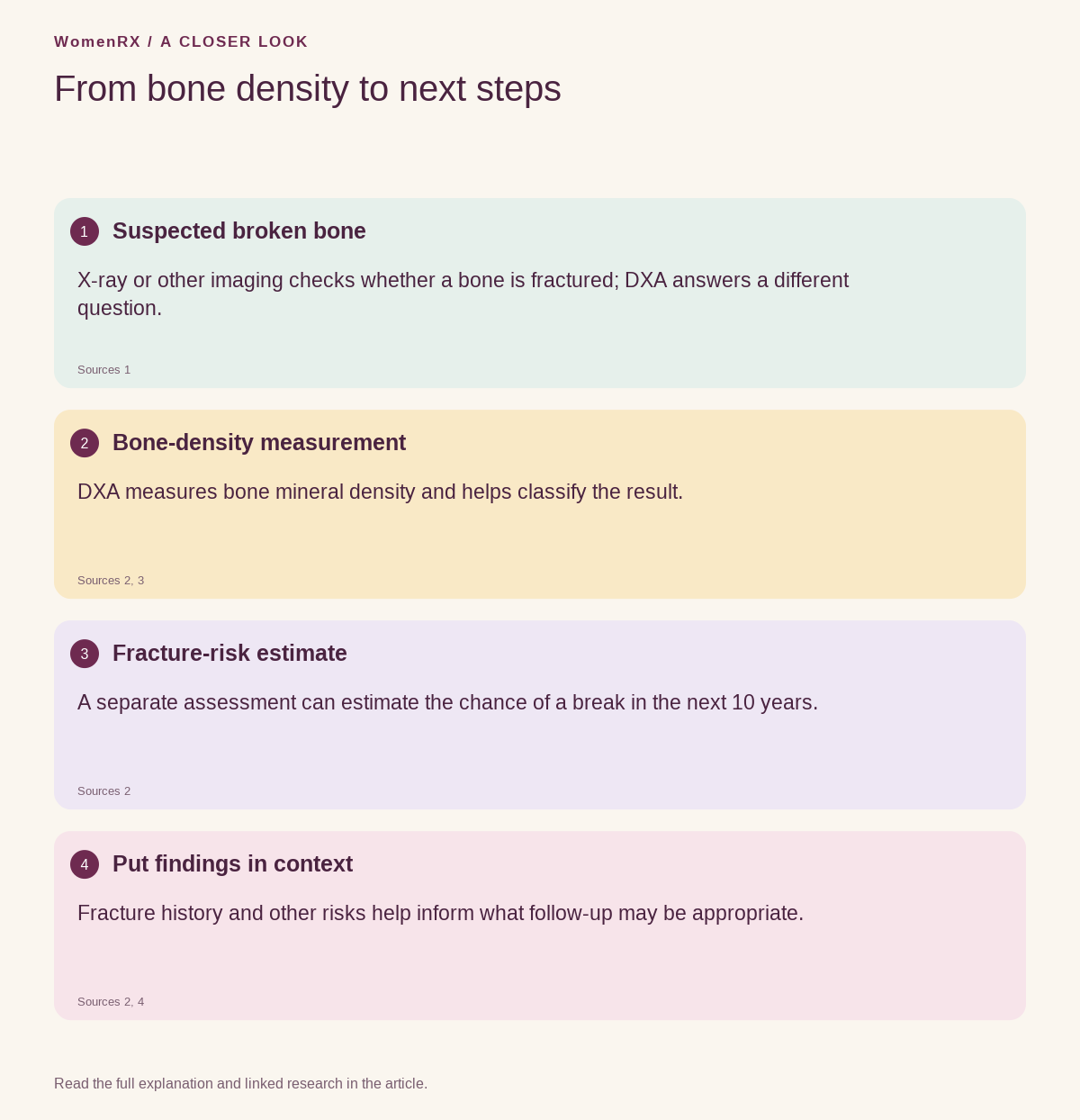
From bone density to next steps
Suspected broken bone: X-ray or other imaging checks whether a bone is fractured; DXA answers a different question.1
Bone-density measurement: DXA measures bone mineral density and helps classify the result.23
Fracture-risk estimate: A separate assessment can estimate the chance of a break in the next 10 years.2
Put findings in context: Fracture history and other risks help inform what follow-up may be appropriate.24
Read the figure as text
Follow the separate questions an osteoporosis evaluation may address: whether a bone is broken, what bone density shows, and how personal history affects future fracture risk.- Suspected broken bone: X-ray or other imaging checks whether a bone is fractured; DXA answers a different question.1
- Bone-density measurement: DXA measures bone mineral density and helps classify the result.23
- Fracture-risk estimate: A separate assessment can estimate the chance of a break in the next 10 years.2
- Put findings in context: Fracture history and other risks help inform what follow-up may be appropriate.24
More questions, answered
Does a DXA scan diagnose a broken bone?
No. DXA measures bone density. A suspected fracture is generally evaluated with an X-ray or other imaging; bone-density testing addresses a separate question about bone health. 12
Can you have osteoporosis without symptoms?
Yes. Osteoporosis usually does not cause symptoms, and a broken bone may be the first sign. 2
Sources you can check
- Fracture | MedlinePlusAccessed 2026-09-25Return to first citation
- Osteoporosis | MedlinePlusAccessed 2026-09-25Return to first citation
- Osteoporosis - NHSAccessed 2026-09-25Return to first citation
- Osteoporosis - Treatment - NHSAccessed 2026-09-25Return to first citation