Calcium and Vitamin D for Osteoporosis: What Helps?
The right supplement depends on what you already get from food, your stone history, and your fracture risk.
There isn’t one calcium or vitamin D supplement that’s right for everyone with osteoporosis. First consider whether your food and fortified drinks provide enough calcium, then discuss any remaining gap and vitamin D needs. Supplements can support bone nutrition, but trials in adults not taking osteoporosis drugs found little to no fracture-prevention benefit overall, especially leaving uncertainty for people at high risk. 1 3 5
Start with what you get from food
Calcium and vitamin D work together in bone health: vitamin D helps your body absorb calcium, and calcium is a major building block of bone. That makes adequate intake worthwhile, but it doesn’t mean every woman needs a supplement. 1 3
For women, the recommended calcium intake is 1,000 mg a day from ages 19 to 50 and 1,200 mg a day after 50. These are total-intake recommendations, not automatic supplement doses. Calcium-rich choices include yogurt, milk, calcium-fortified plant beverages or juice, tofu made with calcium salts, and canned fish with edible bones. Check labels, since amounts vary. 1
The vitamin D recommended intake is 600 IU a day through age 70 and 800 IU after 70. These recommendations are for healthy people; they aren’t individualized treatment targets for osteoporosis or a vitamin D deficiency. Fortified foods and some fish provide vitamin D, and the amount in a plant beverage or other product is listed on its label. 3
A practical first step is to estimate what you regularly eat and drink, rather than adding a full-dose supplement on top of an already adequate intake. If there’s a gap, a supplement may help fill it. The amount to add depends on the gap, so the label’s serving size alone can’t tell you what you need. 1 3
Menopause changes risk, not everyone’s needs
As estrogen falls around menopause, bone breakdown increases and calcium absorption can decrease. This helps explain why bone loss and osteoporosis become more common after menopause. It doesn’t show that every postmenopausal woman has low calcium intake or needs the same supplement. 1
Age, bone density, and a previous fragility fracture are among the factors used in osteoporosis guidelines to assess risk of another fracture. A fragility fracture is one that happens after relatively minor trauma, such as a fall from standing height or less. These details matter because filling a nutrient gap and deciding how to manage a high fracture risk are related, but different, decisions. 1 4
Supplements aren’t a stand-alone fracture plan
A 2026 systematic review and meta-analysis included 69 trials with 153,902 adults who were not receiving osteoporosis drug treatment. Most participants lived in the community and were not considered at high fracture or fall risk. Overall, calcium, vitamin D, or both had little to no effect on fractures and falls. For any fracture, the review found little to no effect from calcium alone or vitamin D alone; combined supplements had a small relative reduction, which the review judged to provide little to no meaningful benefit in absolute terms. The overall result is not specific to postmenopausal women, and evidence for higher-risk groups was limited. 5
That review cannot answer whether supplements can replace, or improve the effects of, a prescribed osteoporosis medicine: trials focused on people taking osteoporosis drugs were excluded. So if you’ve been prescribed treatment, don’t treat calcium or vitamin D as a substitute. Ask how nutrient intake fits alongside your treatment, and what your age, bone density, and fracture history mean for your risk. 4 5 6
Include stone history in the decision
More isn’t automatically better. In a large trial of postmenopausal women, the group assigned calcium and vitamin D supplements had a 17% higher relative risk of kidney stones over seven years; average total calcium intake in that group was about 2,100 mg a day from food and supplements. Other reviews of trials did not find the same association, so the evidence isn’t consistent. A history of kidney stones is still a useful reason to discuss your total calcium intake before adding a supplement. 3 1
Calcium supplements can also cause gas, bloating, or constipation for some people. If you take one, count calcium from food, fortified products, and antacids too, and mention your regular medicines when reviewing the plan. Calcium can interfere with absorption of some medicines, including levothyroxine, and lithium used long term can affect calcium levels. 1 2
The useful question isn’t simply “Which supplement is best?” It’s: “Am I short on calcium or vitamin D, and how does correcting that fit with my fracture risk and any osteoporosis medicine I’m taking?”
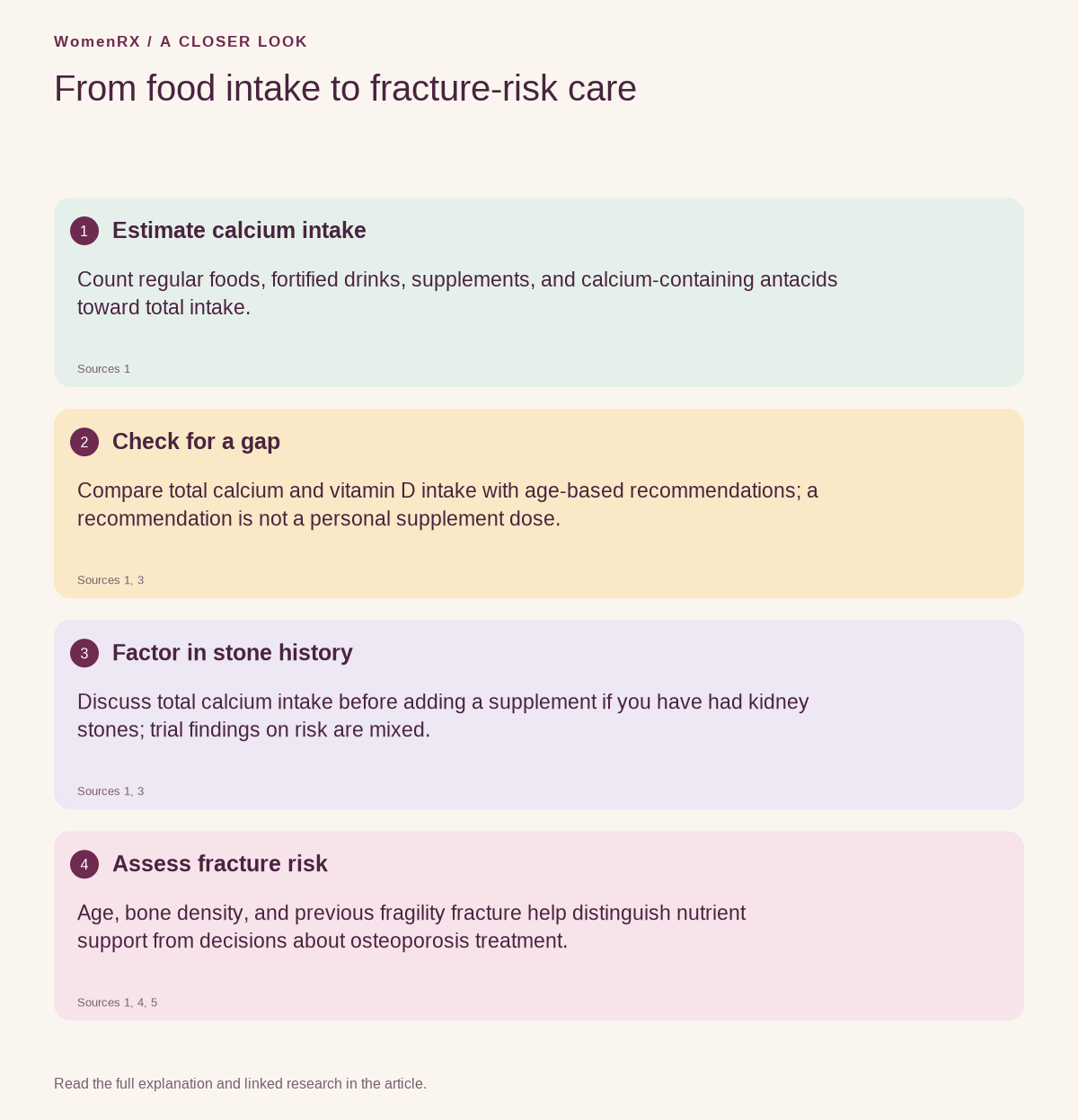
From food intake to fracture-risk care
Estimate calcium intake: Count regular foods, fortified drinks, supplements, and calcium-containing antacids toward total intake.1
Check for a gap: Compare total calcium and vitamin D intake with age-based recommendations; a recommendation is not a personal supplement dose.13
Factor in stone history: Discuss total calcium intake before adding a supplement if you have had kidney stones; trial findings on risk are mixed.13
Assess fracture risk: Age, bone density, and previous fragility fracture help distinguish nutrient support from decisions about osteoporosis treatment.145
Read the figure as text
Use this path to separate a nutrient gap from the separate question of how to manage osteoporosis and fracture risk.- Estimate calcium intake: Count regular foods, fortified drinks, supplements, and calcium-containing antacids toward total intake.1
- Check for a gap: Compare total calcium and vitamin D intake with age-based recommendations; a recommendation is not a personal supplement dose.13
- Factor in stone history: Discuss total calcium intake before adding a supplement if you have had kidney stones; trial findings on risk are mixed.13
- Assess fracture risk: Age, bone density, and previous fragility fracture help distinguish nutrient support from decisions about osteoporosis treatment.145
More questions, answered
Does vitamin D alone prevent fractures?
In a systematic review of adults not taking osteoporosis drugs, vitamin D alone had little to no effect on fractures overall. The findings mostly reflect people at lower risk, so they don’t settle the question for every higher-risk group. 5
Should I take calcium if I have had kidney stones?
Not automatically. Evidence about supplements and kidney stones is mixed, but a trial in postmenopausal women found a higher relative risk in the group assigned calcium and vitamin D. Include calcium from food and supplements when discussing your intake and stone history. 3 1
Sources you can check
- Calcium - Health Professional Fact SheetAccessed 2026-09-25Return to first citation
- Calcium | MedlinePlusAccessed 2026-09-25Return to first citation
- Vitamin D - Health Professional Fact SheetAccessed 2026-09-25Return to first citation
- Defining high risk of osteoporotic fracture: a cross talk between clinical experience and guidelines recommendations.Casado E, Malouf J, Caamaño MM, Salas E, Sánchez-Bursón JM, Rentero ML, Herrero-Beaumont G. · Journal of clinical rheumatology : practical reports on rheumatic & musculoskeletal diseases · 2011Return to first citation
- Calcium, vitamin D, or combined supplementation to prevent fractures and falls: systematic review and meta-analysis.Massé O, Mercurio CM, Dupuis S, Al Sahwi M, Arruda A, Dallaire G, Desforges K, Dugré N, Williamson D. · BMJ (Clinical research ed.) · 2026Return to first citation
- Daily Calcium and Vitamin D Supplementation as a Foundational Pillar in Osteoporosis Management: A Narrative Review.Pascual-Pastor M, Barceló-Bru M. · Nutrients · 2026Return to first citation