Osteoporosis: What Bone Density Can and Can’t Tell You
A bone-density result describes one part of bone health; your age, life stage, health history and fracture risk help put it in context.
Osteoporosis means bones are more likely to break, but a bone-density scan is not a guarantee that a fracture will or won’t happen. It measures bone density and can help estimate fracture risk. Age, family history and certain health conditions also matter. Bone loss can be silent, and bone loss tends to accelerate in the early postmenopausal period. 1 4
A scan result can sound like a forecast. It isn’t. Bone density is one useful piece of information about your bones, while a fracture is an outcome shaped by more than a number. Keeping those ideas separate makes it easier to talk about testing and prevention without assuming that osteoporosis is inevitable, immediately noticeable or limited to women after menopause.
Claim: A bone-density scan and a fracture are the same thing
Fact: They’re related, but they’re not interchangeable. Bone density measures the amount of minerals in bone. Lower density can mean weaker bones, and a bone-density scan can identify low bone density, diagnose osteoporosis and help assess the chance of breaking a bone. But a scan measures density; it doesn’t say with certainty whether or when you’ll have a fracture. 1
A fracture is an actual break in a bone. Injuries, falls and repetitive overuse can cause fractures, and low bone density or osteoporosis makes breaking a bone more likely. So a scan result helps describe risk; it is not itself a fracture and does not guarantee one. 3
Claim: You’d know if your bones were losing strength
Fact: Bone loss can happen without an obvious warning. Osteoporosis may first come to attention after a fracture, and bone loss can be silent. That’s one reason risk assessment and testing may matter even when you feel well. A lack of symptoms alone doesn’t tell you what your bone density is. 4
This does not mean every ache signals osteoporosis. Ordinary aches don’t identify bone loss. If you think you may have a broken bone after an injury, that is a different question from screening: suspected fractures need medical assessment. 3
Claim: Menopause means osteoporosis is inevitable
Fact: Menopause is relevant, but it doesn’t make osteoporosis a certainty. Bone loss tends to speed up in the early postmenopausal period. That makes life stage useful context when considering bone health, but it does not tell you that you have osteoporosis or predict that you will break a bone. Osteoporosis and fractures are not confined to postmenopausal women; bone density also changes with age, and other health and family factors can contribute. 1 4
For example, a woman approaching menopause might ask whether her age and personal history make a bone-density test appropriate. The useful question is about her overall risk, not whether menopause alone settles the answer.
Claim: A screening result settles your future fracture risk
Fact: The result informs an assessment; it isn’t certainty. MedlinePlus describes a bone-density scan as a way to measure bone health and assess fracture risk. It also lists factors such as age, family history, not developing strong bone mass when young, and certain medical conditions as relevant to bone loss. The scan should be understood alongside that broader picture, rather than as a stand-alone prediction. 1
If you’re wondering whether testing fits your situation, ask which features of your history affect that decision and how a result would change what you do next. That keeps the conversation focused without assuming one cutoff applies to everyone.
Claim: Prevention means a guarantee
Fact: Some everyday choices support bone health, but they can’t promise that osteoporosis or fractures won’t happen. Weight-bearing activity, such as walking, and resistance exercise are recommended for bone health. Calcium is important for maintaining bone health, and vitamin D helps the body absorb calcium. These are practical parts of prevention, not a guarantee against fracture. 2 3
A useful next step is to make your question specific: “Given my age, menopause status, family history and health conditions, should we assess my fracture risk or consider a bone-density scan?” If testing is recommended, ask what the result can tell you, what it can’t, and what steps would follow for your situation.
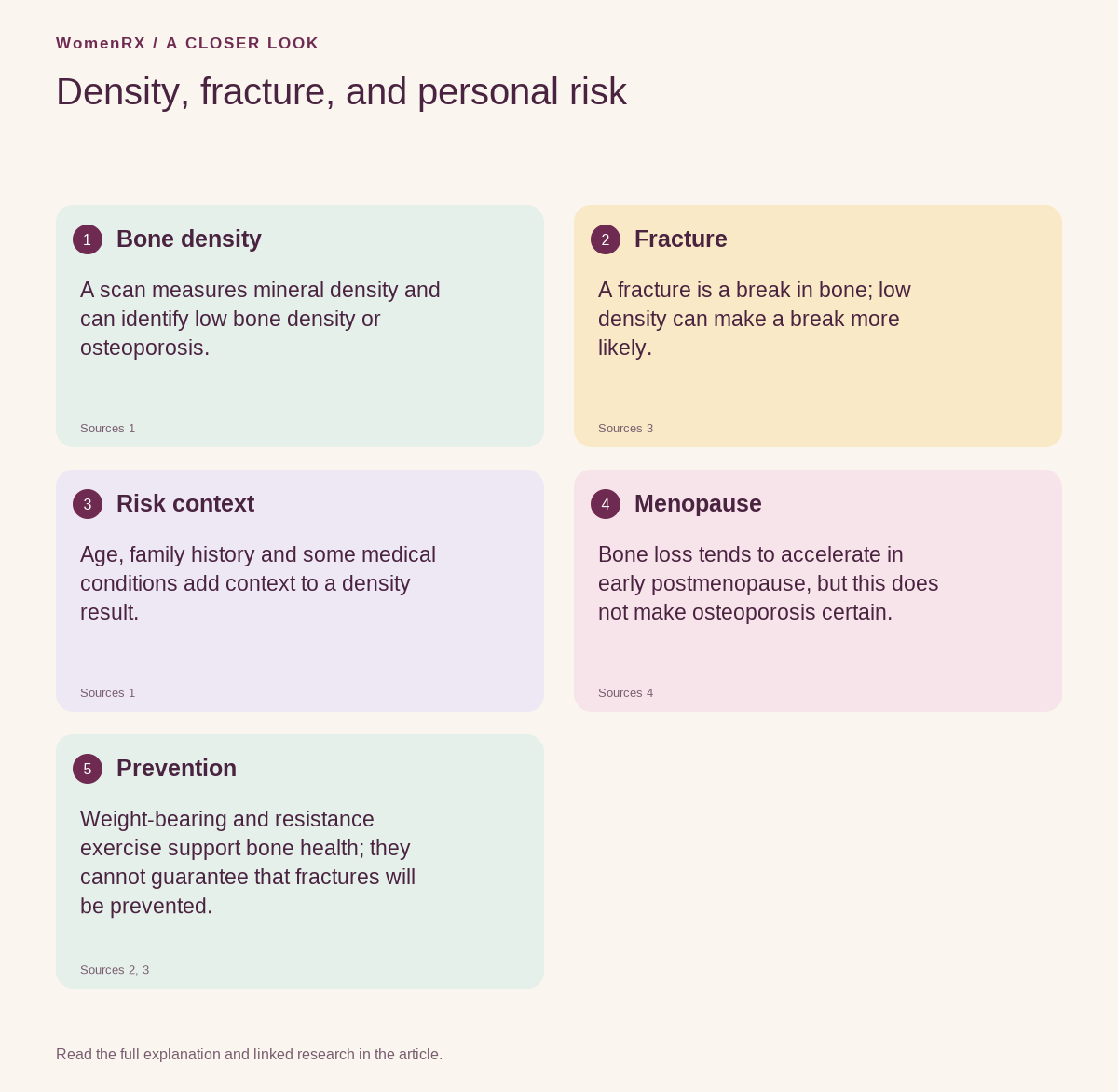
Density, fracture, and personal risk
Bone density: A scan measures mineral density and can identify low bone density or osteoporosis.1
Fracture: A fracture is a break in bone; low density can make a break more likely.3
Risk context: Age, family history and some medical conditions add context to a density result.1
Menopause: Bone loss tends to accelerate in early postmenopause, but this does not make osteoporosis certain.4
Prevention: Weight-bearing and resistance exercise support bone health; they cannot guarantee that fractures will be prevented.23
Read the figure as text
These related ideas answer different questions: what a scan measures, what a fracture is, and what helps put an individual result in context.- Bone density: A scan measures mineral density and can identify low bone density or osteoporosis.1
- Fracture: A fracture is a break in bone; low density can make a break more likely.3
- Risk context: Age, family history and some medical conditions add context to a density result.1
- Menopause: Bone loss tends to accelerate in early postmenopause, but this does not make osteoporosis certain.4
- Prevention: Weight-bearing and resistance exercise support bone health; they cannot guarantee that fractures will be prevented.23
More questions, answered
Does low bone density always mean osteoporosis?
No. Low bone density that is not low enough to meet the description of osteoporosis is sometimes called osteopenia. A scan can show whether density is low and whether it meets the definition of osteoporosis. 1
Can people of any sex have osteoporosis?
Yes. Osteoporosis and fractures are not limited to women. Bone density changes with age, and factors such as family history and certain medical conditions can also contribute to bone loss. 1 3
Sources you can check
- Bone Density | Bone Mineral Density | BMD | MedlinePlusAccessed 2026-09-25Return to first citation
- Osteoporosis - Prevention - NHSAccessed 2026-09-25Return to first citation
- Fracture | MedlinePlusAccessed 2026-09-25Return to first citation
- Diagnostic Perspectives on the Relationship Between Paraspinal Muscles and Bone Mineral Density: A Narrative Review.Liu H, Suo M, Yan S, Wang Q, Chen X, Li Z, Zhang C. · Diagnostics (Basel, Switzerland) · 2026Return to first citation