Exercise and Bone Density: What Loading Can Do
In postmenopausal women, pooled evidence links impact, strength, and high-intensity training with small gains in bone density, but it doesn’t identify a best approach.
For postmenopausal women, a review found small bone mineral density improvements when high-intensity, impact, and strength training were analyzed together, but it didn’t identify a best category. Another review, focused on women with osteoporosis or low bone mass, found better density at two bone sites when exercise was added to calcium and vitamin D. 2 3 If you have osteoporosis, a previous fracture, or questions about age, ask which loading approach fits you.
What the exercise labels tell you
If your goal is bone mineral density (BMD), the main postmenopausal review pools impact, high-intensity, and strength training rather than testing which category works best. 3
BMD measures the amount of mineral in bone. Denser bones tend to be stronger and less likely to fracture, but that general relationship doesn’t show whether a particular exercise program prevents fractures. 1
Impact and strength: a pooled, modest BMD finding
A systematic review and meta-analysis of eight randomized trials found small, statistically significant effects at the femoral neck and lumbar spine when high-intensity, impact, and strength training were pooled for postmenopausal women. Six trials involved postmenopausal women; two involved premenopausal women. The results don’t tell us how much each exercise category contributed, or which one would produce the best result on its own. 3
A separate review looked at exercise alongside calcium and vitamin D in postmenopausal women with osteoporosis or low bone mass. Across 13 randomized trials, the combined approach improved BMD at the lumbar spine and femoral neck compared with calcium and vitamin D alone. Because both groups received the nutrients, this comparison points to an added exercise effect in that supplemented setting. It doesn’t establish what exercise does without supplementation. 2
The supplemented-exercise review also reported subgroup findings: whole-body vibration showed benefits at both measured sites, while mind-body exercises showed an improvement at the lumbar spine. Those findings concern exercise added to calcium and vitamin D in women with osteoporosis or low bone mass; they don’t compare those approaches directly with impact or strength training. The pooled loading-exercise review noted methodological limitations. 2 3
Balance is a different goal
If steadiness or falling is your concern, ask what the proposed program aims to improve and how you would judge progress. The BMD findings above don’t establish balance, fall, or fracture benefits. 1 2 3
How your diagnosis and history change the conversation
If you’ve been diagnosed with osteoporosis or have had a fracture, the pooled BMD result alone can’t tell you which loading approach or impact level fits your situation. Bone density also tends to decrease with age, though these reviews don’t show how age changes the suitability of a particular exercise. 1 3
For a discussion with your clinician, try: “Given my bone-density results and fracture history, should I consider impact loading, resistance work, or another approach? What level of loading should I consider or modify?” If you’re already taking calcium and vitamin D, ask whether the exercise-plus-nutrients findings apply to you. Raise steadiness as a separate goal. 2 3
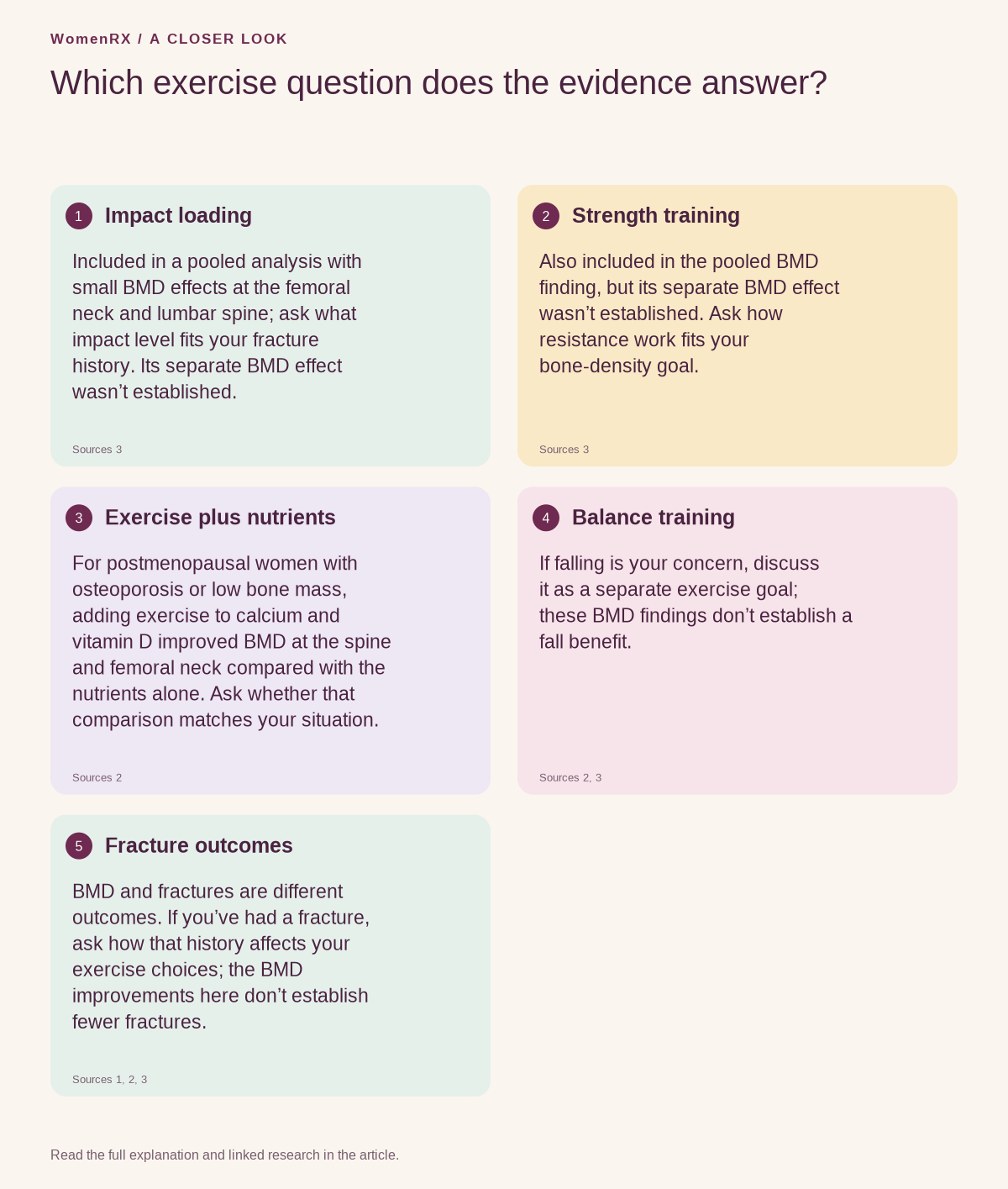
Which exercise question does the evidence answer?
Impact loading: Included in a pooled analysis with small BMD effects at the femoral neck and lumbar spine; ask what impact level fits your fracture history. Its separate BMD effect wasn’t established.3
Strength training: Also included in the pooled BMD finding, but its separate BMD effect wasn’t established. Ask how resistance work fits your bone-density goal.3
Exercise plus nutrients: For postmenopausal women with osteoporosis or low bone mass, adding exercise to calcium and vitamin D improved BMD at the spine and femoral neck compared with the nutrients alone. Ask whether that comparison matches your situation.2
Balance training: If falling is your concern, discuss it as a separate exercise goal; these BMD findings don’t establish a fall benefit.23
Fracture outcomes: BMD and fractures are different outcomes. If you’ve had a fracture, ask how that history affects your exercise choices; the BMD improvements here don’t establish fewer fractures.123
Read the figure as text
Compare which BMD finding applies and what to discuss if you have low bone mass or a prior fracture.- Impact loading: Included in a pooled analysis with small BMD effects at the femoral neck and lumbar spine; ask what impact level fits your fracture history. Its separate BMD effect wasn’t established.3
- Strength training: Also included in the pooled BMD finding, but its separate BMD effect wasn’t established. Ask how resistance work fits your bone-density goal.3
- Exercise plus nutrients: For postmenopausal women with osteoporosis or low bone mass, adding exercise to calcium and vitamin D improved BMD at the spine and femoral neck compared with the nutrients alone. Ask whether that comparison matches your situation.2
- Balance training: If falling is your concern, discuss it as a separate exercise goal; these BMD findings don’t establish a fall benefit.23
- Fracture outcomes: BMD and fractures are different outcomes. If you’ve had a fracture, ask how that history affects your exercise choices; the BMD improvements here don’t establish fewer fractures.123
Sources you can check
- Bone Density | Bone Mineral Density | BMD | MedlinePlusAccessed 2026-09-25Return to first citation
- Effects of Combined Exercise and Calcium/Vitamin D Supplementation on Bone Mineral Density in Postmenopausal Women: A Systematic Review and Meta-Analysis.Bai J, Huang W, Yan R, Du X. · Nutrients · 2025Return to first citation
- A systematic review and meta-analysis of the effects of high-intensity, impact, and strength training on bone mineral density in premenopausal and postmenopausal women.Jones E, Jones E, Starrs P, Hunter B. · Menopause (New York, N.Y.) · 2026Return to first citation