Creatine and Bone Health: What Women’s Studies Show
In postmenopausal women, creatine hasn’t improved bone density overall, even when added to exercise, though some studies have reported changes in bone shape.
The most direct evidence in postmenopausal women does not show that creatine adds a bone-density benefit to exercise. A two-year trial found no difference in hip or spine bone mineral density between women taking creatine and those taking placebo, although two measures of femoral-neck geometry changed. A separate review describes a trial without resistance training that also found no density benefit. 3 5
Bone density, bone shape, and muscle are different outcomes
Creatine is often discussed with resistance training because researchers study its effects on muscle and strength. But improvement in a muscle outcome doesn’t demonstrate a benefit to bone. Bone mineral density (BMD) measures the amount of minerals in bone; studies can also measure bone geometry, meaning features of its shape and structure. Those outcomes aren’t interchangeable. 1 5
For a bone-health claim, the key question is whether creatine changes a directly measured bone outcome compared with a similar group not taking creatine. That comparison helps separate any added effect of the supplement from changes associated with exercise.
The clearest long-term test added creatine to exercise
In a randomized trial, 237 postmenopausal women, with a mean age of 59, took creatine or placebo while following the same program of resistance training and walking for two years. Creatine did not improve BMD at the femoral neck, total hip, or lumbar spine compared with placebo. 5
The researchers did find differences in two measures of femoral-neck geometry: section modulus and buckling ratio. These describe aspects of bone structure related to bending and compression. They’re interesting findings, but they don’t change the trial’s BMD result or establish that creatine prevents fractures. 5
Because both groups exercised, the trial tested whether creatine added a benefit to that exercise program. It didn’t test creatine as a replacement for exercise. A review of studies in postmenopausal women found that systematic strength training improved BMD overall, while the evidence for additional benefits from supplements was inconclusive. 4 5
Studies without exercise and other results
Creatine hasn’t only been studied alongside exercise. A 2026 review focused on postmenopausal women describes a two-year trial in women with osteopenia who took creatine without resistance training; it found no effect on BMD measured by DXA. The same review describes a different, 12-month trial combining creatine with resistance training that reported preserved femoral-neck BMD and improved femoral-shaft geometry compared with placebo. These individual findings differ, and the review’s overall conclusion was that bone density was unchanged. 3
That review included seven randomized trials, with 608 participants randomized, and found no overall change in bone density. It reported average improvements in some muscle outcomes, including lean mass and leg-press strength, but those are not evidence that creatine improves bone. The distinction matters if you’re considering creatine specifically for your bones rather than for a separate muscle or strength goal. 3
An eight-month randomized trial in aging adults also measured BMD at several sites while participants did resistance training. It found no effect of creatine on BMD or bone mineral content. The abstract doesn’t report a women-specific result, so it can’t answer whether the effect is different in women. 2
What a bone-health claim can reasonably say
Current evidence in postmenopausal women doesn’t establish that creatine raises BMD. Some trials have reported changes in bone geometry, but that’s a separate outcome, and these findings don’t prove fewer fractures. A bone-density scan directly measures BMD; a change in muscle strength or a supplement claim can’t stand in for that measurement. 1 3 5
If your reason for considering creatine is muscle or strength, weigh that evidence separately from the bone evidence. The postmenopausal-women review found a more favorable signal for some muscle outcomes than for bone density. For bone specifically, the direct results remain mixed at the individual-study level, with no overall BMD benefit in that review. 3
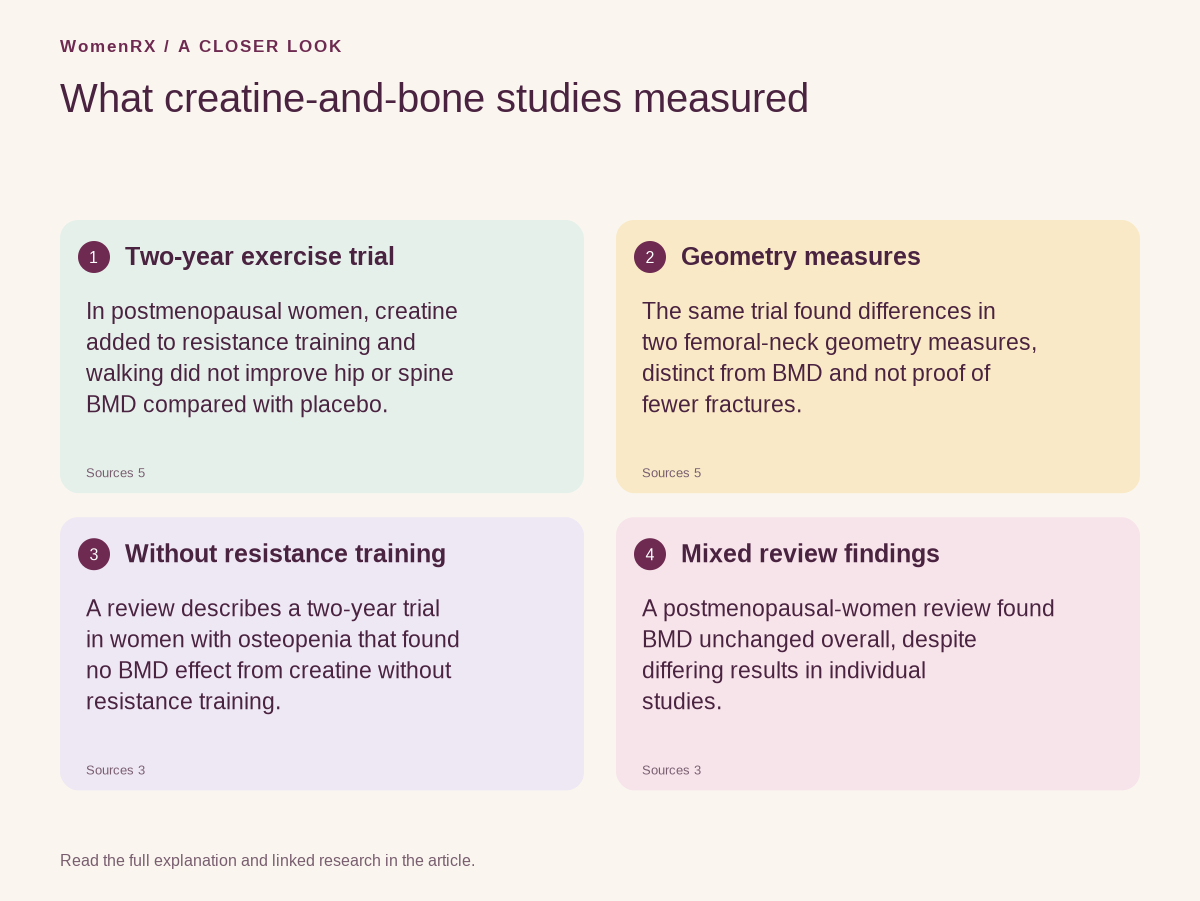
What creatine-and-bone studies measured
Two-year exercise trial: In postmenopausal women, creatine added to resistance training and walking did not improve hip or spine BMD compared with placebo.5
Geometry measures: The same trial found differences in two femoral-neck geometry measures, distinct from BMD and not proof of fewer fractures.5
Without resistance training: A review describes a two-year trial in women with osteopenia that found no BMD effect from creatine without resistance training.3
Mixed review findings: A postmenopausal-women review found BMD unchanged overall, despite differing results in individual studies.3
Read the figure as text
These study examples distinguish direct bone measurements from muscle outcomes and show whether creatine was tested with exercise or without resistance training.- Two-year exercise trial: In postmenopausal women, creatine added to resistance training and walking did not improve hip or spine BMD compared with placebo.5
- Geometry measures: The same trial found differences in two femoral-neck geometry measures, distinct from BMD and not proof of fewer fractures.5
- Without resistance training: A review describes a two-year trial in women with osteopenia that found no BMD effect from creatine without resistance training.3
- Mixed review findings: A postmenopausal-women review found BMD unchanged overall, despite differing results in individual studies.3
More questions, answered
Does improved bone geometry mean fewer fractures?
Not by itself. Geometry describes aspects of bone shape and structure, while BMD measures mineral content. The two-year trial reported changes in two geometry measures but no added BMD benefit; those results don’t establish that creatine reduces fracture risk. 1 5
Sources you can check
- Bone Density | Bone Mineral Density | BMD | MedlinePlusAccessed 2026-09-25Return to first citation
- Effect of pre-exercise and post-exercise creatine supplementation on bone mineral content and density in healthy aging adults.Candow DG, Forbes SC, Vogt E. · Experimental gerontology · 2019Return to first citation
- Creatine monohydrate for lean mass, strength, and bone density in postmenopausal women: a systematic review and meta-analysis.Naddafha S, Antonio J, Kreider RB, Stout JR. · Journal of the International Society of Sports Nutrition · 2026Return to first citation
- Analysis of the Additive Effects of Nutritional Strategies in Strength Training Interventions on Body Composition, Muscle Strength and Bone Mineral Density in Postmenopausal Women: A Systematic Review.Walter F, Schalla J, Bloch W, Diel P, Geisler S, Isenmann E. · Sports medicine - open · 2026Return to first citation
- A 2-yr Randomized Controlled Trial on Creatine Supplementation during Exercise for Postmenopausal Bone Health.Chilibeck PD, Candow DG, Gordon JJ, Duff WRD, Mason R, Shaw K, Taylor-Gjevre R, Nair B, Zello GA. · Medicine and science in sports and exercise · 2023Return to first citation