Creatine for Women: What to Know Before You Start
Creatine monohydrate may modestly support strength and lean mass when paired with resistance training, with the clearest women-specific results in postmenopausal women.
If you’re considering creatine for strength or muscle, creatine monohydrate is the form studied in the relevant trials, and it makes most sense to consider alongside resistance training. A review of trials in postmenopausal women found small average gains in lean mass and leg-press strength, but not bone density. Results don’t establish benefits for every life stage, or safety in pregnancy. 2 3
Creatine is an optional add-on, not a substitute for strength training. It can increase the amount of creatine stored in muscle, which is involved in high-intensity exercise. Whether that translates into a noticeable result depends on your goal and on how closely the research matches your circumstances. 2 3
What the research found in postmenopausal women
The most direct women-specific evidence comes from a systematic review and meta-analysis of seven randomized, placebo-controlled trials in postmenopausal women. In five trials with 338 participants, the average lean-mass difference favored creatine by 0.37 kg compared with placebo. In three trials with 111 participants, leg-press strength favored creatine by an average of 7.5 kg. These are group averages, not a guarantee that you’ll notice the same change. 3
The review found benefits particularly in studies that paired creatine with resistance training. Bone density, by contrast, was unchanged overall. So if your goal is stronger bones, these findings don’t support choosing creatine as a bone-density strategy. 3
The results need some context: participants were postmenopausal women, with an average age of about 62. Most of the included trials had some risk-of-bias concerns, and the review wasn’t prospectively registered. These findings are useful for considering creatine alongside training after menopause, but they don’t settle what to expect at other ages or stages. 3
What we know about younger women, periods, and pregnancy
A small randomized trial included 29 healthy young adults, 12 of them women. Participants did supervised resistance exercise while taking creatine monohydrate, creatyl-L-leucine, or placebo for 14 days. Muscle creatine content increased with monohydrate, but not with the other compound or placebo. The reported results don’t show whether women specifically benefited, or whether this change led to more strength or muscle over time. 2
A separate 10-week study included 45 older men and women who did resistance training with creatine, training with placebo, or no training. The reported findings don’t separate women’s results from men’s, so they can’t show whether the effects differed by sex. 1
These studies don’t establish whether results change across menstrual-cycle phases or during perimenopause. The postmenopausal trial review also doesn’t answer whether creatine is appropriate in pregnancy or postpartum. If you’re pregnant, breastfeeding, or considering creatine while managing a medical condition, get advice specific to your situation rather than assuming the exercise findings apply to you. 1 2 3
A practical way to decide and choose
- Match the supplement to your goal. The most relevant result is a modest average improvement in lean mass and leg-press strength among postmenopausal women, especially when creatine was paired with resistance training. The review didn’t find an overall bone-density benefit. 3
- Check the form on the label. Creatine monohydrate is the form studied in the young-adult trial. Creatyl-L-leucine didn’t increase muscle creatine content in that study, so don’t assume a different creatine-related ingredient has the same support. The trial wasn’t a comparison of long-term strength or muscle outcomes. 2
- Treat product quality as a separate question. The studies don’t compare brands or establish the quality of products on store shelves. A study of one ingredient form can’t verify a particular product’s contents.
- Keep the decision proportionate. Creatine isn’t necessary to start or continue resistance training. Consider whether a possible modest added benefit is worthwhile for you, and follow the product’s directions rather than turning a study regimen into a personal prescription.
- Know the limits of the safety findings. The postmenopausal review reported mild adverse events that were similar to placebo and no change in renal indices in the included trials. Those findings are reassuring for the people studied, but don’t establish safety for every health condition or for pregnancy. 3
If your goal is strength or muscle, the most relevant question is whether a possible extra benefit is worth adding a supplement to training you can sustain. The answer is more grounded for postmenopausal women than it is for younger women, and the product form and your personal health situation both matter.
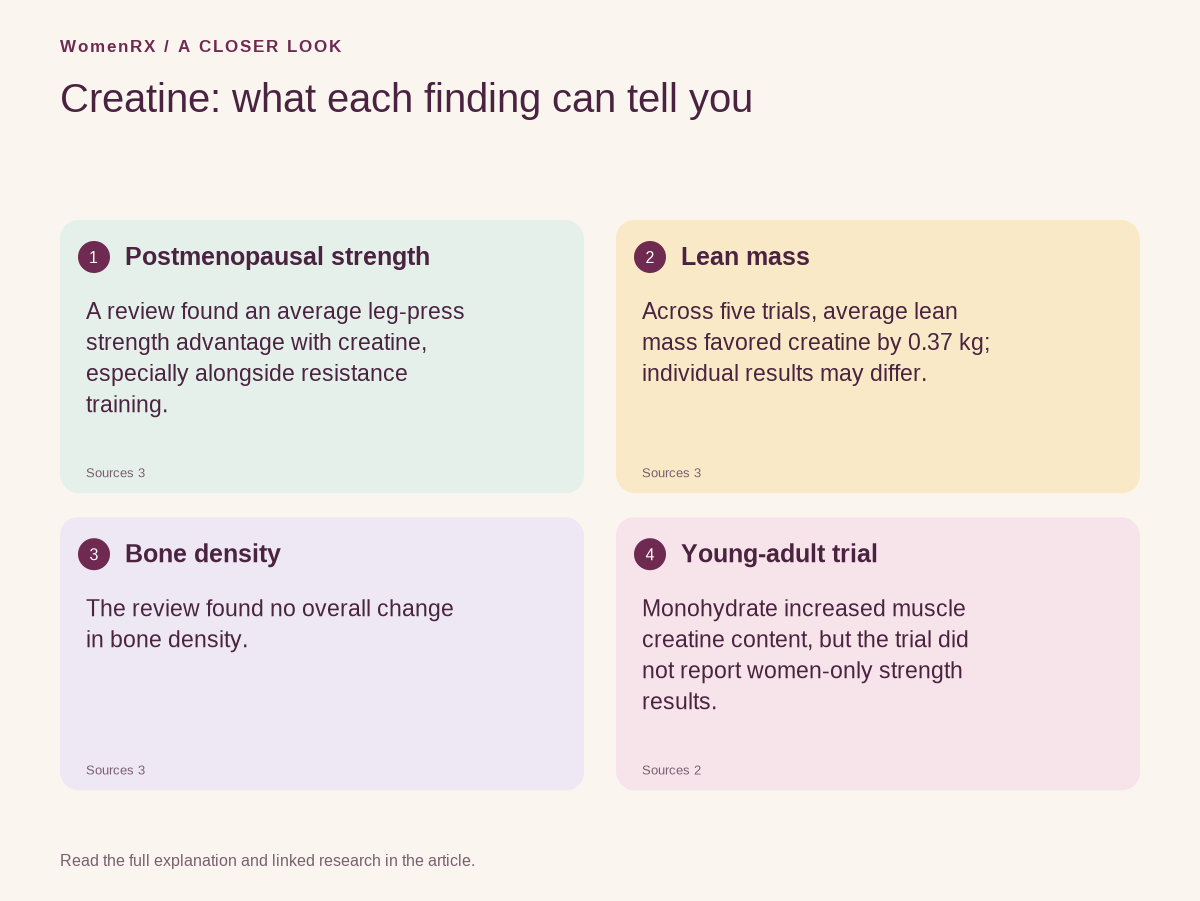
Creatine: what each finding can tell you
Postmenopausal strength: A review found an average leg-press strength advantage with creatine, especially alongside resistance training.3
Lean mass: Across five trials, average lean mass favored creatine by 0.37 kg; individual results may differ.3
Bone density: The review found no overall change in bone density.3
Young-adult trial: Monohydrate increased muscle creatine content, but the trial did not report women-only strength results.2
Read the figure as text
The clearest results concern postmenopausal women doing resistance training. Other findings address narrower questions, so they shouldn’t be read as proof of benefit for every goal or life stage.- Postmenopausal strength: A review found an average leg-press strength advantage with creatine, especially alongside resistance training.3
- Lean mass: Across five trials, average lean mass favored creatine by 0.37 kg; individual results may differ.3
- Bone density: The review found no overall change in bone density.3
- Young-adult trial: Monohydrate increased muscle creatine content, but the trial did not report women-only strength results.2
Sources you can check
- The role of resistance training and creatine supplementation on oxidative stress, antioxidant defense, muscle strength, and quality of life in older adults.Amiri E, Sheikholeslami-Vatani D. · Frontiers in public health · 2023Return to first citation
- Creatine Monohydrate Supplementation, but not Creatyl-L-Leucine, Increased Muscle Creatine Content in Healthy Young Adults: A Double-Blind Randomized Controlled Trial.Askow AT, Paulussen KJM, McKenna CF, Salvador AF, Scaroni SE, Hamann JS, Ulanov AV, Li Z, Paluska SA, Beaudry KM, De Lisio M, Burd NA. · International journal of sport nutrition and exercise metabolism · 2022Return to first citation
- Creatine monohydrate for lean mass, strength, and bone density in postmenopausal women: a systematic review and meta-analysis.Naddafha S, Antonio J, Kreider RB, Stout JR. · Journal of the International Society of Sports Nutrition · 2026Return to first citation