Creatine for Women: How to Judge the Evidence
Creatine is most relevant to consider alongside resistance training, but results differ by age group, outcome, and the women actually studied.
Creatine monohydrate has been studied with resistance training in women, but it hasn’t helped every group in the same way. A small trial in experienced women found no added strength or lean-mass benefit, while a review of postmenopausal women found modest average gains in lean mass and leg-press strength. Your training goal and life stage matter when weighing those findings. 2 3
Start with the result you want
Creatine is worth considering mainly if you’re doing resistance training and want to know whether a supplement might add to its effects. The clearest outcomes in the women-specific research here are lean mass and strength. Those results don’t establish creatine as a treatment for menopause symptoms, a weight-loss aid, or a way to improve bone density.
A practical first question is: What change am I hoping for, and would it matter to me? If you aren’t doing resistance training, or your goal is unrelated to muscle and strength, the findings below may not answer your question.
The results aren’t the same for every group
In a 10-week randomized trial, 26 experienced women resistance trainees took creatine monohydrate or a placebo while following the same training program. Both groups improved in lean body mass and several strength measures, but creatine didn’t add a significant improvement in lean mass, strength, or training volume compared with training alone. This is a direct study in trained women, but its small size means it can’t settle the question for every woman or training situation. 2
A 2026 systematic review and meta-analysis looked specifically at postmenopausal women. Across five trials with 338 participants, average lean mass was 0.37 kg higher with creatine than with comparison treatments. Across three trials with 111 participants, leg-press strength was 7.5 kg higher. These are differences between group averages, not predictions of what one person will gain. Bone density was unchanged overall in the review. 3
Those findings don’t necessarily conflict with the trial in younger, experienced trainees: the studies involved different populations and combined evidence across different trials. The postmenopausal review suggests modest average gains for some muscle outcomes, while one small study in trained women didn’t detect an added benefit. Neither result guarantees an individual response. 2 3
Age and life stage also affect how directly a result applies to you. A study of 45 older adults included both men and women, but the reported results don’t give women-only estimates. Improvements in that study therefore can’t tell us what women specifically gained from creatine. The postmenopausal findings shouldn’t automatically be applied to women in their cycling years, or taken as proof of a menopause-symptom benefit. 1 3
Product form: use the research as your reference point
Creatine monohydrate is the form used in the trial of experienced women and in the postmenopausal review. If you’re comparing products, check whether the label actually names creatine monohydrate rather than assuming another form has the same support. 2 3
In a short randomized study of 29 healthy young adults, including 12 women, monohydrate increased muscle creatine content, while creatyl-L-leucine did not. The study measured muscle creatine over 14 days, not long-term strength or health outcomes, and didn’t report separate results for women. It supports monohydrate as the better-established reference in this comparison, but it doesn’t show that every alternative has been tested and ruled out. 4
A short decision check
- Training: Are you doing resistance training regularly? The findings most relevant here involve creatine used alongside training, not as a substitute for it. 2 3
- Goal: Are you looking for a possible difference in strength or lean mass? These have relevant findings in postmenopausal women, though one trial in trained women found no added benefit. Bone density didn’t improve overall in the postmenopausal review. 2 3
- Life stage: Are you pregnant or breastfeeding? These studies don’t establish benefits or safety for those situations. Ask your clinician about that specific question rather than assuming adult training results apply. 2 3 4
- Product: Does the ingredient list say creatine monohydrate? That’s the form used in the directly relevant training studies. 2 3
- Expectations: Would the choice still feel worthwhile if you didn’t notice a clear change? Results vary by group, and added benefit wasn’t found in every study. 2 3
If your main goal is a menopause symptom, pregnancy or breastfeeding safety, or a health outcome beyond strength and lean mass, this research doesn’t resolve that question. Narrowing down the outcome you care about helps keep a product decision tied to what has actually been studied.
What women’s creatine studies show
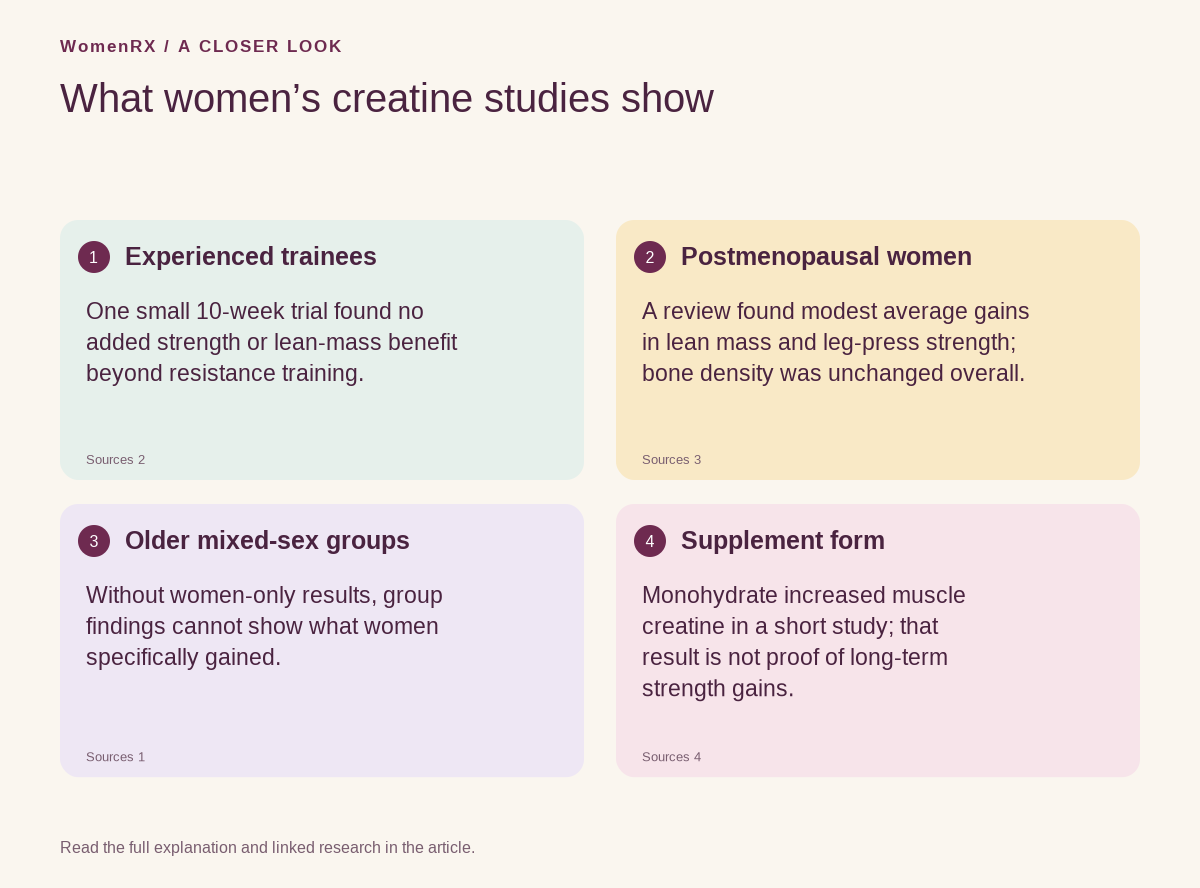
Experienced trainees: One small 10-week trial found no added strength or lean-mass benefit beyond resistance training.2
Postmenopausal women: A review found modest average gains in lean mass and leg-press strength; bone density was unchanged overall.3
Older mixed-sex groups: Without women-only results, group findings cannot show what women specifically gained.1
Supplement form: Monohydrate increased muscle creatine in a short study; that result is not proof of long-term strength gains.4
Read the figure as text
Compare the populations and outcomes studied before deciding how closely a finding fits your own training and life stage.- Experienced trainees: One small 10-week trial found no added strength or lean-mass benefit beyond resistance training.2
- Postmenopausal women: A review found modest average gains in lean mass and leg-press strength; bone density was unchanged overall.3
- Older mixed-sex groups: Without women-only results, group findings cannot show what women specifically gained.1
- Supplement form: Monohydrate increased muscle creatine in a short study; that result is not proof of long-term strength gains.4
More questions, answered
Does creatine help with menopause symptoms?
The postmenopausal review examined outcomes including lean mass, strength, and bone density. It doesn’t establish that creatine treats menopause symptoms. 3
Do mixed-sex studies tell us what women gain?
Only when women’s results are reported separately can a mixed-sex study show a women-specific estimate. A 10-week study in older adults included men and women but didn’t provide women-only strength results. 1
Sources you can check
- The role of resistance training and creatine supplementation on oxidative stress, antioxidant defense, muscle strength, and quality of life in older adults.Amiri E, Sheikholeslami-Vatani D. · Frontiers in public health · 2023Return to first citation
- Effects of creatine monohydrate supplementation on body composition and strength indices in experienced resistance trained women.Ferguson TB, Syrotuik DG. · Journal of strength and conditioning research · 2006Return to first citation
- Creatine monohydrate for lean mass, strength, and bone density in postmenopausal women: a systematic review and meta-analysis.Naddafha S, Antonio J, Kreider RB, Stout JR. · Journal of the International Society of Sports Nutrition · 2026Return to first citation
- Creatine Monohydrate Supplementation, but not Creatyl-L-Leucine, Increased Muscle Creatine Content in Healthy Young Adults: A Double-Blind Randomized Controlled Trial.Askow AT, Paulussen KJM, McKenna CF, Salvador AF, Scaroni SE, Hamann JS, Ulanov AV, Li Z, Paluska SA, Beaudry KM, De Lisio M, Burd NA. · International journal of sport nutrition and exercise metabolism · 2022Return to first citation