Creatine for Women: What Research Actually Shows
Creatine is best studied for strength and repeated high-intensity effort, but the women-specific evidence is still limited and study protocols vary.
Creatine may support strength, power, and work during repeated high-intensity efforts. One 12-week trial in adults ages 45 to 65 also reported increases in lean tissue mass and strength without an exercise-and-diet intervention, but it didn’t report results separately for women. Studies use different dosing patterns, so none should be treated as a personal prescription. 1 2
Start with the kind of effort you want to support
Creatine helps muscles supply energy during short, intense activity. The strongest general exercise evidence is for high-intensity, intermittent efforts, such as repeated hard sets or sprints, with potential improvements in strength, power, and work from maximal contractions. The NIH Office of Dietary Supplements describes creatine as of little value for endurance sports. 1
That distinction can help you weigh whether the supplement matches your goal. If most of your training is steady endurance work, creatine has less support as a way to improve performance. If your goal involves strength or repeated intense efforts, creatine has a more relevant evidence base. Results can still vary with the activity and the person. 1
There’s a useful nuance to the claim that creatine only helps when you’re training. A 12-week randomized trial studied 64 healthy adults ages 45 to 65, including 40 women and 24 men. Participants chose whether to join an exercise-and-diet intervention, then were assigned to creatine monohydrate or placebo. The study reported increases in lean tissue mass, strength, and muscular endurance among participants taking creatine without the exercise-and-diet intervention, as well as benefits during the intervention. This is a finding from one mixed-sex study, not a guarantee of the same effect in other groups; the results weren’t reported separately for women. 2
Why study doses don’t add up to one rule
Researchers have tested different patterns. The NIH fact sheet describes examples of a loading phase of 20 grams per day for up to seven days, followed by 3 to 5 grams per day, and reports few safety concerns for the specified study periods. The 12-week trial in adults ages 45 to 65 used 10 grams per day. In a review of exercise trials in women, creatine protocols ranged from 0.1 grams per kilogram of body weight to 20 grams per day. 1 2 3
Those are descriptions of what researchers tested, not individualized instructions. The studies differ in population, duration, and training context, so a result from one pattern doesn’t establish that it’s the right choice for you. The 12-week trial and the creatine studies in the women-focused review used creatine monohydrate, but the evidence doesn’t settle every question about how a particular product or protocol will work for an individual. 2 3
What the women’s evidence can and can’t tell you
A systematic review and meta-analysis included 14 exercise trials with 763 women across reproductive stages. Three trials examined creatine monohydrate; the others studied protein or other amino-acid products. Across all supplement types combined, the review found no significant effects on the measured muscle-mass or bone outcomes, while some measures of strength improved. Those pooled results can’t show that creatine alone caused the strength changes. 3
So, “women have never been studied” is too broad: women were included in those trials and made up most of the participants in the mixed-sex study described above. But inclusion isn’t the same as a clear answer for women. There were only three creatine trials in the women-focused review, and the mixed-sex trial didn’t report women’s results separately. Neither finding establishes what to expect at every reproductive stage. 2 3
The available findings don’t establish benefits or safety during pregnancy or breastfeeding. The women’s review covers reproductive stages, but its reported results don’t give pregnancy- or breastfeeding-specific conclusions. 3
Common claims, checked against the evidence
“Creatine is only for men.” Women have been included in research, but the women-specific creatine evidence remains small. The women’s review had three creatine trials, and a mixed-sex study didn’t report separate results for women. 2 3
“It’s mainly for endurance.” The evidence points more toward strength, power, and intermittent high-intensity activity. The NIH summary describes little value for endurance sports. 1
“Any weight gain means fat or new muscle.” Not necessarily. Water retention can increase body weight, so a change on the scale alone can’t tell you what tissue has changed. The NIH fact sheet lists water-retention-related weight gain as a reported effect. 1
“It can’t affect muscle without a workout.” One trial in adults ages 45 to 65 reported increased lean tissue mass and strength with creatine in a group that didn’t take part in an exercise-and-diet intervention. That single mixed-sex study is a reason not to make a categorical claim, but it doesn’t tell us whether the same result applies to women at other ages or in other circumstances. 2
A practical way to decide is to compare your goal with the outcome actually studied: creatine has the clearest fit for strength and repeated high-intensity effort, not endurance alone. Then keep the limits in view: dosing approaches vary, water-related weight change is possible, and evidence specific to women remains modest.
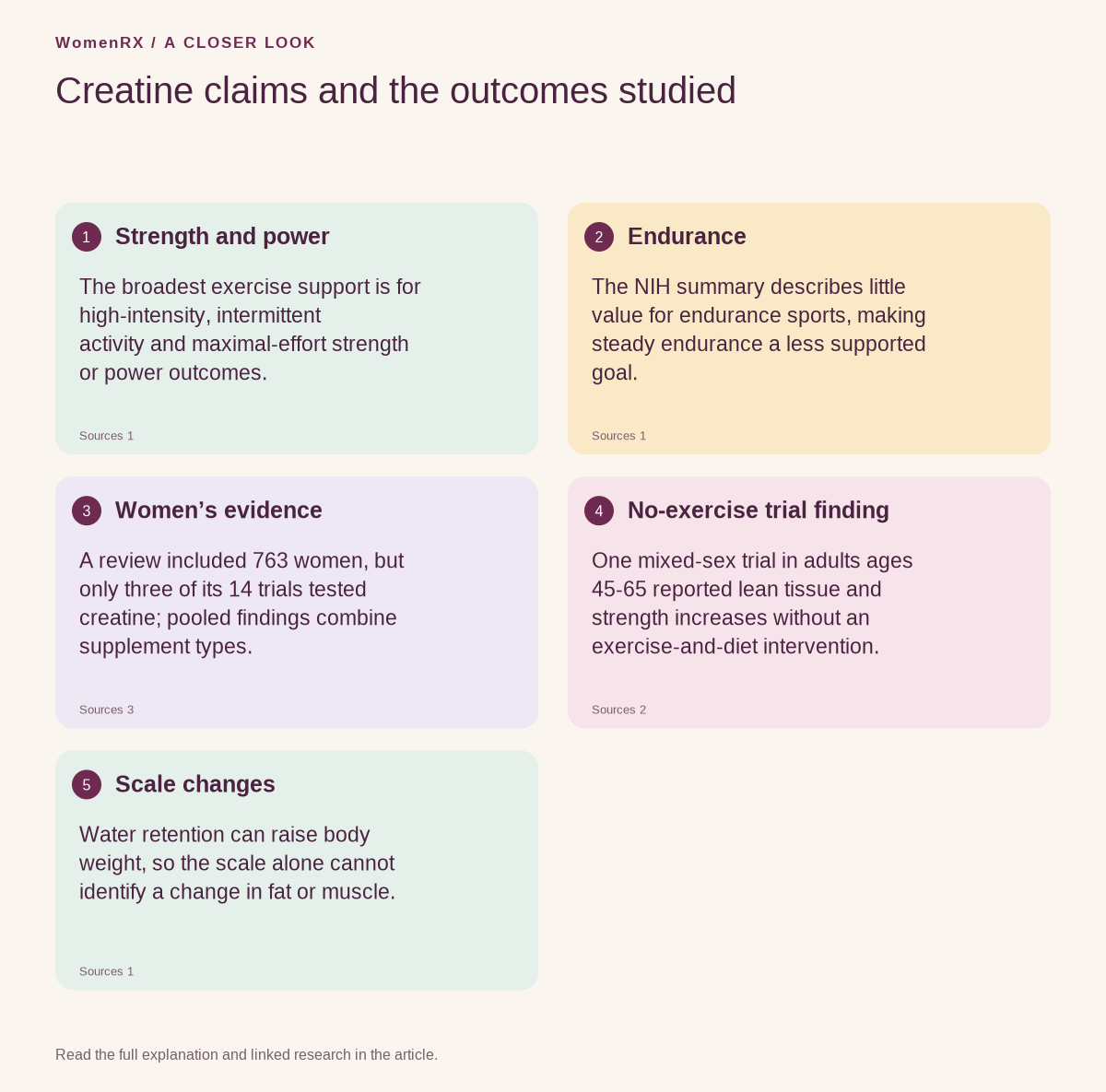
Creatine claims and the outcomes studied
Strength and power: The broadest exercise support is for high-intensity, intermittent activity and maximal-effort strength or power outcomes.1
Endurance: The NIH summary describes little value for endurance sports, making steady endurance a less supported goal.1
Women’s evidence: A review included 763 women, but only three of its 14 trials tested creatine; pooled findings combine supplement types.3
No-exercise trial finding: One mixed-sex trial in adults ages 45-65 reported lean tissue and strength increases without an exercise-and-diet intervention.2
Scale changes: Water retention can raise body weight, so the scale alone cannot identify a change in fat or muscle.1
Read the figure as text
Compare common expectations with the exercise outcomes and populations represented in the research.- Strength and power: The broadest exercise support is for high-intensity, intermittent activity and maximal-effort strength or power outcomes.1
- Endurance: The NIH summary describes little value for endurance sports, making steady endurance a less supported goal.1
- Women’s evidence: A review included 763 women, but only three of its 14 trials tested creatine; pooled findings combine supplement types.3
- No-exercise trial finding: One mixed-sex trial in adults ages 45-65 reported lean tissue and strength increases without an exercise-and-diet intervention.2
- Scale changes: Water retention can raise body weight, so the scale alone cannot identify a change in fat or muscle.1
Sources you can check
- Dietary Supplements for Exercise and Athletic Performance - Health Professional Fact SheetAccessed 2026-09-25Return to first citation
- Effects of creatine supplementation with and without exercise and diet intervention on body composition, cognitive function, and markers of health in middle-aged and older adults.Chun J, Liu Y, Kibler GL, Lee H, Babakhani K, Rhoades N, Bivins I, Ko J, Dickerson B, Gonzalez DE, Sowinski RJ, Rasmussen CJ, Kreider RB. · Journal of the International Society of Sports Nutrition · 2026Return to first citation
- Nutritional Supplementation Combined with Exercise for Musculoskeletal Health in Women: A Systematic Review and Meta-Analysis Evaluating Proteins, Amino Acids, and Creatine across Reproductive Stages.Chen KH, Yeh TP, Lin SC, Liu PJ, Bai D, Chen IH. · International journal of medical sciences · 2026Return to first citation